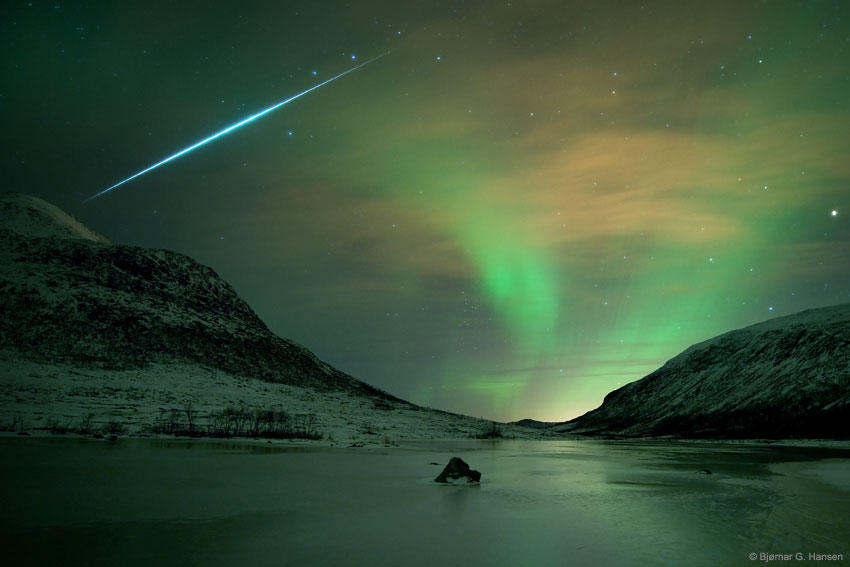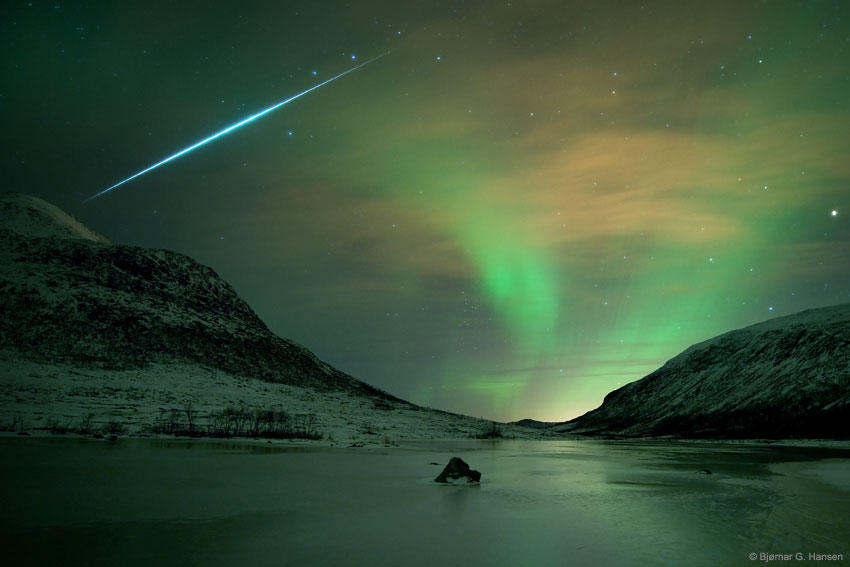
Some night skies are serene and passive -- others shimmer and flash. The later, in the form of auroras and meteors, haunted skies over the island of Kvaløya, near Tromsø Norway on 2009 December 13. This 30 second long exposure records a shimmering auroral glow gently lighting the wintery coastal scene. A study in contrasts, the image also captures the sudden flash of a fireball meteor from the excellent Geminid meteor shower of 2009. Streaking past familiar stars in the handle of the Big Dipper, the trail points back toward the constellation Gemini, off the top of the view. Both auroras and meteors occur in Earth's upper atmosphere at altitudes of 100 kilometers or so, but aurora caused by energetic charged particles from the magnetosphere, while meteors are trails of cosmic dust. Nine years after this photograph was taken, toward the end of this week, the yearly 2018 Geminids meteor shower will peak again, although this time their flashes will compete with the din of a half-lit first-quarter moon during the first half of the night. Free Download: 2019 APOD Calendar
Crédito: NASA, APOD Algunos cielos nocturnos son serenos y pasivos, mientras que otros brillan y destellan. El segundo, en forma de auroras y meteoros, asombró los cielos sobre la isla de Kvaløya, cerca de Tromsø, Noruega, el 13 de diciembre de 2009. Esta exposición de 30 segundos registra un brillo auroral que ilumina suavemente la escena invernal costera. En contraste, la imagen también captura el repentino destello de un meteorito de bola de fuego de la excelente lluvia de meteoros Geminidas de 2009. Rascando las estrellas familiares en el mango de la Osa Mayor, la trayectoria apunta hacia atrás hacia la constelación de Géminis, fuera del borde superior de la imagen. Tanto las auroras como los meteoros ocurren en la atmósfera superior de la Tierra a altitudes de unos 100 kilómetros, pero las auroras son causadas por partículas cargadas energéticas del magnetosfera, mientras que los meteoros son rastros de polvo cósmico. Nueve años después de que se tomara esta fotografía, hacia el final de esta semana, la anual lluvia de meteoros Geminidas de 2018 alcanzará su máximo nuevamente, aunque esta vez sus destellos competirán con el ruido de una luna en cuarto creciente parcialmente iluminada durante la primera mitad de la noche.