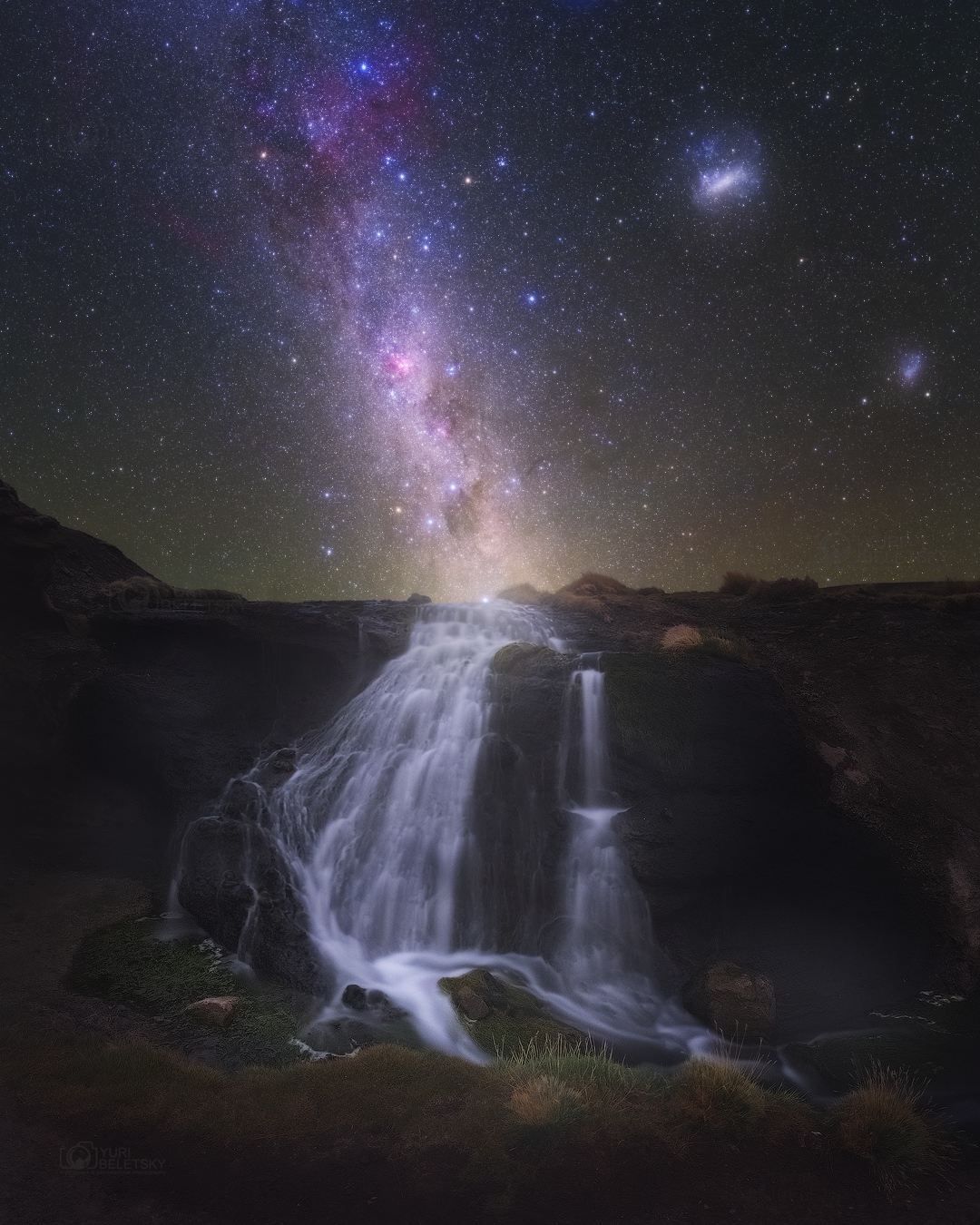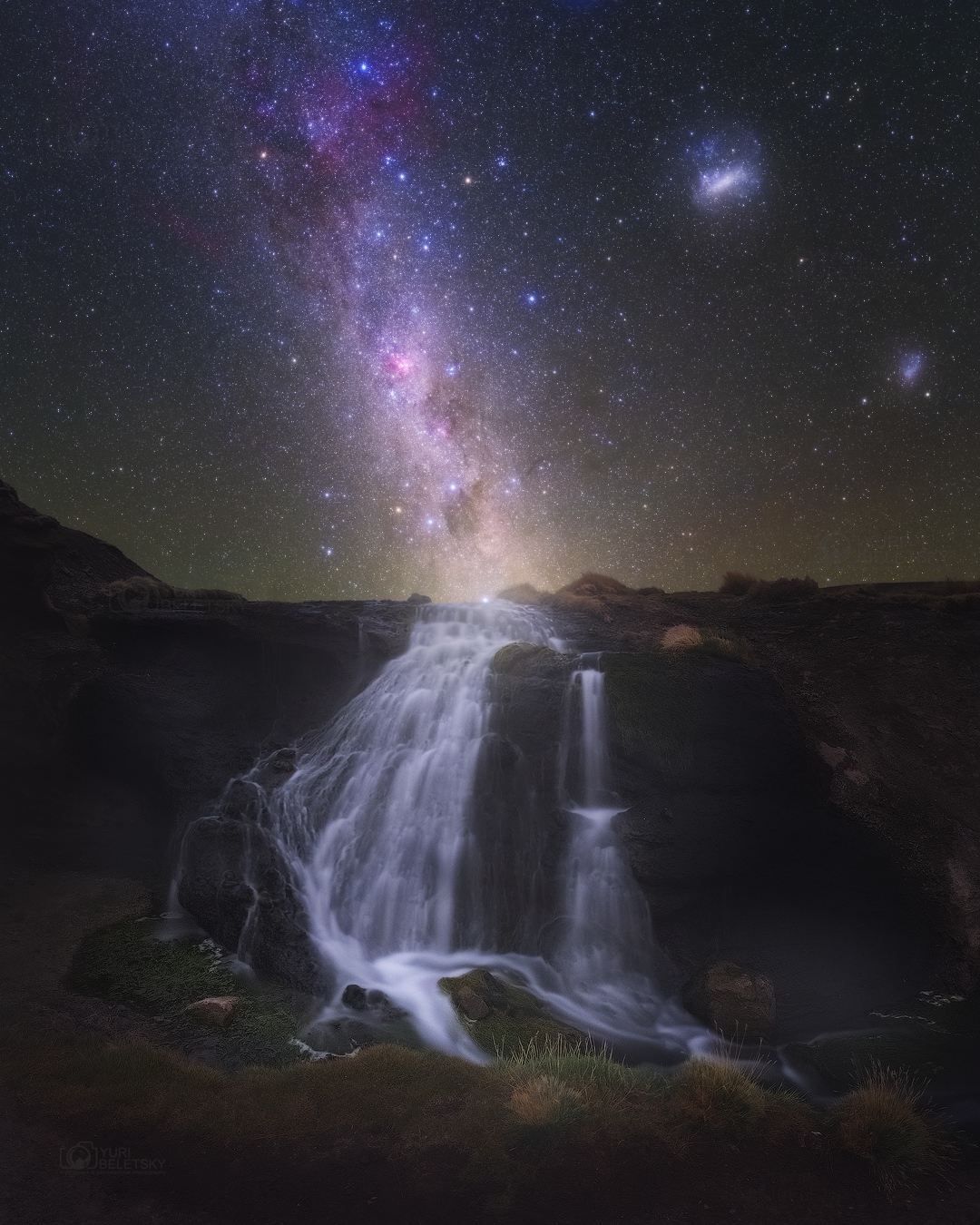
It can be the driest place on planet Earth, but water still flows in Chile's Atacama desert, high in the mountains. After discovering this small creek with running water, the photographer returned to the site to watch the Milky Way rise in the dark southern skies, calculating the moment when Milky Way and precious flowing water would meet. In the panoramic night skyscape, stars and nebulae immersed in the glow along the Milky Way itself also shared that moment with the Milky Way's satellite galaxies the Large and Small Magellanic clouds above the horizon at the right. Bright star Beta Centauri is poised at the very top of the waterfall. Above it lies the dark expanse of the Coalsack nebula and the stars of the Southern Cross.
Puede ser el lugar más seco del planeta Tierra, pero aún así fluye agua en el desierto de Atacama de Chile, alto en las montañas. Después de descubrir este pequeño arroyo con agua corriente, el fotógrafo regresó al lugar para observar la Vía Láctea elevarse en los oscuros cielos del sur, calculando el momento en que la Vía Láctea y el agua corriente preciosa se encontrarían. En la panorámica del cielo nocturno, estrellas y nebulosas sumergidas en el resplandor a lo largo de la propia Vía Láctea también compartieron ese momento con las galaxias satélite de la Vía Láctea, las Nubes de Magallanes Mayor y Menor, sobre el horizonte a la derecha. La brillante estrella Beta Centauri se encuentra en la cima misma de la cascada. Sobre ella se extiende la oscura expansión de la nebulosa Coalsack y las estrellas de la Cruz del Sur.