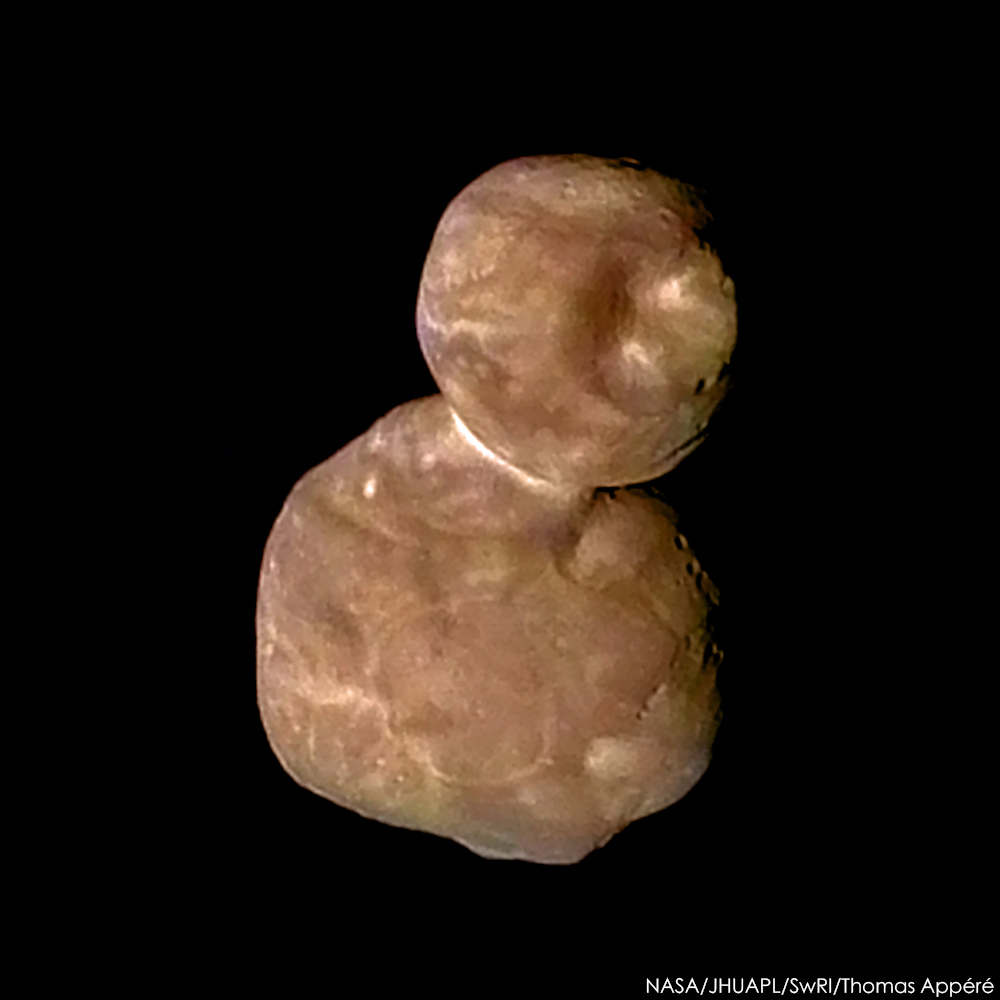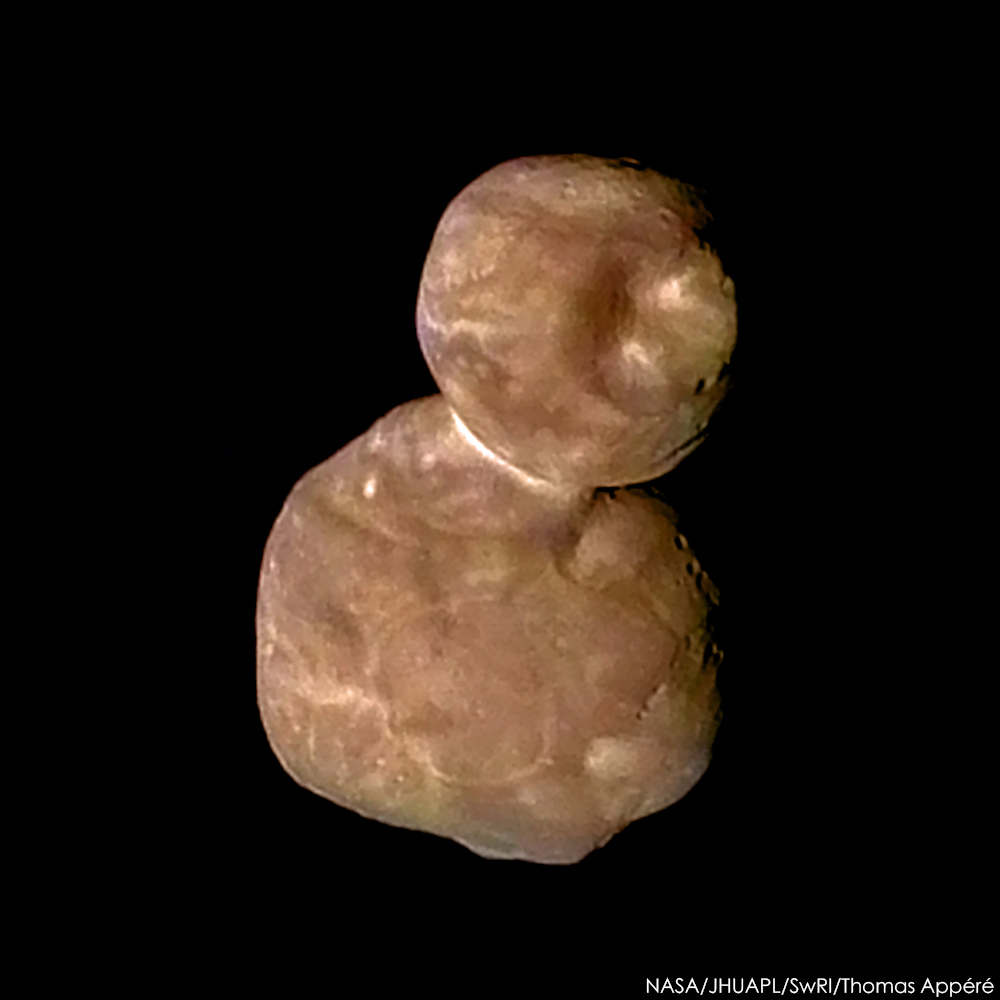
How do distant asteroids differ from those near the Sun? To help find out, NASA sent the robotic New Horizons spacecraft past the classical Kuiper belt object 2014 MU69, nicknamed Ultima Thule, the farthest asteroid yet visited by a human spacecraft. Zooming past the 30-km long space rock on January 1, the featured image is the highest resolution picture of Ultima Thule's surface beamed back so far. Ultima Thule does look different from imaged asteroids of the inner Solar System, as it shows unusual surface texture, relatively few obvious craters, and nearly spherical lobes. Its shape is hypothesized to have formed from the coalescence of early Solar System rubble in into two objects -- Ultima and Thule -- which then spiraled together and stuck. Research will continue into understanding the origin of different surface regions on Ultima Thule, whether it has a thin atmosphere, how it obtained its red color, and what this new knowledge of the ancient Solar System tells us about the formation of our Earth.
¿Cómo se diferencian los asteroides distantes de los que están cerca del Sol? Para ayudar a descubrirlo, la NASA envió la nave espacial robótica New Horizons cerca del objeto del cinturón de Kuiper 2014 MU69, apodado Última Thule, el asteroide más lejano visitado hasta ahora por una nave espacial humana. El 1 de enero, la nave pasó junto a la roca espacial de 30 km de largo, y la imagen destacada es la de mayor resolución de la superficie de Última Thule enviada hasta ahora. Última Thule sí se ve diferente de los asteroides del sistema solar interior que han sido fotografiados, ya que muestra una textura superficial inusual, relativamente pocos cráteres obvios y lóbulos casi esféricos. Se hipotetiza que su forma se formó por la coalescencia de escombros del sistema solar primitivo en dos objetos — Última y Thule — que luego se enroscaron entre sí y se unieron. La investigación continuará para entender el origen de las diferentes regiones de la superficie de Última Thule, si tiene una atmósfera delgada, cómo adquirió su color rojo, y qué nos dice este nuevo conocimiento sobre el antiguo sistema solar acerca de la formación de nuestro planeta Tierra.