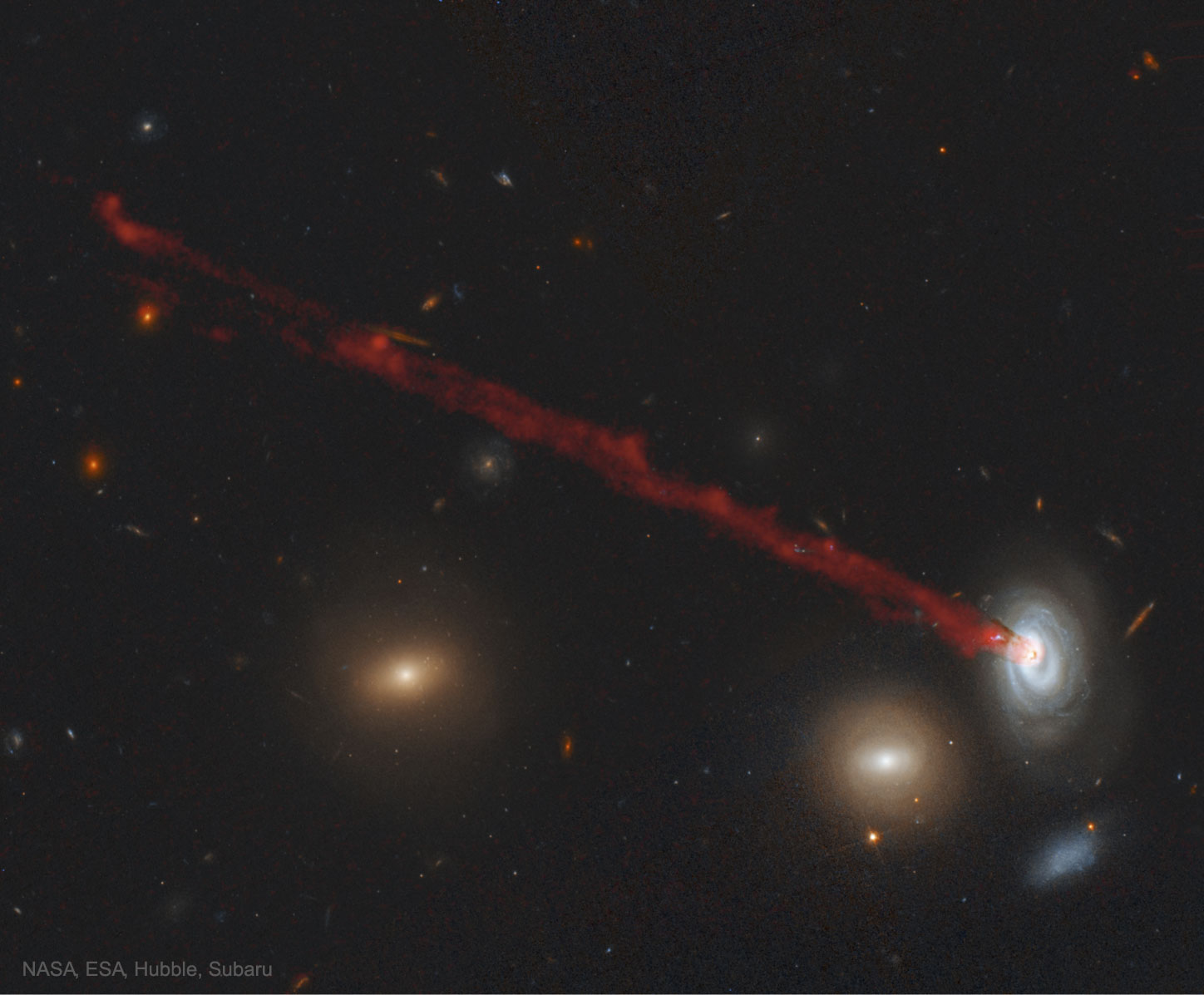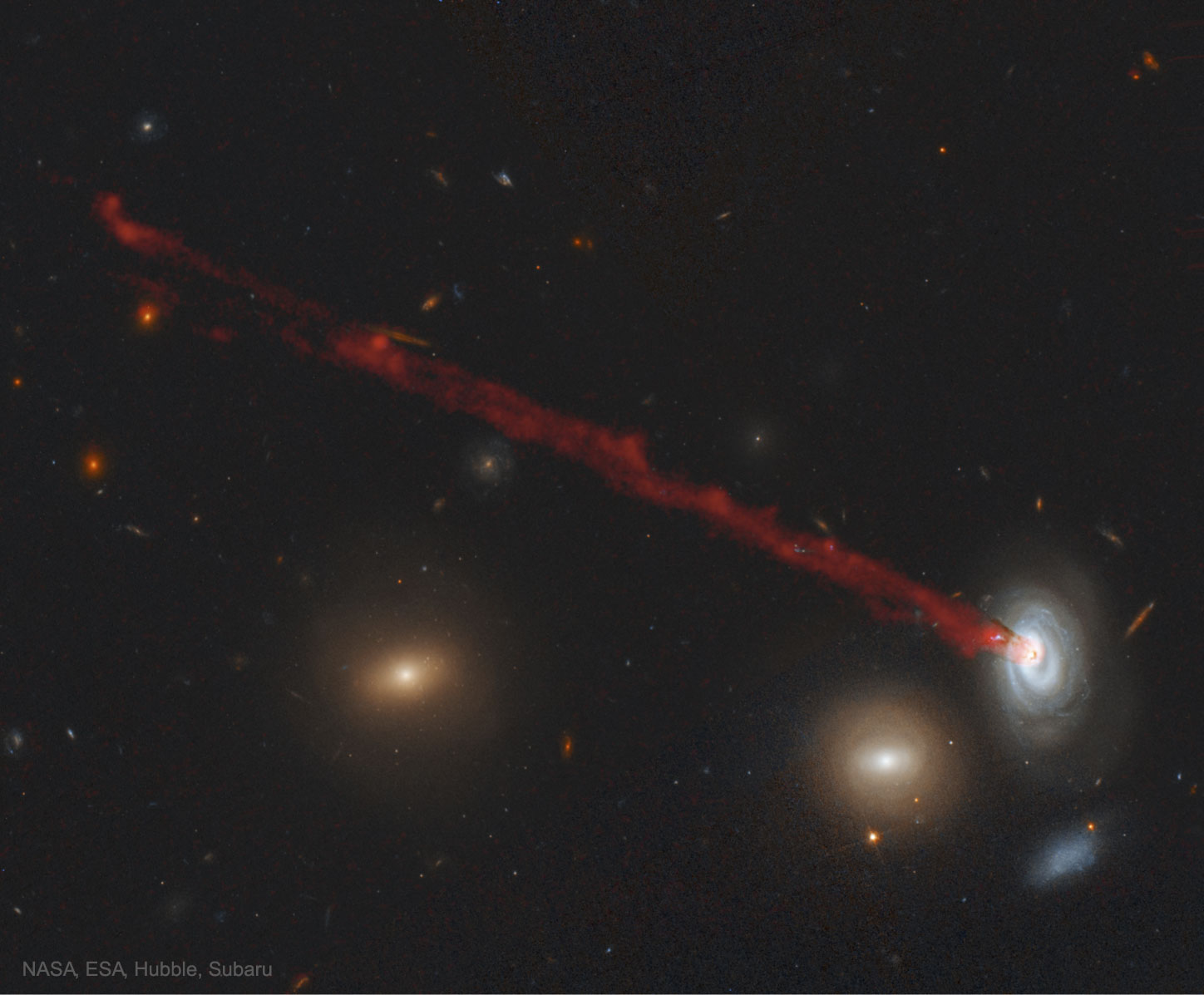
Why is there long red streak attached to this galaxy? The streak is made mostly of glowing hydrogen that has been systematically stripped away as the galaxy moved through the ambient hot gas in a cluster of galaxies. Specifically, the galaxy is spiral galaxy D100, and cluster is the Coma Cluster of galaxies. The red path connects to the center of D100 because the outer gas, gravitationally held less strongly, has already been stripped away by ram pressure. The extended gas tail is about 200,000 light-years long, contains about 400,000 times the mass of our Sun, and stars are forming within it. Galaxy D99, visible to D100's lower left, appears red because it glows primarily from the light of old red stars -- young blue stars can no longer form because D99 has been stripped of its star-forming gas. The featured false-color picture is a digitally enhanced composite of images from Earth-orbiting Hubble and the ground-based Subaru telescope. Studying remarkable systems like this bolsters our understanding of how galaxies evolve in clusters.
Crédito: NASA, Hubble, Subaru ¿Por qué hay un largo rastro rojo unido a esta galaxia? El rastro está compuesto principalmente de hidrógeno brillante que ha sido sistemáticamente arrancado a medida que la galaxia se movía a través del gas caliente ambiental en un cúmulo de galaxias. Específicamente, la galaxia es la galaxia espiral D100, y el cúmulo es el Cúmulo de Coma. El camino rojo se conecta al centro de D100 porque el gas exterior, que está gravitacionalmente menos fuertemente unido, ya ha sido arrancado por la presión de impacto. La cola extendida de gas tiene aproximadamente 200 000 años luz de longitud, contiene alrededor de 400 000 veces la masa de nuestro Sol, y en ella se están formando estrellas. La galaxia D99, visible a la izquierda inferior de D100, aparece roja porque brilla principalmente con la luz de estrellas rojas antiguas — ya no se pueden formar estrellas azules jóvenes porque a D99 se le ha arrancado el gas necesario para formar estrellas. La imagen destacada en falso color es un compuesto digitalmente mejorado de imágenes de Hubble en órbita terrestre y del telescopio Subaru basado en tierra. Estudiar sistemas notables como este fortalece nuestra comprensión de cómo evolucionan las galaxias en los cúmulos.