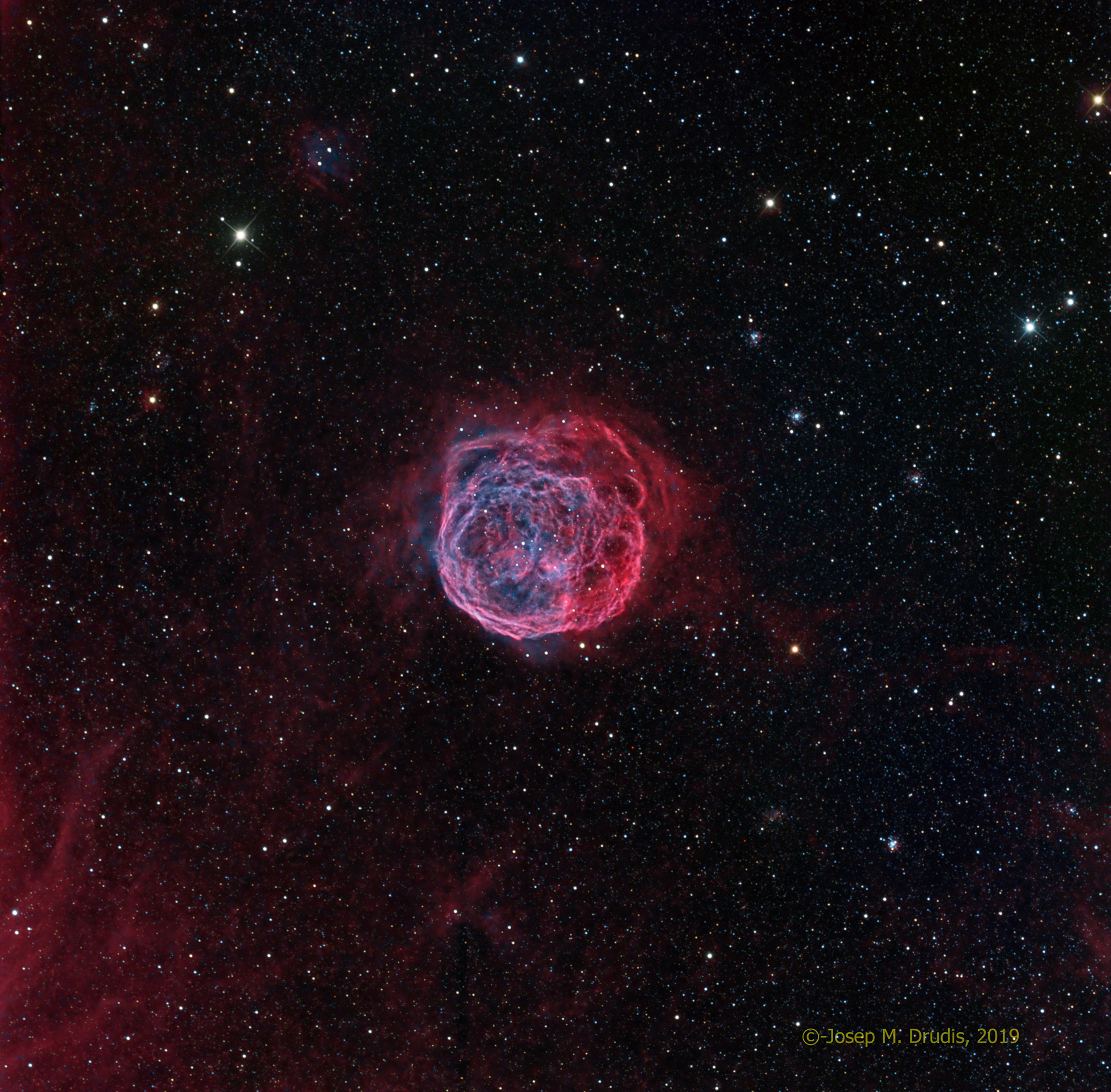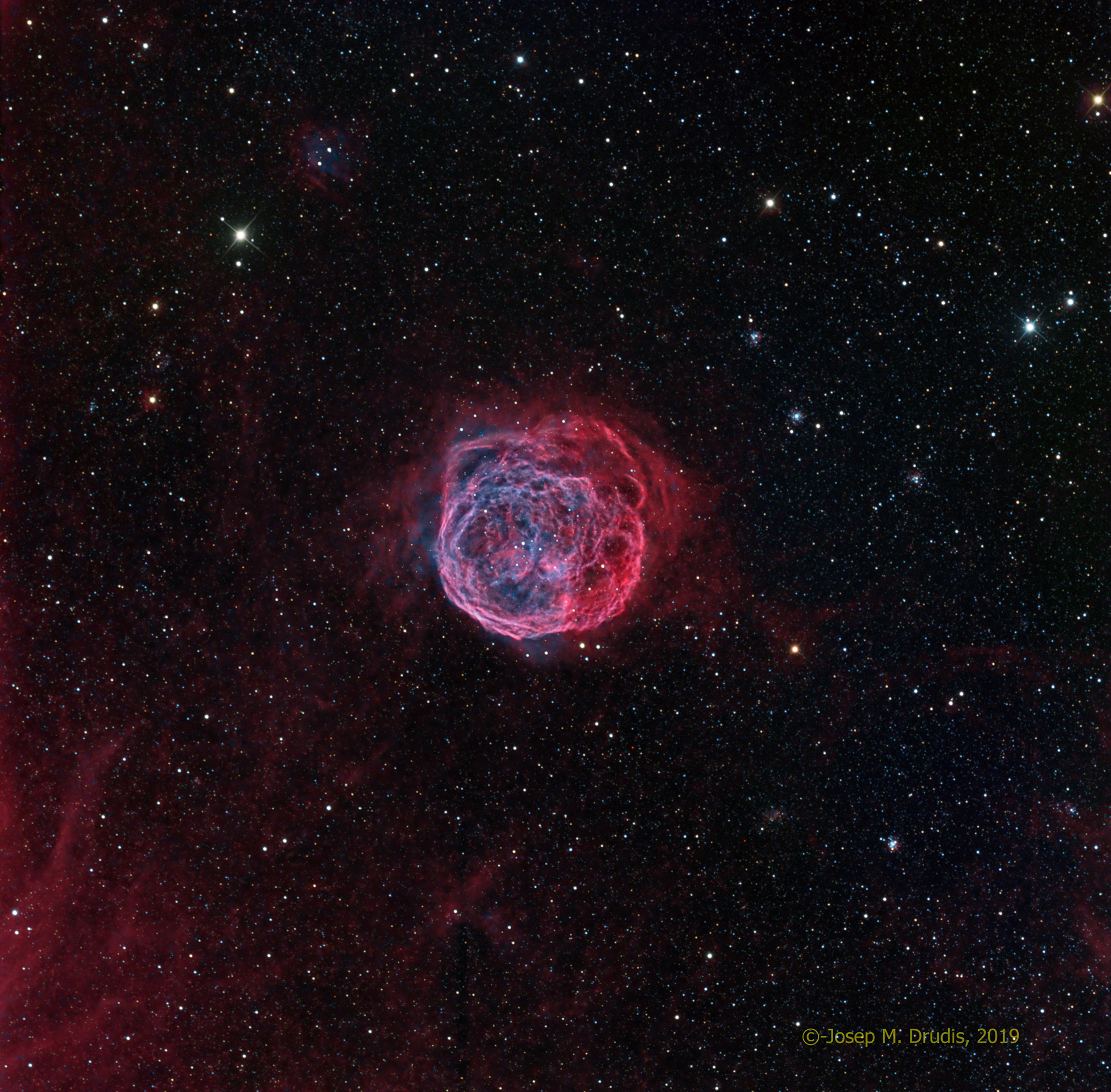
Massive stars profoundly affect their galactic environments. Churning and mixing interstellar clouds of gas and dust, stars -- most notably those upwards of tens of times the mass of our Sun -- leave their mark on the compositions and locations of future generations of stars. Dramatic evidence of this is illustrated in our neighboring galaxy, the Large Magellanic Cloud (LMC), by the featured nebula, Henize 70 (also known as N70 and DEM301). Henize 70 is actually a luminous superbubble of interstellar gas about 300 light-years in diameter, blown by winds from hot, massive stars and supernova explosions, with its interior filled with tenuous hot and expanding gas. Because superbubbles can expand through an entire galaxy, they offer humanity a chance to explore the connection between the lifecycles of stars and the evolution of galaxies.
Las estrellas masivas tienen un impacto profundo en sus entornos galácticos. Al agitar y mezclar las nubes interestelares de gas y polvo, las estrellas —especialmente aquellas que tienen decenas de veces la masa de nuestro Sol— dejan su huella en las composiciones y ubicaciones de las futuras generaciones de estrellas. Prueba dramática de esto se muestra en nuestra galaxia vecina, la Gran Nube de Magallanes (LMC), mediante la nebulosa destacada, Henize 70 (también conocida como N70 y DEM301). Henize 70 es en realidad una brillante superburbuja de gas interestelar de aproximadamente 300 años luz de diámetro, formada por vientos de estrellas calientes y masivas y explosiones de supernovas, con su interior lleno de gas tenue, caliente y en expansión. Dado que las superburbujas pueden expandirse a través de toda una galaxia, ofrecen a la humanidad la oportunidad de explorar la conexión entre los ciclos de vida de las estrellas y la evolución de las galaxias.