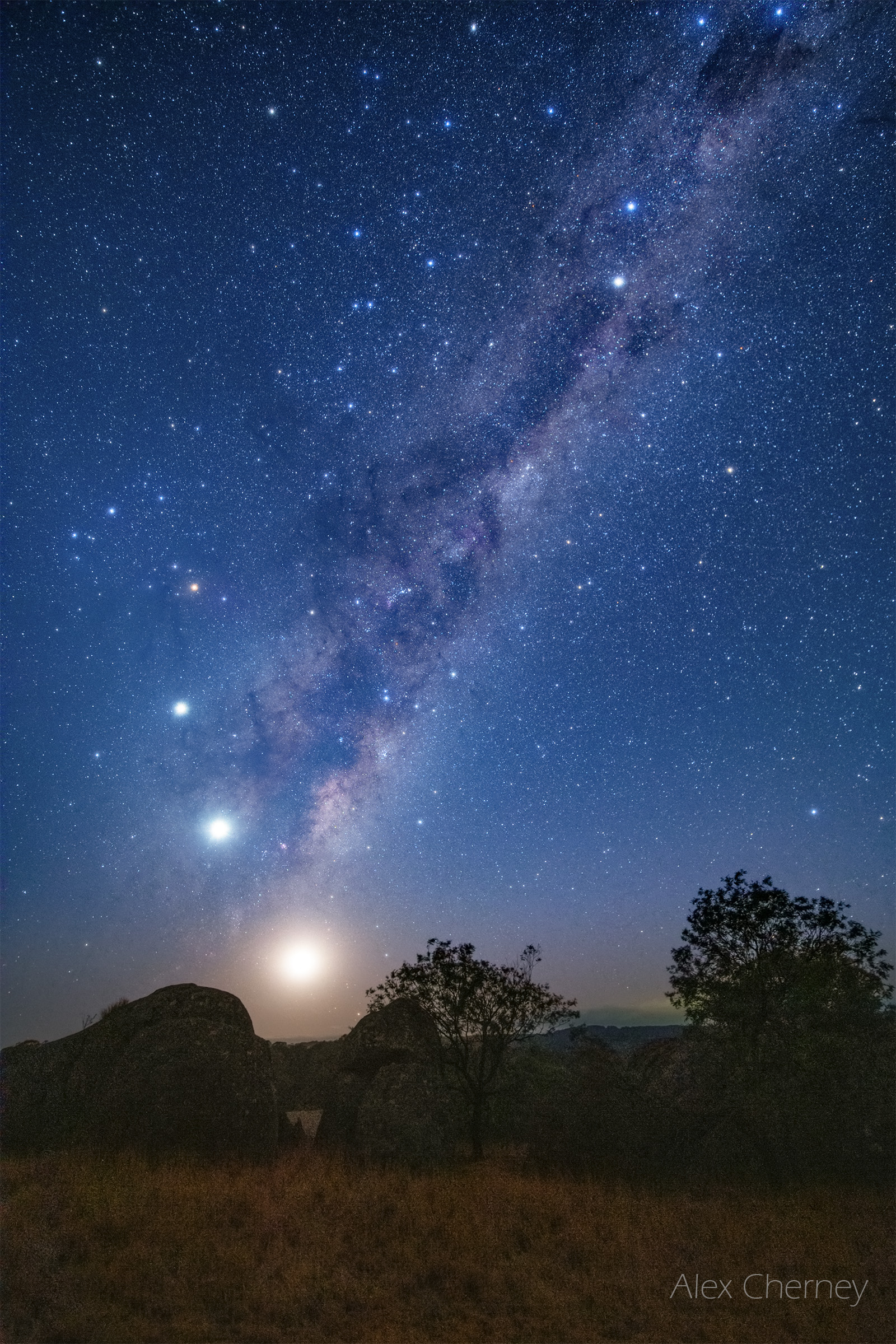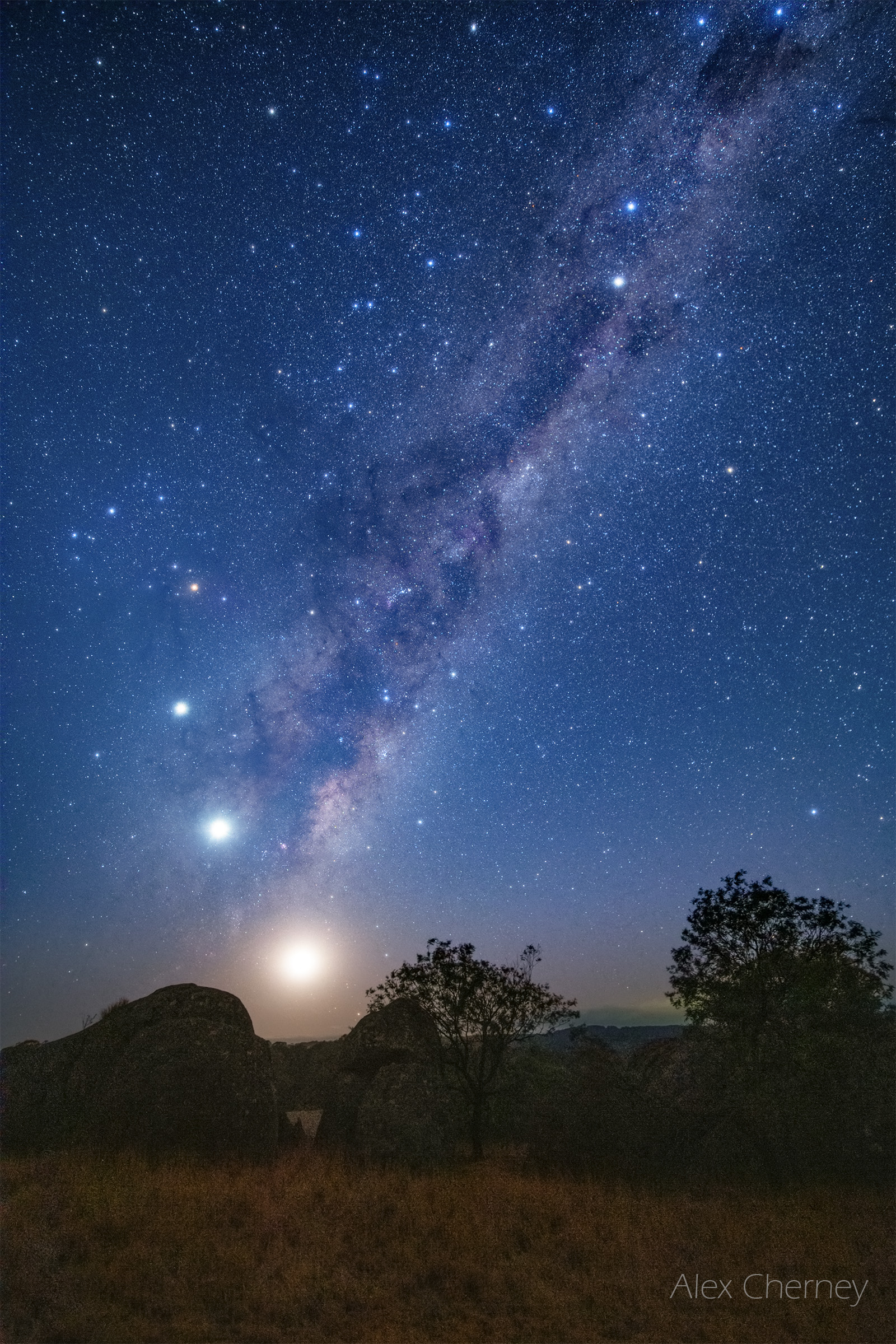
A luminous Milky Way falls toward the horizon in this deep skyscape, starting at the top of the frame from the stars of the Southern Cross and the dark Coalsack Nebula. Captured in the dark predawn of February 2nd from Central Victoria, Australia, planet Earth, the 26 day old waning crescent Moon still shines brightly near the horizon. The second and third brightest celestial beacons are Venus and Jupiter along the lower part of the Milky Way's central bulge. Almost in line with the brighter planets and Moon, Saturn is the pinprick of light just visible below and right of the lunar glow. Australia's first astronomers saw the elongated, bulging shape of the familiar Milky Way as a great celestial Emu. The Moon and planets could almost be the Emu's eggs on this starry night.
Una luminosa Vía Láctea se extiende hacia el horizonte en esta profunda imagen del cielo, comenzando en la parte superior del marco desde las estrellas de la Cruz del Sur y la oscura Nebulosa del Sac de Carbón. Capturada en la oscuridad de la madrugada del 2 de febrero desde Victoria Central, Australia, la Luna menguante de 26 días aún brilla claramente cerca del horizonte. Los segundos y terceros objetos más brillantes del cielo son Venus y Júpiter, a lo largo de la parte inferior del bulbo central de la Vía Láctea. Casi alineado con los planetas más brillantes y la Luna, Saturno es el puntito de luz apenas visible debajo y a la derecha del resplandor lunar. Los primeros astrónomos australianos vieron la forma alargada y abultada de la familiar Vía Láctea como un gran emú celeste. La Luna y los planetas podrían casi ser los huevos del emú en esta noche estrellada.