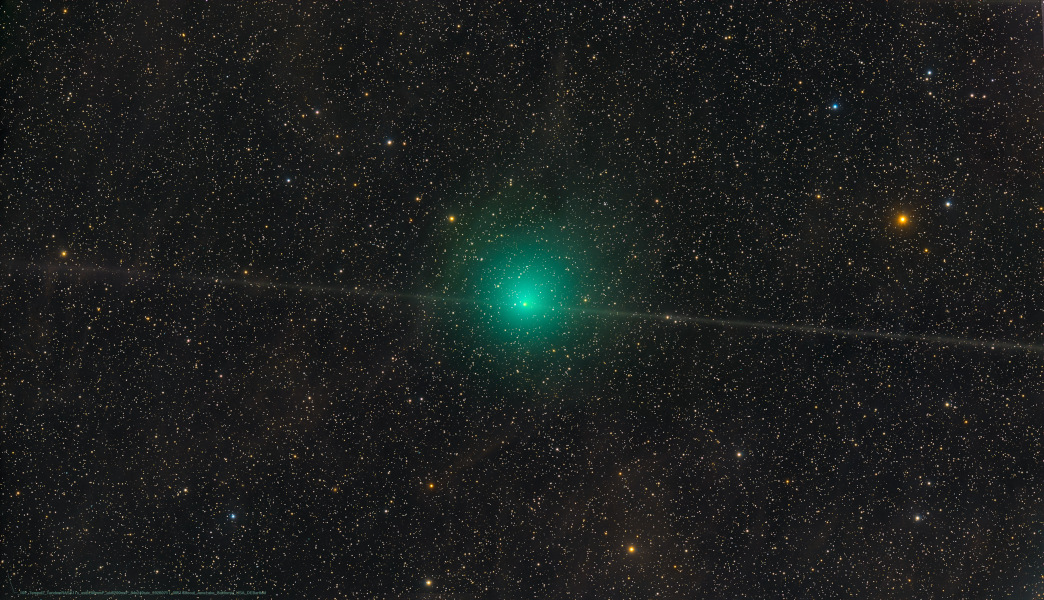
It isn't every night that a comet passes a galaxy. Last Thursday, though, binocular comet C/2018 Y1 (Iwamoto) moved nearly in front of a spiral galaxy of approximately the same brightness: NGC 2903. Comet Iwamoto was discovered late last year and orbits the Sun in a long ellipse. It last visited the inner Solar System during the Middle Ages, around the year 648. The comet reached its closest point to the Sun -- between Earth and Mars -- on February 6, and its closest point to Earth a few days ago, on February 13. The featured time-lapse video condenses almost three hours into about ten seconds, and was captured last week from Switzerland. At that time Comet Iwamoto, sporting a green coma, was about 10 light minutes distant, while spiral galaxy NGC 2903 remained about 30 million light years away. Two satellites zip diagonally through the field about a third of the way through the video. Typically, a few comets each year become as bright as Comet Iwamoto.
No es habitual que un cometa pase frente a una galaxia. Sin embargo, el jueves pasado, el cometa binocular C/2018 Y1 (Iwamoto) se movió casi frente a una galaxia espiral de brillo aproximadamente similar: NGC 2903. El cometa Iwamoto fue descubierto a finales del año pasado y orbita al Sol en una elipse larga. Su última visita al sistema solar interior fue durante la Edad Media, alrededor del año 648. El cometa alcanzó su punto más cercano al Sol —entre la Tierra y Marte— el 6 de febrero, y su punto más cercano a la Tierra hace unos días, el 13 de febrero. El video de tiempo acelerado mostrado aquí condensa casi tres horas en unos diez segundos, y fue capturado la semana pasada desde Suiza. En ese momento, el cometa Iwamoto, con una coma verde, se encontraba a unos 10 minutos luz de distancia, mientras que la galaxia espiral NGC 2903 permanecía a unos 30 millones de años luz de distancia. Dos satélites atraviesan diagonalmente el campo alrededor de un tercio del camino del video. Típicamente, un par de cometas al año se vuelven tan brillantes como el cometa Iwamoto.