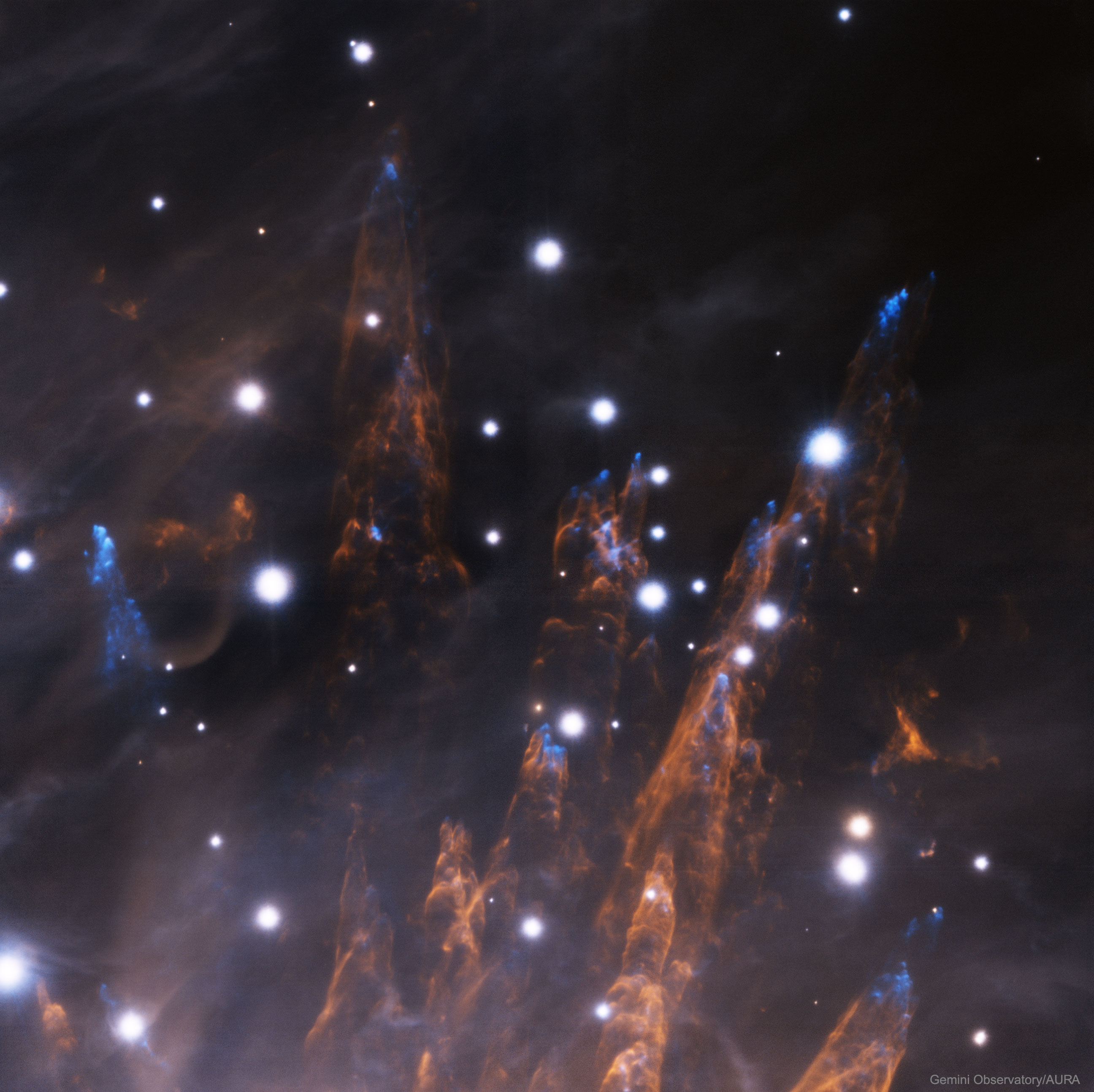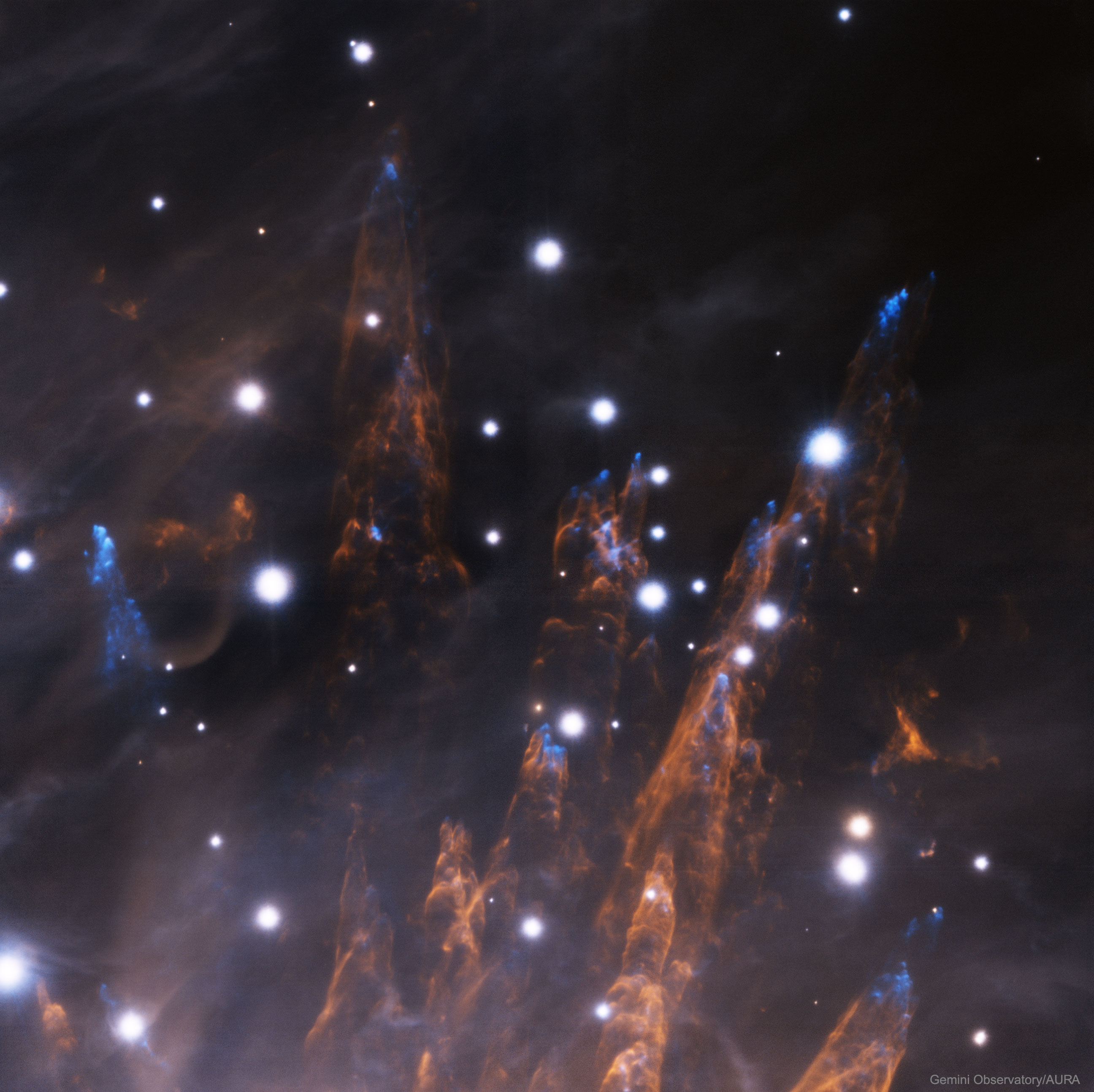
Why are bullets of gas shooting out of the Orion Nebula? Nobody is yet sure. First discovered in 1983, each bullet is actually about the size of our Solar System, and moving at about 400 km/sec from a central source dubbed IRc2. The age of the bullets, which can be found from their speed and distance from IRc2, is very young -- typically less than 1,000 years. As the bullets expand out the top of the Kleinmann-Low section of the Orion Nebula, a small percentage of iron gas causes the tip of each bullet to glow blue, while each bullet leaves a tubular pillar that glows by the light of heated hydrogen gas. The detailed image was created using the 8.1 meter Gemini South telescope in Chile with an adaptive optics system (GeMS). GeMS uses five laser generated guide stars to help compensate for the blurring effects of planet Earth's atmosphere.
¿Por qué salen chorros de gas de la Nebulosa de Orión? Nadie está seguro aún. Descubiertas por primera vez en 1983, cada bala tiene aproximadamente el tamaño de nuestro Sistema Solar y se mueve a unos 400 km/seg desde una fuente central llamada IRc2. La edad de las balas, que se puede determinar a partir de su velocidad y distancia a IRc2, es muy joven — típicamente menos de 1,000 años. Mientras las balas se expanden hacia la parte superior de la sección Kleinmann-Low de la Nebulosa de Orión, un pequeño porcentaje de gas de hierro hace que la punta de cada bala brille en azul, mientras que cada bala deja un pilar tubular que brilla por la luz del hidrógeno calentado. La imagen detallada fue creada utilizando el telescopio Gemini South de 8.1 metros en Chile con un sistema de óptica adaptativa (GeMS). GeMS utiliza cinco guías estelares generadas por láser para compensar los efectos desenfocantes de la atmósfera de la Tierra.