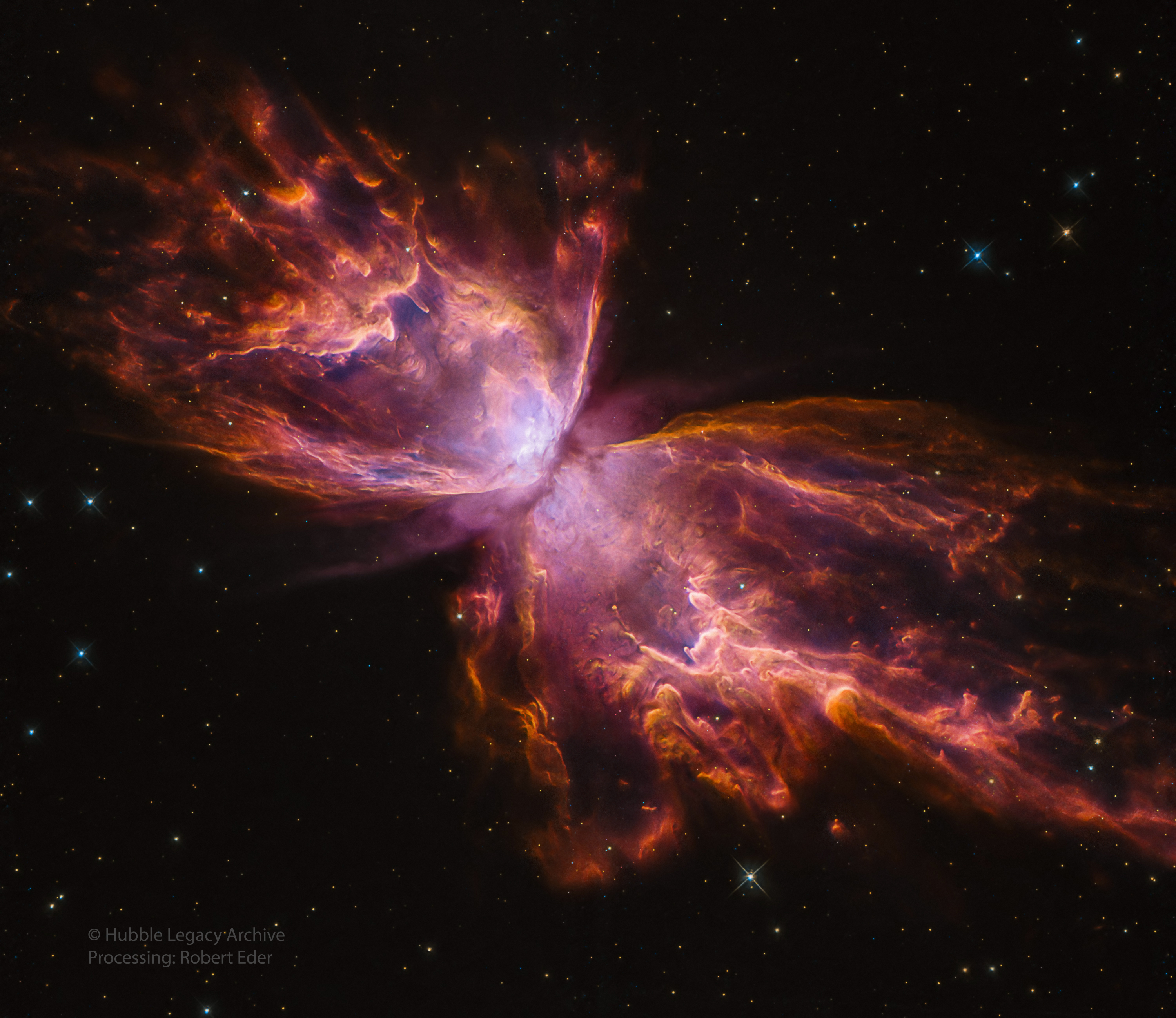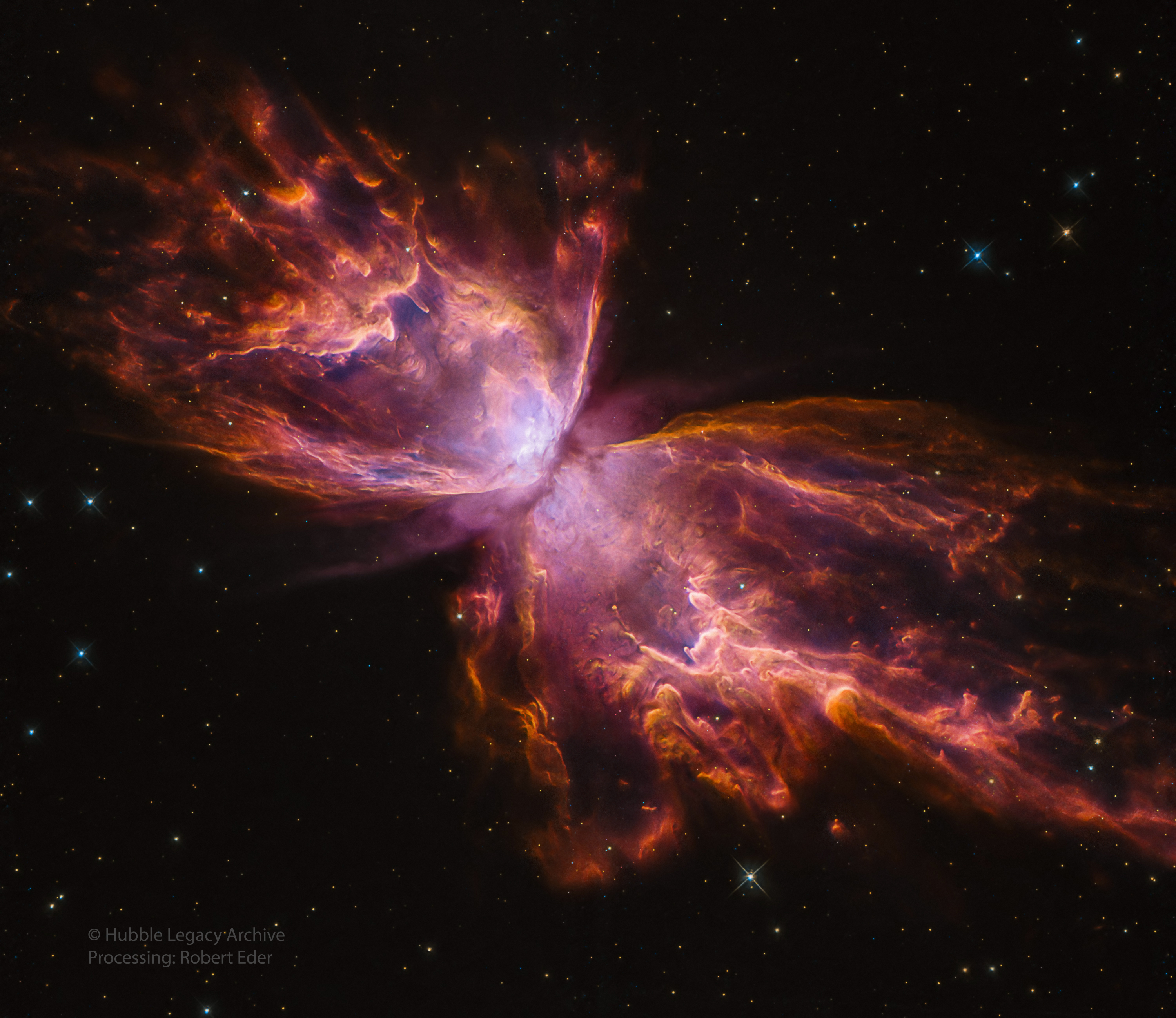
The bright clusters and nebulae of planet Earth's night sky are often named for flowers or insects. Though its wingspan covers over 3 light-years, NGC 6302 is no exception. With an estimated surface temperature of about 250,000 degrees C, the dying central star of this particular planetary nebula has become exceptionally hot, shining brightly in ultraviolet light but hidden from direct view by a dense torus of dust. This sharp close-up was recorded by the Hubble Space Telescope in 2009. The Hubble image data is reprocessed here, showing off the remarkable details of the complex planetary nebula. Cutting across a bright cavity of ionized gas, the dust torus surrounding the central star is near the center of this view, almost edge-on to the line-of-sight. Molecular hydrogen has been detected in the hot star's dusty cosmic shroud. NGC 6302 lies about 4,000 light-years away in the arachnologically correct constellation of the Scorpion (Scorpius).
Los brillantes cúmulos y nebulosas del cielo nocturno de la Tierra suelen recibir nombres basados en flores o insectos. Aunque su envergadura abarca más de 3 años luz, el NGC 6302 no es una excepción. Con una temperatura superficial estimada de unos 250 000 grados Celsius, la estrella central moribunda de esta nebulosa planetaria se ha vuelto excepcionalmente caliente, brillando intensamente en luz ultravioleta pero oculta de la vista directa por un denso toro de polvo. Esta imagen nítida y detallada fue capturada por el Telescopio Espacial Hubble en 2009. Los datos de la imagen del Hubble se han reprocesado aquí, mostrando los sorprendentes detalles de esta compleja nebulosa planetaria. Cruzando un brillante hueco de gas ionizado, el toro de polvo que rodea a la estrella central se encuentra cerca del centro de esta vista, casi de perfil respecto a la línea de visión. Se ha detectado hidrógeno molecular en la envoltura cósmica de polvo que rodea a la estrella caliente. El NGC 6302 se encuentra a unos 4 000 años luz de distancia en la constelación aracnológicamente correcta del Escorpión (Scorpius).