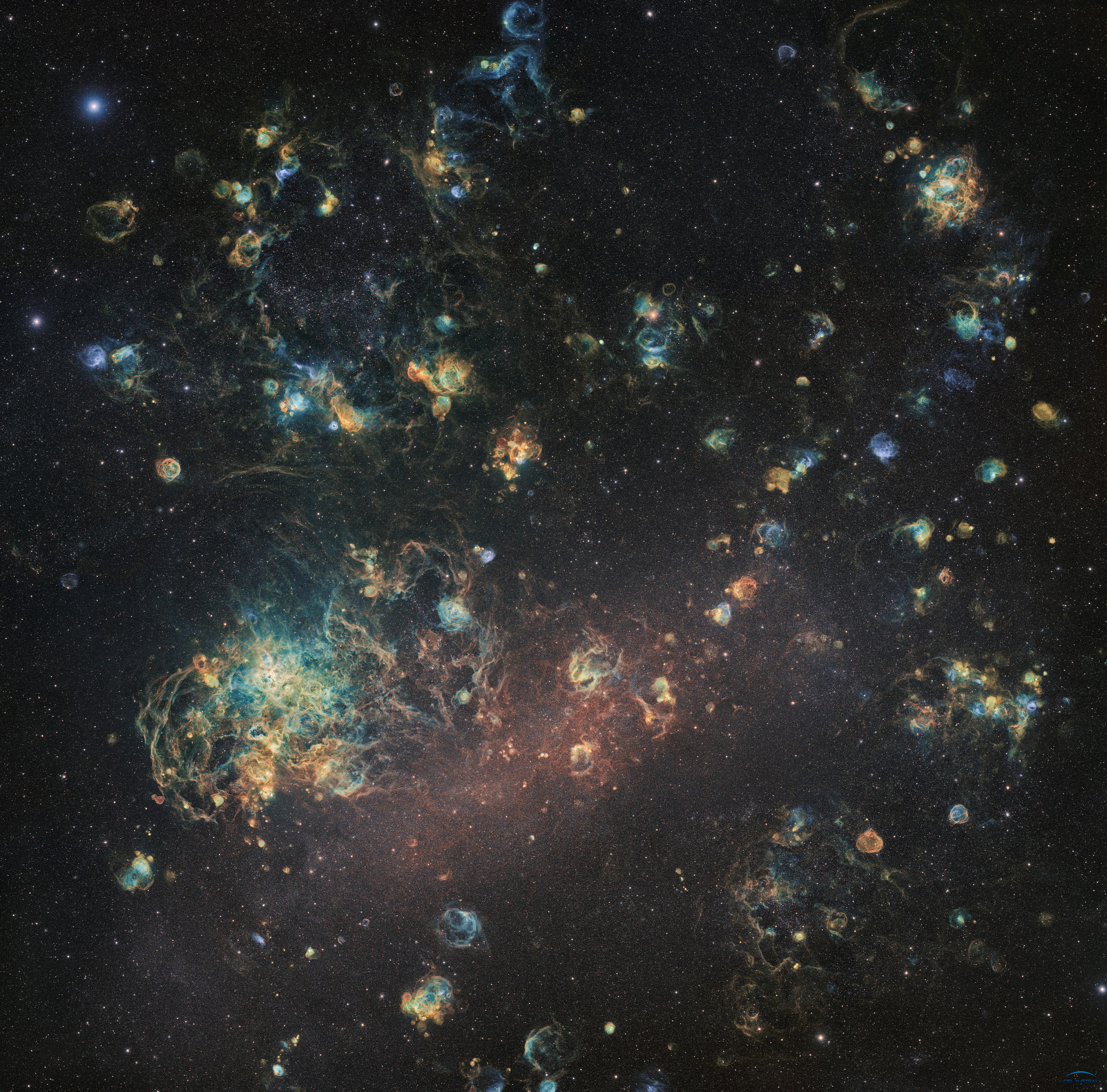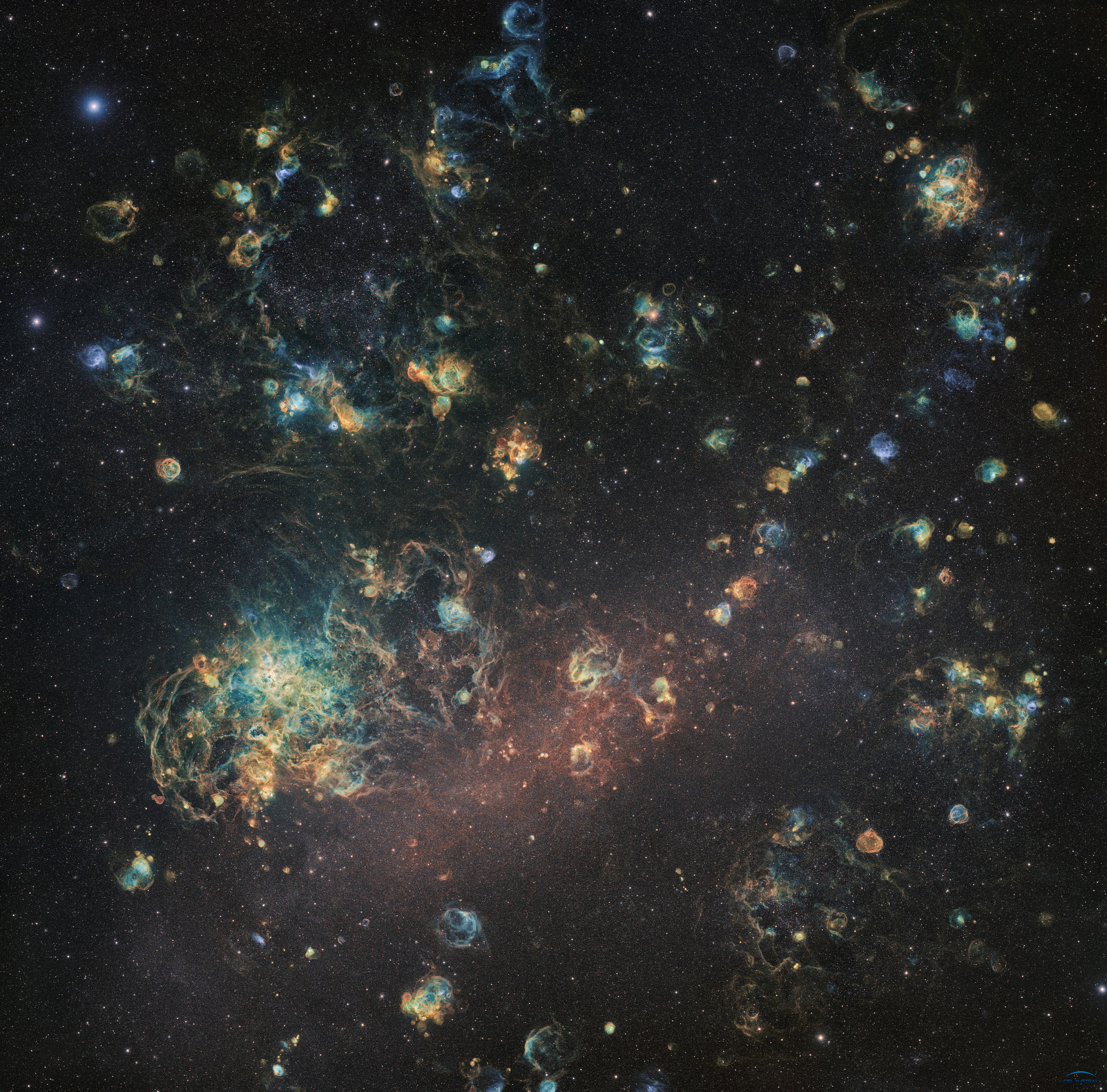
The Large Magellanic Cloud (LMC) is an alluring sight in southern skies. But this deep and detailed telescopic view, over 10 months in the making, goes beyond what is visible to most circumnavigators of planet Earth. Spanning over 5 degrees or 10 full moons, the 4x4 panel mosaic was constructed from 3900 frames with a total of 1,060 hours of exposure time in both broadband and narrowband filters. The narrowband filters are designed to transmit only light emitted by sulfur, hydrogen, and oxygen atoms. Ionized by energetic starlight, the atoms emit their characteristic light as electrons are recaptured and the atoms transition to a lower energy state. As a result, in this image the LMC seems covered with its own clouds of ionized gas surrounding its massive, young stars. Sculpted by the strong stellar winds and ultraviolet radiation, the glowing clouds, dominated by emission from hydrogen, are known as H II (ionized hydrogen) regions. Itself composed of many overlapping H II regions, the Tarantula Nebula is the large star forming region at the left. The largest satellite of our Milky Way Galaxy, the LMC is about 15,000 light-years across and lies a mere 160,000 light-years away toward the constellation Dorado.
La Gran Nube de Magallanes (LMC) es un atractivo espectáculo en los cielos del hemisferio sur. Pero esta imagen telescópica profunda y detallada, que tomó más de 10 meses de trabajo, va más allá de lo que es visible para la mayoría de los observadores de la Tierra. Con un tamaño de más de 5 grados, equivalente a 10 lunas llenas, el mosaico de 4x4 paneles fue construido a partir de 3900 fotogramas con un tiempo total de exposición de 1060 horas, utilizando filtros de banda ancha y banda estrecha. Los filtros de banda estrecha están diseñados para transmitir únicamente la luz emitida por átomos de azufre, hidrógeno y oxígeno. Ionizados por la luz energética de las estrellas, los átomos emiten su luz característica cuando los electrones son recapturados y los átomos pasan a un estado de menor energía. Como resultado, en esta imagen, la LMC parece estar cubierta por sus propias nubes de gas ionizado que rodean sus estrellas masivas y jóvenes. Moldeadas por los fuertes vientos estelares y la radiación ultravioleta, las nubes brillantes, dominadas por la emisión del hidrógeno, se conocen como regiones H II (hidrógeno ionizado). Compuesta por muchas regiones H II superpuestas, la Nebulosa Tarántula es la gran región de formación estelar que aparece a la izquierda. La LMC, el mayor satélite de nuestra Galaxia Vía Láctea, tiene aproximadamente 15 000 años luz de diámetro y se encuentra a solo 160 000 años luz de distancia, en la constelación de Dorado.