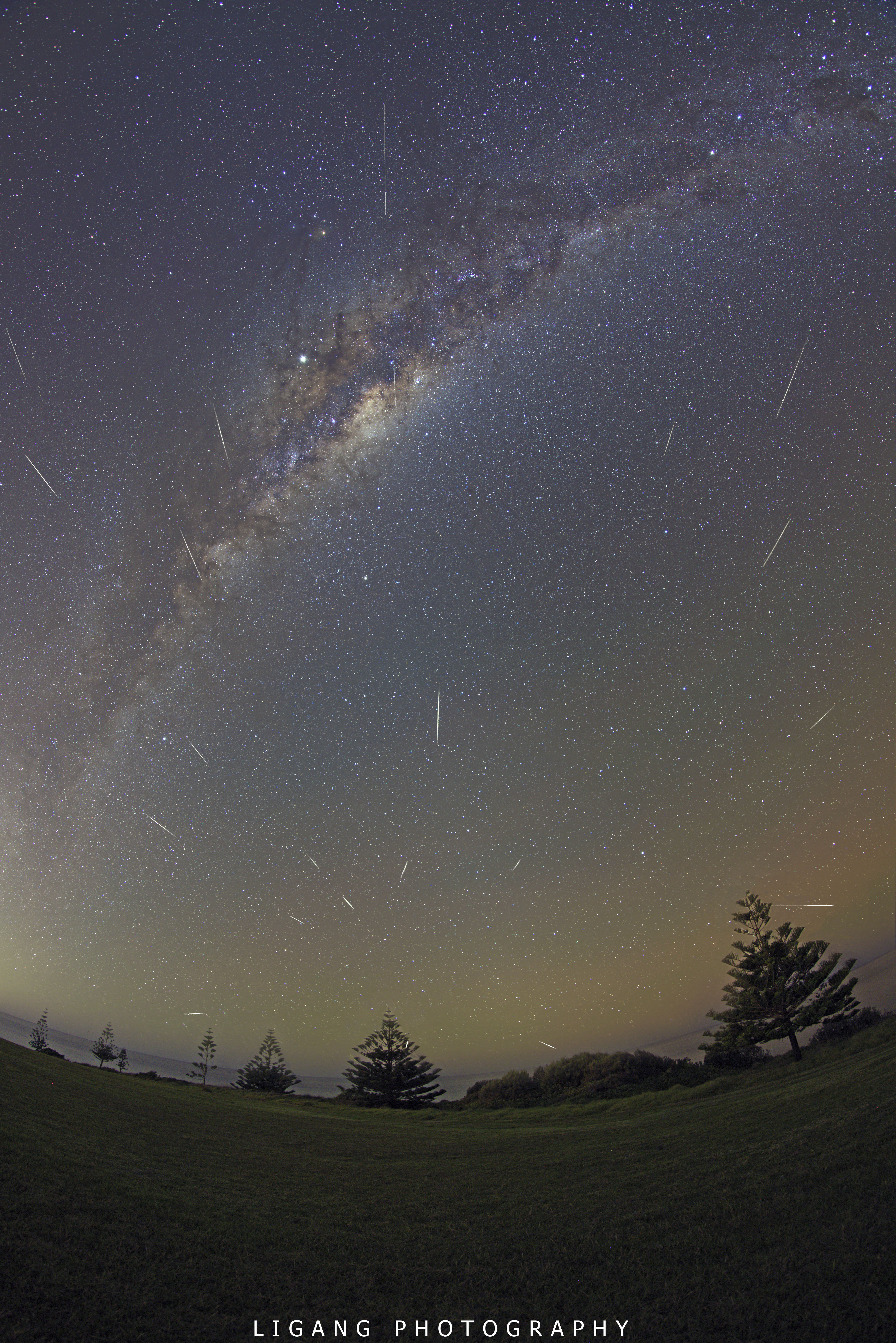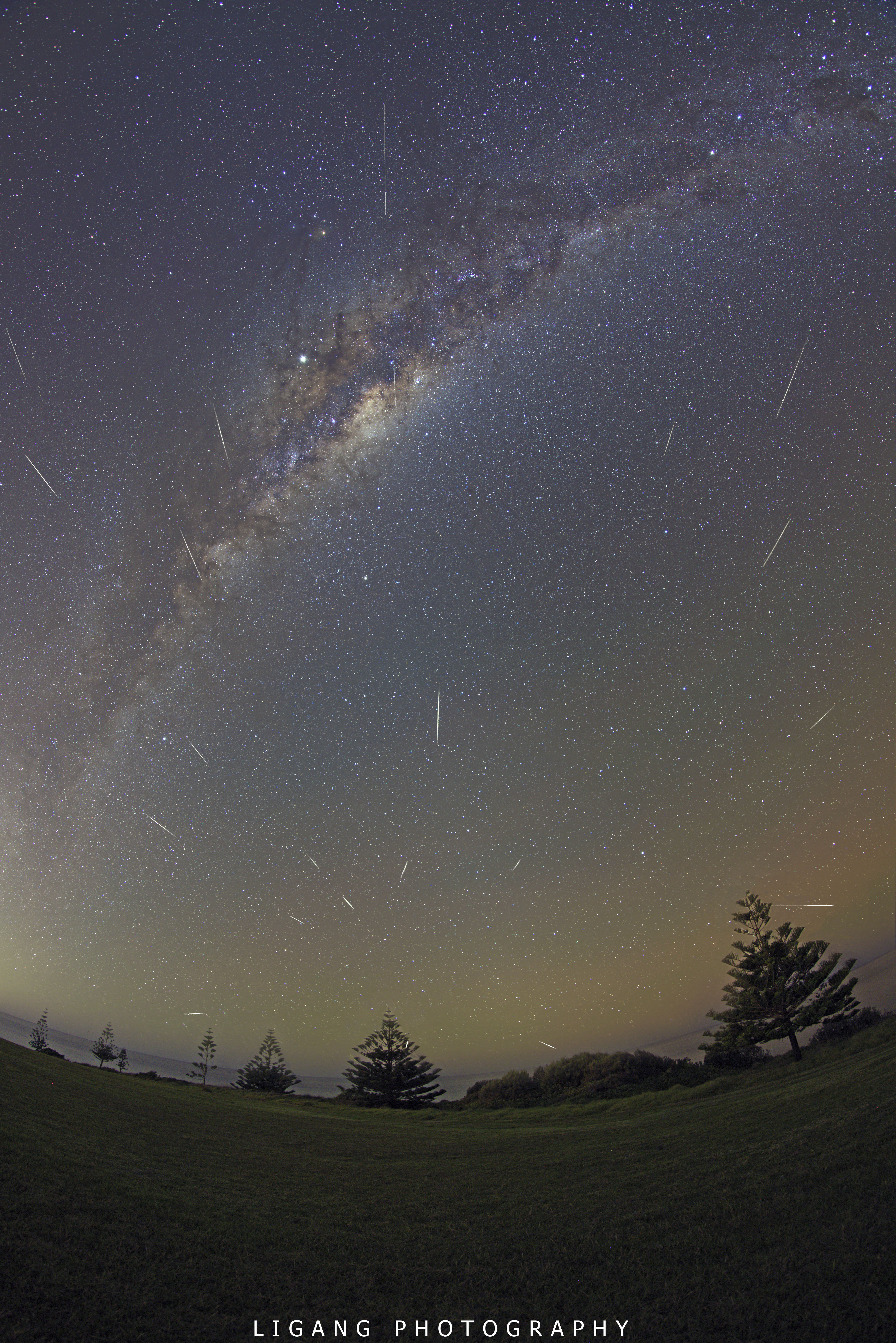
Grains of cosmic dust streaked through the mostly moonless night skies of May 7. Swept up as planet Earth plowed through the debris streams left behind by periodic Comet Halley, the annual meteor shower is known as the Eta Aquarids. Though it was made about a day after the shower's predicted maximum, this composite image still captures 20 meteors in exposures taken over a 2 hour period, registered on a background exposure of the sky. The meteor trails point back to the shower radiant near eponymous faint star Eta Aquarii close to the horizon, seen from 100 kilometers south of Sydney Australia. Known for speed, Eta Aquarid meteors move fast, entering the atmosphere at about 66 kilometers per second. Brilliant Jupiter shines near the central bulge of the Milky Way high above the horizon. The Southern Cross is just tucked in to the upper right corner of the frame.
Granos de polvo cósmico atravesaron las cielos nocturnos casi sin luna del 7 de mayo. Recogidos cuando la Tierra atravesó los restos dejados por el cometa Halley, que tiene un período fijo, la lluvia de meteoros anual se conoce como las Eta Acuáridas. Aunque esta imagen compuesta fue hecha aproximadamente un día después del máximo previsto de la lluvia, aún captura 20 meteoros en exposiciones tomadas durante un período de 2 horas, registrados sobre una exposición de fondo del cielo. Las trayectorias de los meteoros apuntan hacia el radiante de la lluvia cerca de la estrella tenue y homónima Eta Acuarii, cerca del horizonte, vista desde 100 kilómetros al sur de Sydney, Australia. Conocidas por su velocidad, las meteoro Eta Acuáridas se mueven rápidamente, entrando a la atmósfera a unos 66 kilómetros por segundo. Júpiter brilla brillantemente cerca del bulbo central de la Vía Láctea, alta sobre el horizonte. La Cruz del Sur está justo escondida en la esquina superior derecha del marco.