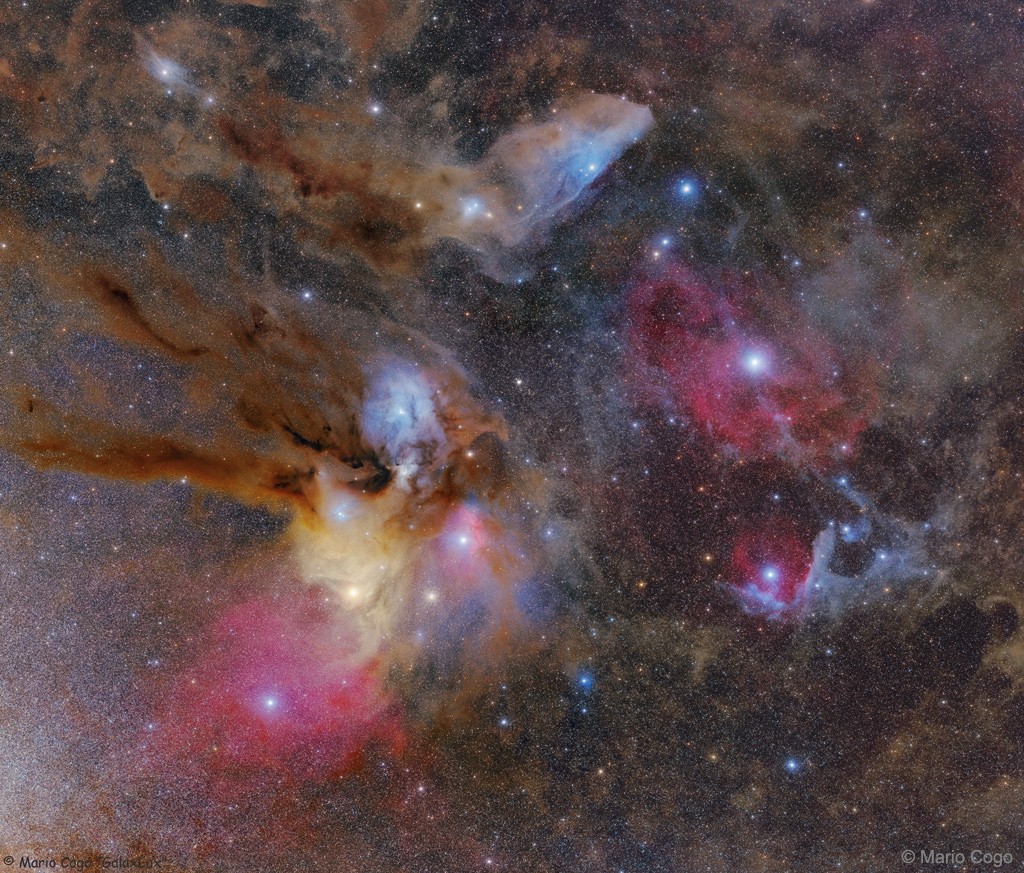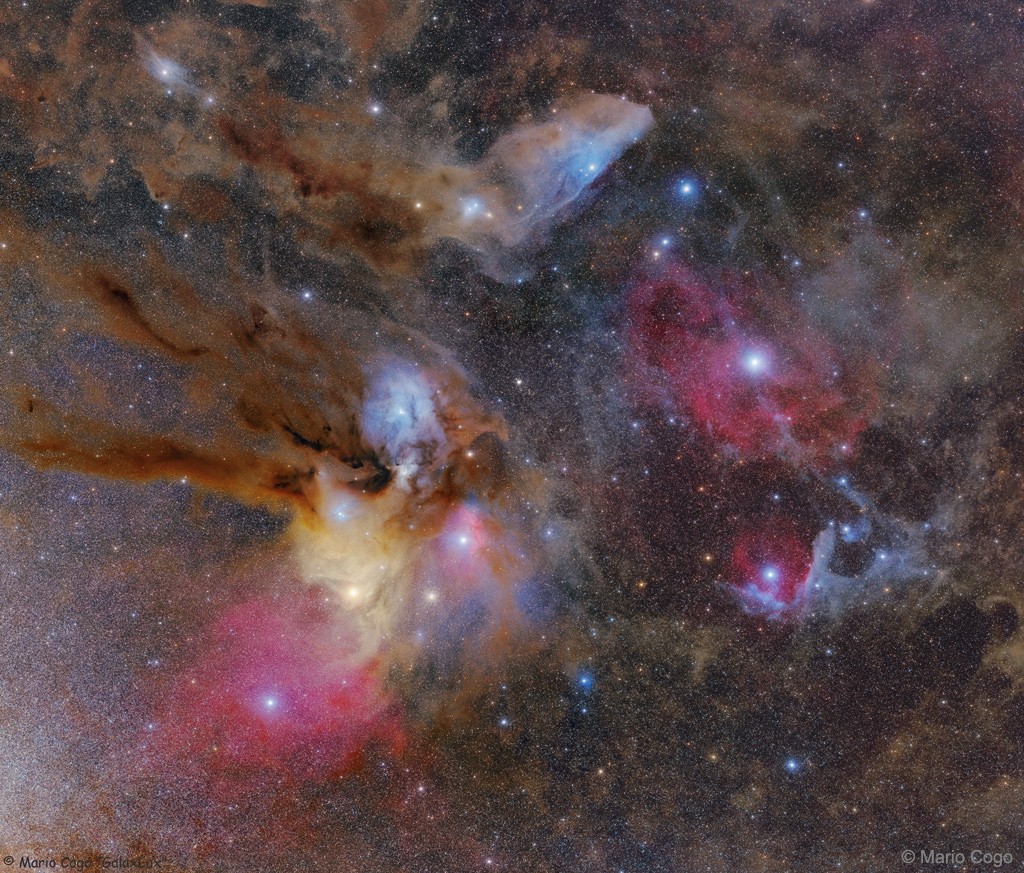
The colorful clouds surrounding the star system Rho Ophiuchi compose one of the closest star forming regions. Rho Ophiuchi itself is a binary star system visible in the blue reflection nebula just to the left of the image center. The star system, located only 400 light years away, is distinguished by its multi-colored surroundings, which include a red emission nebula and numerous light and dark brown dust lanes. Near the lower left of the Rho Ophiuchi molecular cloud system is the yellow star Antares, while a distant but coincidently-superposed globular cluster of stars, M4, is visible just to the right of Antares. Near the image top lies IC 4592, the Blue Horsehead nebula. The blue glow that surrounds the Blue Horsehead's eye -- and other stars around the image -- is a reflection nebula composed of fine dust. On the featured image right is a geometrically angled reflection nebula cataloged as Sharpless 1. Here, the bright star near the dust vortex creates the light of surrounding reflection nebula. Although most of these features are visible through a small telescope pointed toward the constellations of Ophiuchus, Scorpius, and Sagittarius, the only way to see the intricate details of the dust swirls, as featured above, is to use a long exposure camera.
Las nubes coloridas que rodean al sistema estelar Rho Ophiuchi componen una de las regiones más cercanas de formación estelar. Rho Ophiuchi en sí mismo es un sistema binario visible en la nebulosa de reflexión azul ubicada justo a la izquierda del centro de la imagen. El sistema estelar, ubicado a solo 400 años luz de distancia, se distingue por sus alrededores multicolores, que incluyen una nebulosa de emisión roja y numerosas vías de polvo marrón claro y oscuro. Cerca de la esquina inferior izquierda del sistema de la nube molecular de Rho Ophiuchi se encuentra la estrella amarilla Antares, mientras que un antiguo y distante cúmulo globular de estrellas, M4, es visible justo a la derecha de Antares. En la parte superior de la imagen se encuentra IC 4592, la nebulosa Caballito Azul. El brillo azul que rodea el ojo del Caballito Azul — y otras estrellas alrededor de la imagen — es una nebulosa de reflexión compuesta por polvo fino. A la derecha de la imagen destacada se encuentra una nebulosa de reflexión con ángulos geométricos catalogada como Sharpless 1. Aquí, la estrella brillante cerca del vórtice de polvo crea la luz de la nebulosa de reflexión circundante. Aunque la mayoría de estas características son visibles a través de un pequeño telescopio apuntado hacia las constelaciones de Ofiuco, Escorpión y Sagitario, la única manera de ver los detalles intrincados de las espirales de polvo, como se muestra arriba, es utilizar una cámara con exposición prolongada.