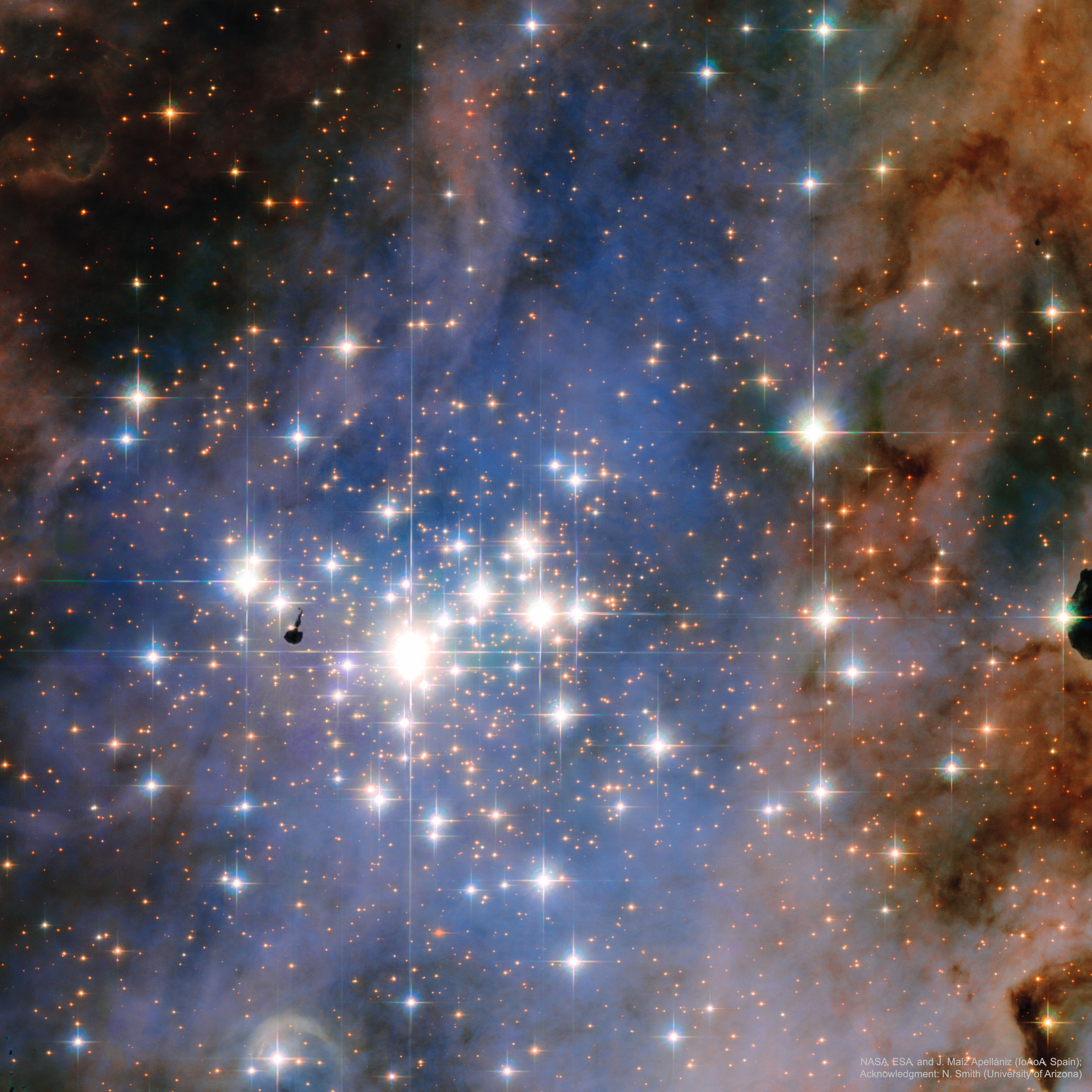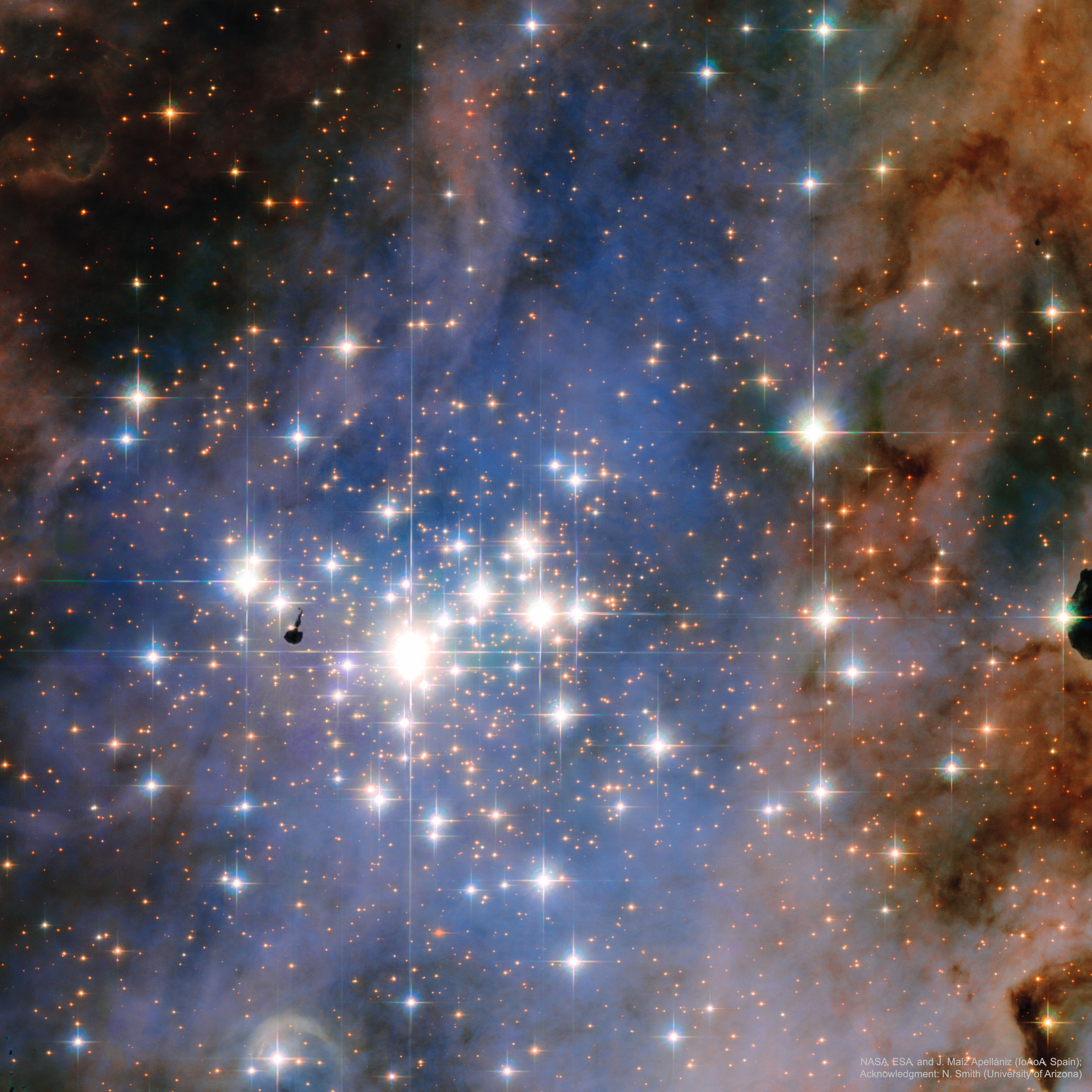
Why does star cluster Trumpler 14 have so many bright stars? Because it is so young. Many cluster stars have formed only in the past 5 million years and are so hot they emit detectable X-rays. In older star clusters, most stars this young have already died -- typically exploding in a supernova -- leaving behind stars that are fainter and redder. Trumpler 14 spans about 40 light years and lies about 9,000 light years away on the edge of the famous Carina Nebula. A discerning eye can spot two unusual objects in this detailed 2006 image of Trumpler 14 by the Hubble Space Telescope. First, a dark cloud just left of center may be a planetary system trying to form before being destroyed by the energetic winds of Trumpler 14's massive stars. Second is the arc at the bottom left, which one hypothesis holds is the supersonic shock wave of a fast star ejected 100,000 years ago from a completely different star cluster.
¿Por qué el grupo de estrellas Trumpler 14 tiene tantas estrellas brillantes? Porque es muy joven. Muchas estrellas del grupo se formaron hace solo 5 millones de años y son tan calientes que emiten rayos X detectables. En grupos de estrellas más antiguos, la mayoría de las estrellas tan jóvenes ya habrían muerto, normalmente explotando en una supernova, dejando atrás estrellas más tenues y rojizas. Trumpler 14 abarca aproximadamente 40 años luz y se encuentra a unos 9000 años luz de distancia, en el borde del famoso nebulosa Carina. Un ojo perspicaz puede identificar dos objetos inusuales en esta imagen detallada de 2006 de Trumpler 14 tomada por el Telescopio Espacial Hubble. Primero, una nube oscura justo a la izquierda del centro podría ser un sistema planetario intentando formarse antes de ser destruido por los vientos energéticos de las estrellas masivas de Trumpler 14. Segundo, el arco en la esquina inferior izquierda, que según una hipótesis podría ser la onda de choque supersónica de una estrella rápida expulsada hace 100000 años desde un grupo de estrellas completamente diferente.