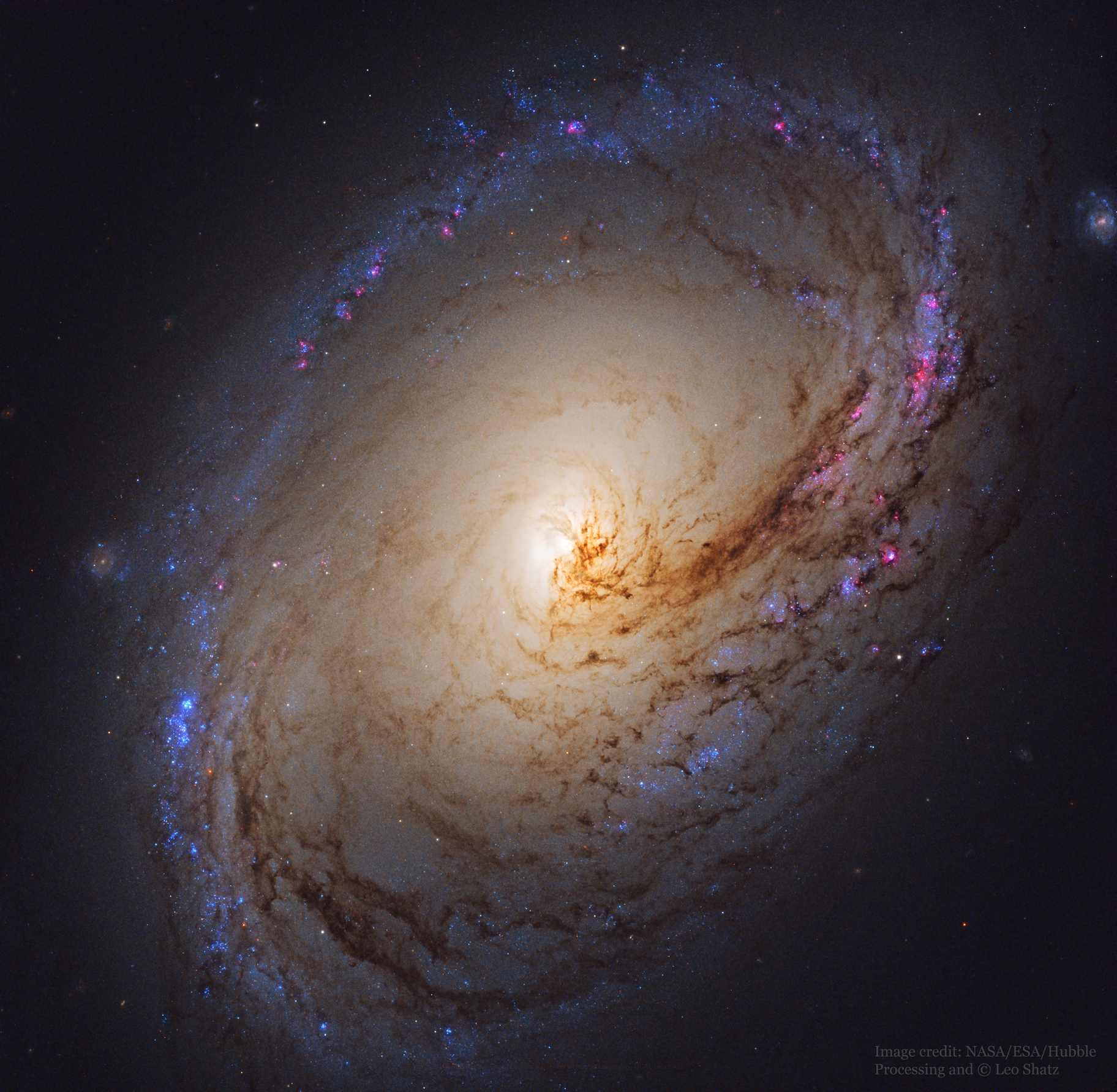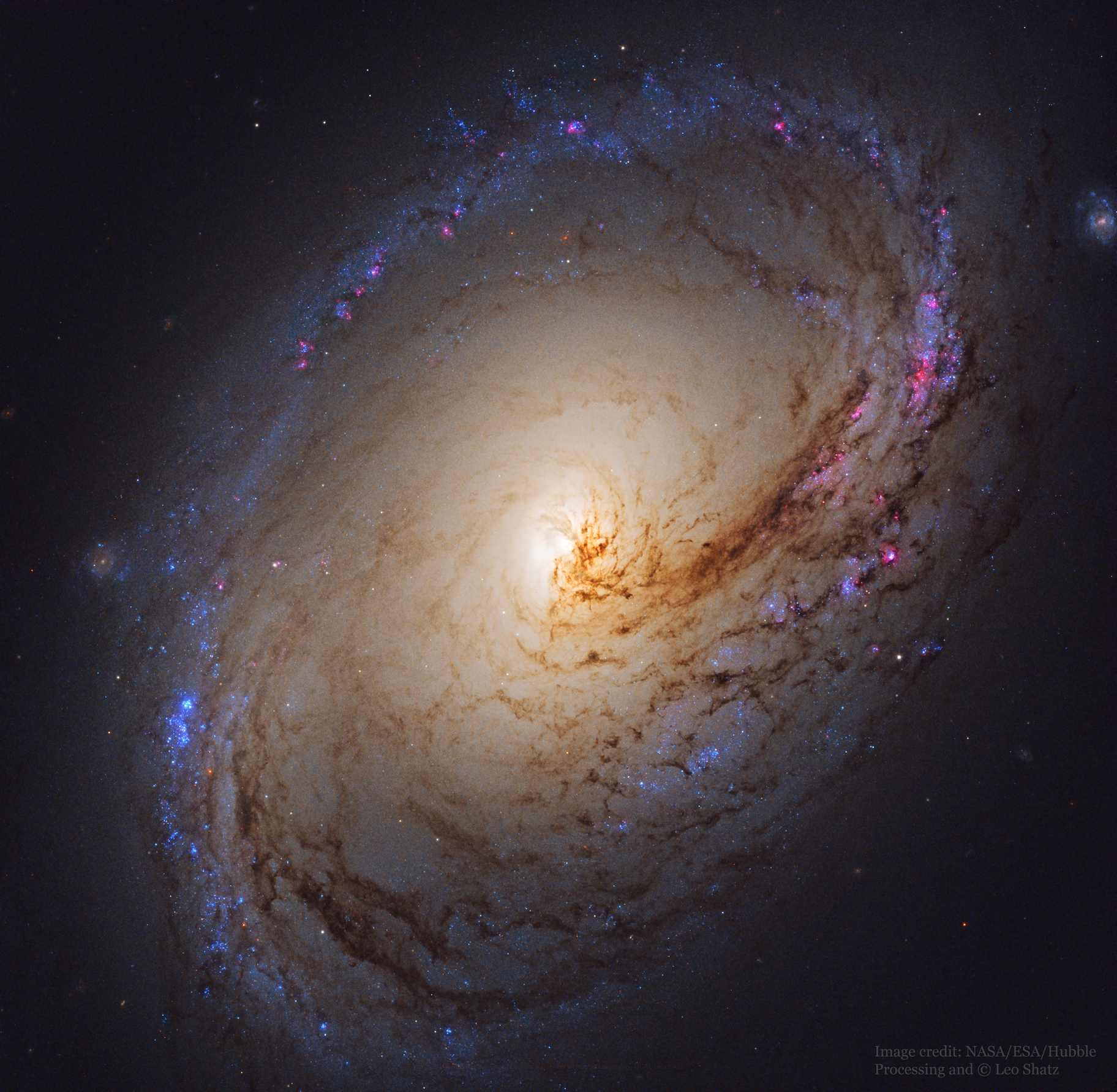
Dust lanes seem to swirl around the core of Messier 96 in this colorful, detailed portrait of the center of a beautiful island universe. Of course M96 is a spiral galaxy, and counting the faint arms extending beyond the brighter central region, it spans 100 thousand light-years or so, making it about the size of our own Milky Way. M96, also known as NGC 3368, is known to be about 35 million light-years distant and a dominant member of the Leo I galaxy group. The featured image was taken by the Hubble Space Telescope. The reason for M96's asymmetry is unclear -- it could have arisen from gravitational interactions with other Leo I group galaxies, but the lack of an intra-group diffuse glow seems to indicate few recent interactions. Galaxies far in the background can be found by examining the edges of the picture. APOD in other languages: Arabic, Catalan, Chinese (Beijing), Chinese (Taiwan), Croatian, Czech, Dutch, Farsi, French, French, German, Hebrew, Indonesian, Japanese, Korean, Montenegrin, Polish, Russian, Serbian, Slovenian, Spanish and Ukrainian
Crédito: NASA, Hubble Space Telescope Las vías de polvo parecen girar alrededor del núcleo de Messier 96 en este colorido y detallado retrato del centro de un hermoso universo isla. Por supuesto, M96 es una galaxia espiral, y contando los brazos tenues que se extienden más allá de la región central más brillante, tiene un diámetro de unos 100 000 años luz, lo que la hace del mismo tamaño aproximado que nuestra propia Vía Láctea. M96, también conocida como NGC 3368, se sabe que se encuentra a unos 35 millones de años luz de distancia y es un miembro dominante del grupo galáctico Leo I. La imagen destacada fue tomada por el Telescopio Espacial Hubble. La razón de la asimetría de M96 no está clara: podría haber surgido de interacciones gravitacionales con otras galaxias del grupo Leo I, pero la falta de un brillo difuso intra-grupal parece indicar pocas interacciones recientes. Galaxias muy lejanas en el fondo pueden encontrarse examinando los bordes de la imagen.