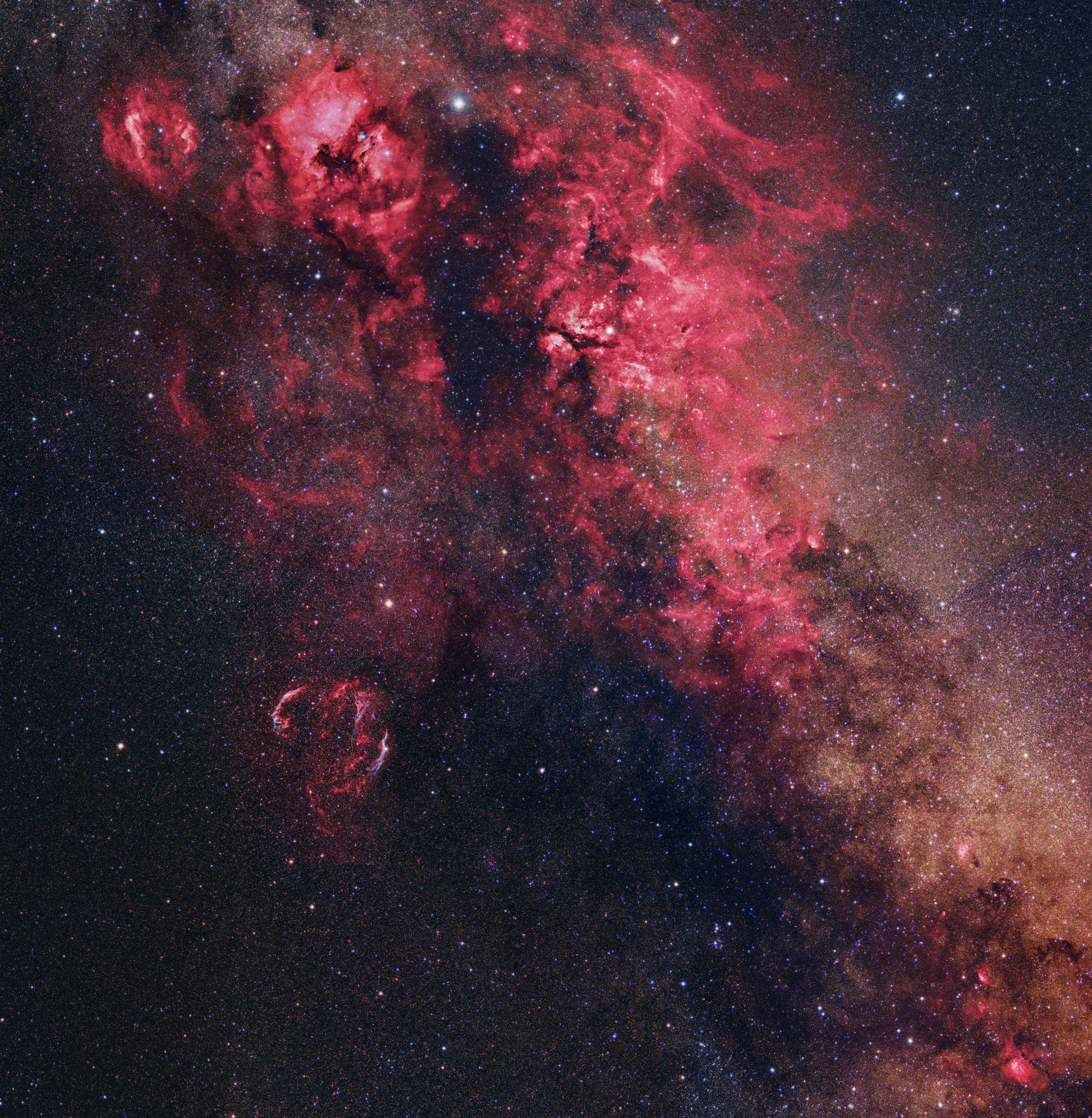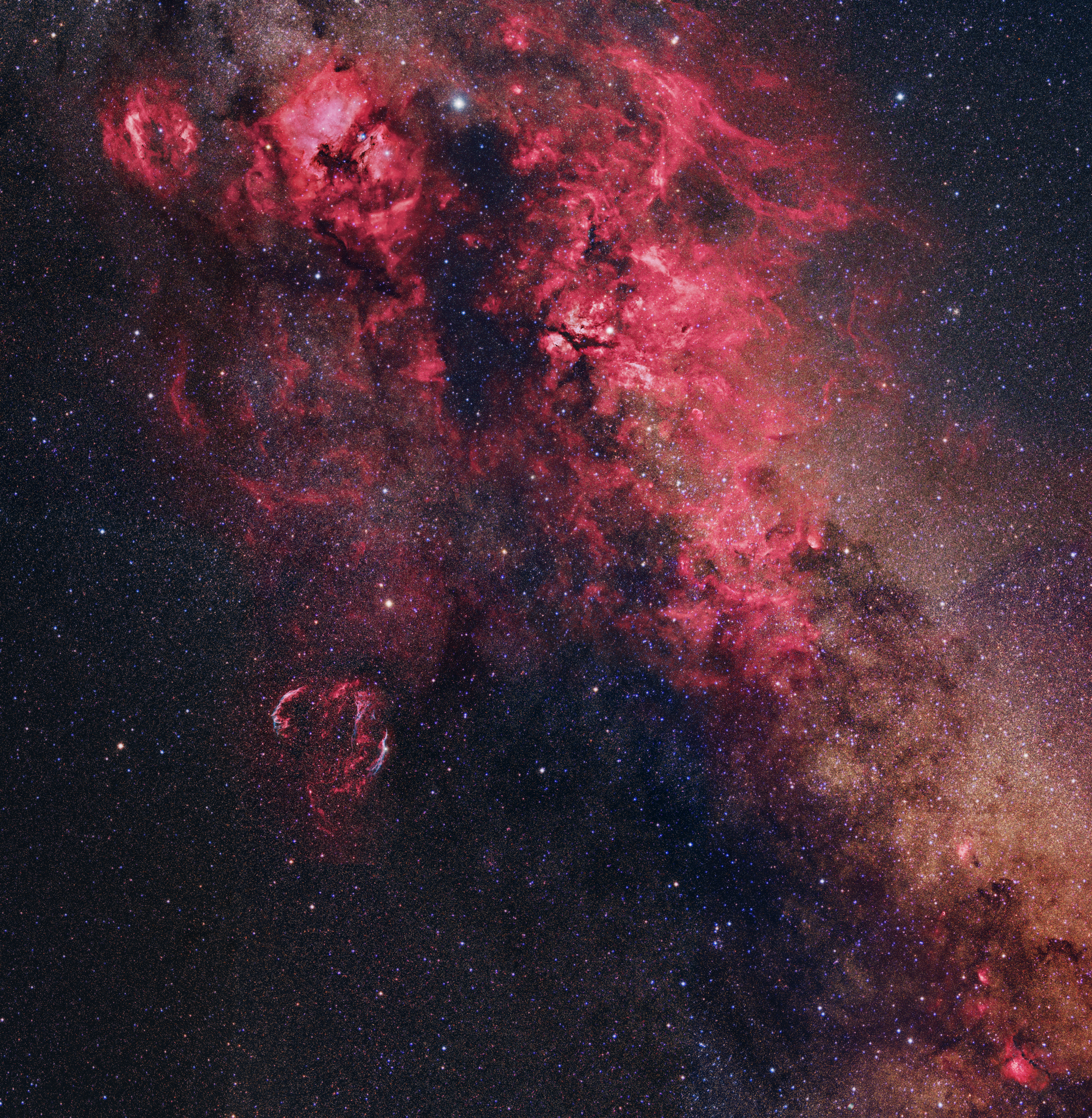
In brush strokes of interstellar dust and glowing hydrogen gas, this beautiful skyscape is painted across the plane of our Milky Way Galaxy near the northern end of the Great Rift and the constellation Cygnus the Swan. Composed with three different telescopes and about 90 hours of image data the widefield mosaic spans an impressive 24 degrees across the sky. Alpha star of Cygnus, bright, hot, supergiant Deneb lies near top center. Crowded with stars and luminous gas clouds Cygnus is also home to the dark, obscuring Northern Coal Sack Nebula, extending from Deneb toward the center of the view. The reddish glow of star forming regions NGC 7000, the North America Nebula and IC 5070, the Pelican Nebula, are just left of Deneb. The Veil Nebula is a standout below and left of center. A supernova remnant, the Veil is some 1,400 light years away, but many other nebulae and star clusters are identifiable throughout the cosmic scene. Of course, Deneb itself is also known to northern hemisphere skygazers for its place in two asterisms -- marking the top of the Northern Cross and a vertex of the Summer Triangle.
Con pinceladas de polvo interestelar y gas hidrógeno brillante, este hermoso paisaje celeste se pinta a lo largo del plano de nuestra Galaxia Vía Láctea, cerca del extremo norte del Gran Rastro y la constelación de Cisne, el cisne. Compuesta con tres telescopios diferentes y aproximadamente 90 horas de datos de imagen, la mosaico de campo amplio abarca un impresionante 24 grados a través del cielo. La estrella alfa de Cisne, la brillante, caliente, supergigante Deneb, se encuentra cerca del centro superior. Llena de estrellas y nubes de gas luminoso, Cisne también es hogar de la oscura, obscurecedora Nebulosa del Sac de Carbón del Norte, que se extiende desde Deneb hacia el centro de la vista. El brillo rojizo de las regiones de formación estelar NGC 7000, la Nebulosa del Norteamérica, e IC 5070, la Nebulosa del Pelícano, se encuentran justo a la izquierda de Deneb. La Nebulosa del Velón es un destaque debajo y a la izquierda del centro. Un resto de supernova, el Velón se encuentra a unos 1.400 años luz de distancia, pero muchas otras nebulosas y cúmulos estelares son identificables a lo largo de la escena cósmica. Por supuesto, Deneb en sí mismo es también conocido por los observadores del hemisferio norte por su lugar en dos asterismos: marcando la parte superior de la Cruz del Norte y un vértice del Triángulo de Verano.