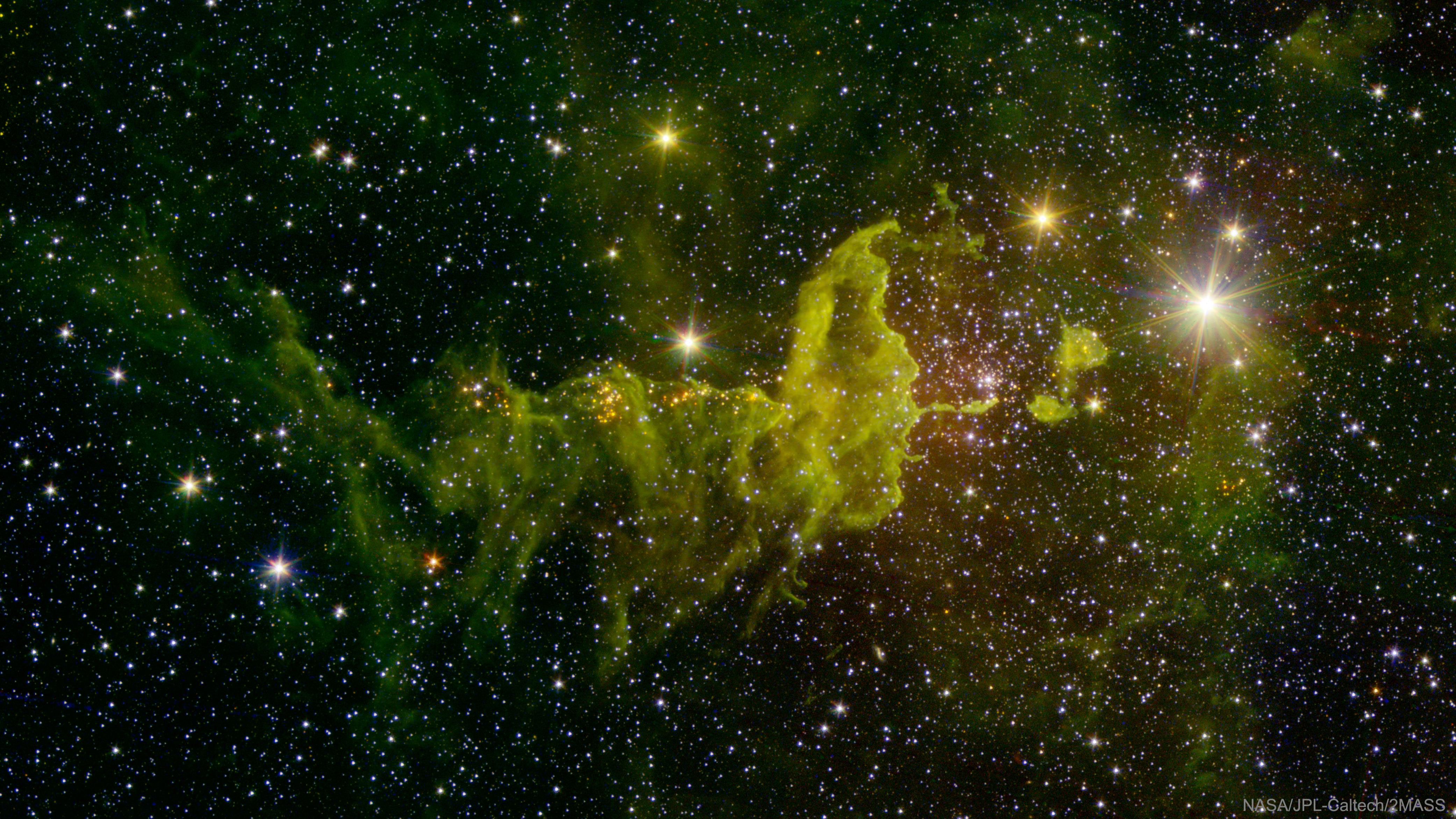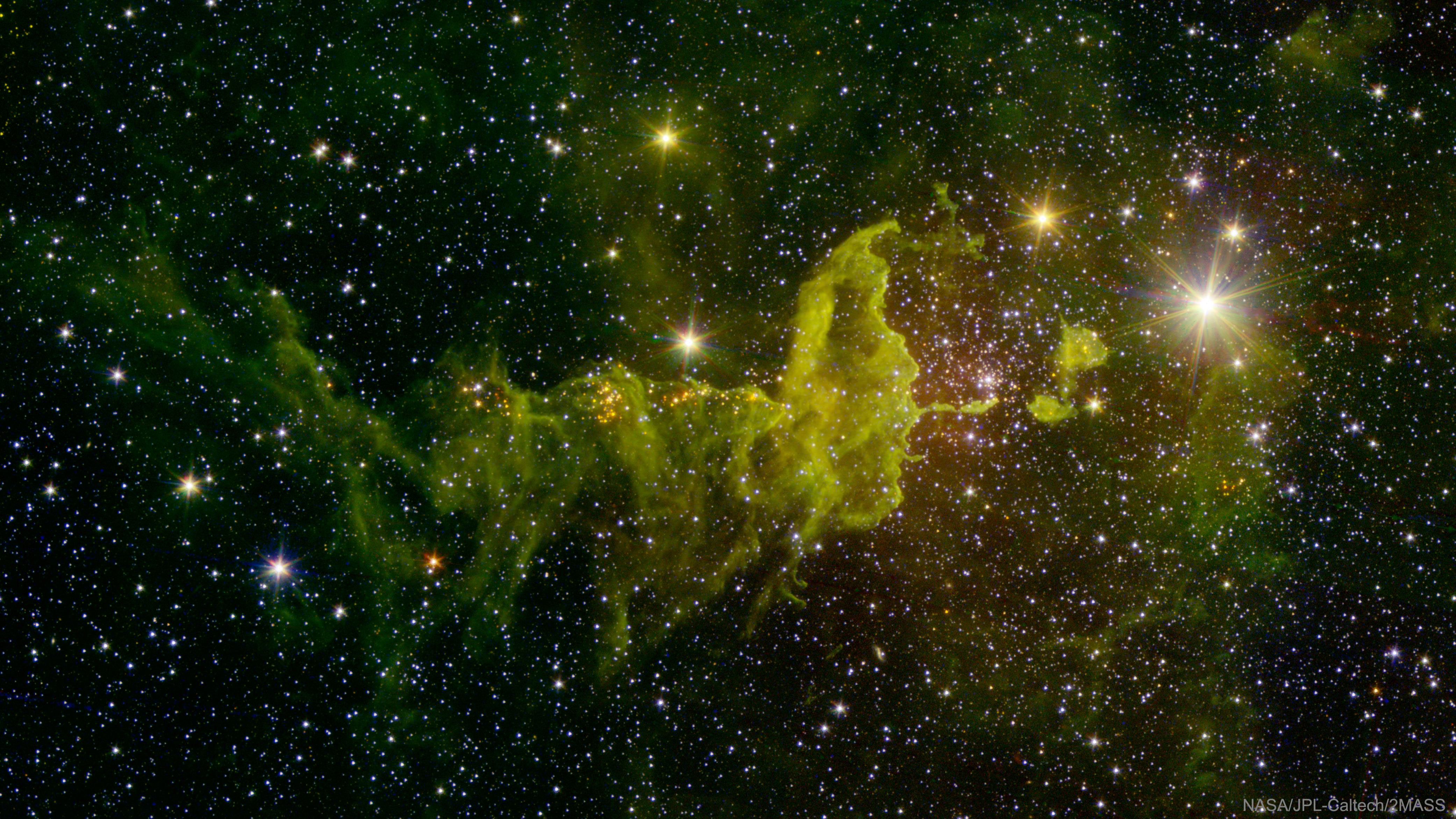
Will the spider ever catch the fly? Not if both are large emission nebulas toward the constellation of the Charioteer (Auriga). The spider-shaped gas cloud on the left is actually an emission nebula labelled IC 417, while a smaller fly-shaped cloud off the image to the left is dubbed NGC 1931 and is both an emission nebula and a reflection nebula. About 10,000 light-years distant, both nebulas harbor young, open star clusters. For scale, the more compact NGC 1931 (Fly) is about 10 light-years across. The featured picture in scientifically-assigned, infrared colors combines images from the Spitzer Space Telescope and the Two Micron All Sky Survey (2MASS). Spitzer is celebrating its 16th year orbiting the Sun near the Earth. APOD in other languages: Arabic, Catalan, Chinese (Beijing), Chinese (Taiwan), Croatian, Czech, Dutch, Farsi, French, French, German, Hebrew, Indonesian, Japanese, Korean, Montenegrin, Polish, Russian, Serbian, Slovenian, Spanish and Ukrainian
¿La araña alguna vez atrapará a la mosca? No si ambas son grandes nebulosas emisoras hacia la constelación del Chariotero (Auriga). La nube de gas con forma de araña a la izquierda es en realidad una nebulosa emisora etiquetada como IC 417, mientras que una nube más pequeña con forma de mosca fuera del borde izquierdo de la imagen se llama NGC 1931 y es tanto una nebulosa emisora como una nebulosa de reflexión. A unos 10 000 años luz de distancia, ambas nebulosas albergan jóvenes cúmulos de estrellas abiertos. Para dar escala, el más compacto NGC 1931 (la mosca) tiene aproximadamente 10 años luz de diámetro. La imagen destacada, con colores asignados científicamente en el infrarrojo, combina imágenes del telescopio espacial Spitzer y del Censo Infrarrojo de Todo el Cielo a Dos Micrones (2MASS). Spitzer celebra su 16º año orbitando el Sol cerca de la Tierra.