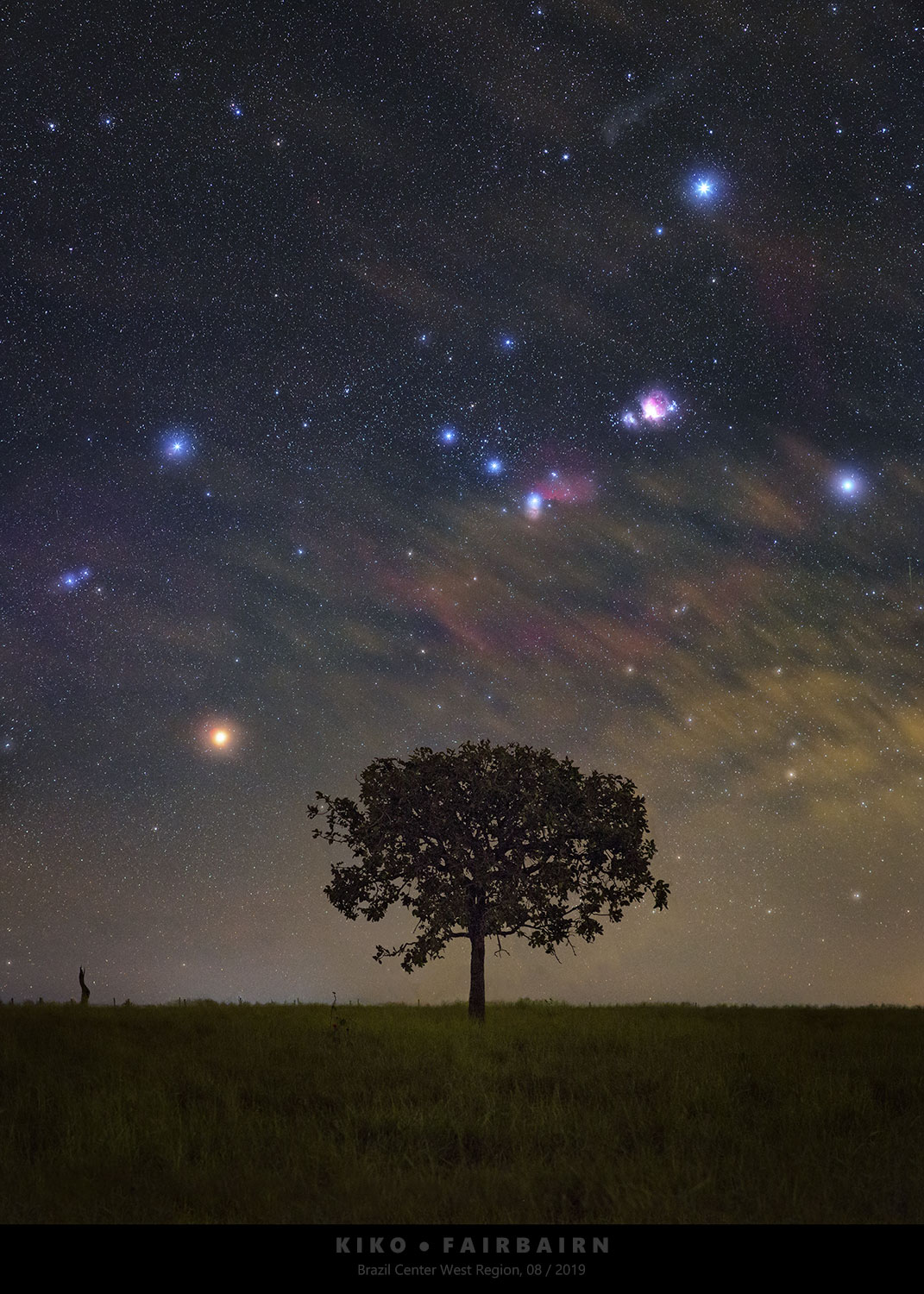
Have you seen Orion lately? The next few months will be the best for seeing this familiar constellation as it rises continually earlier in the night. However, Orion's stars and nebulas won't look quite as colorful to the eye as they do in this fantastic camera image. In the featured image, Orion was captured by camera showing its full colors last month over a Brazilian copal tree from Brazil's Central-West Region. Here the cool red giant Betelgeuse takes on a strong orange hue as the brightest star on the far left. Otherwise, Orion's hot blue stars are numerous, with supergiant Rigel balancing Betelgeuse at the upper right, Bellatrix at the upper left, and Saiph at the lower right. Lined up in Orion's belt (bottom to top) are Alnitak, Alnilam, and Mintaka all about 1,500 light-years away, born of the constellation's well studied interstellar clouds. And if a "star" toward the upper right Orion's sword looks reddish and fuzzy to you, it should. It's the stellar nursery known as the Great Nebula of Orion.
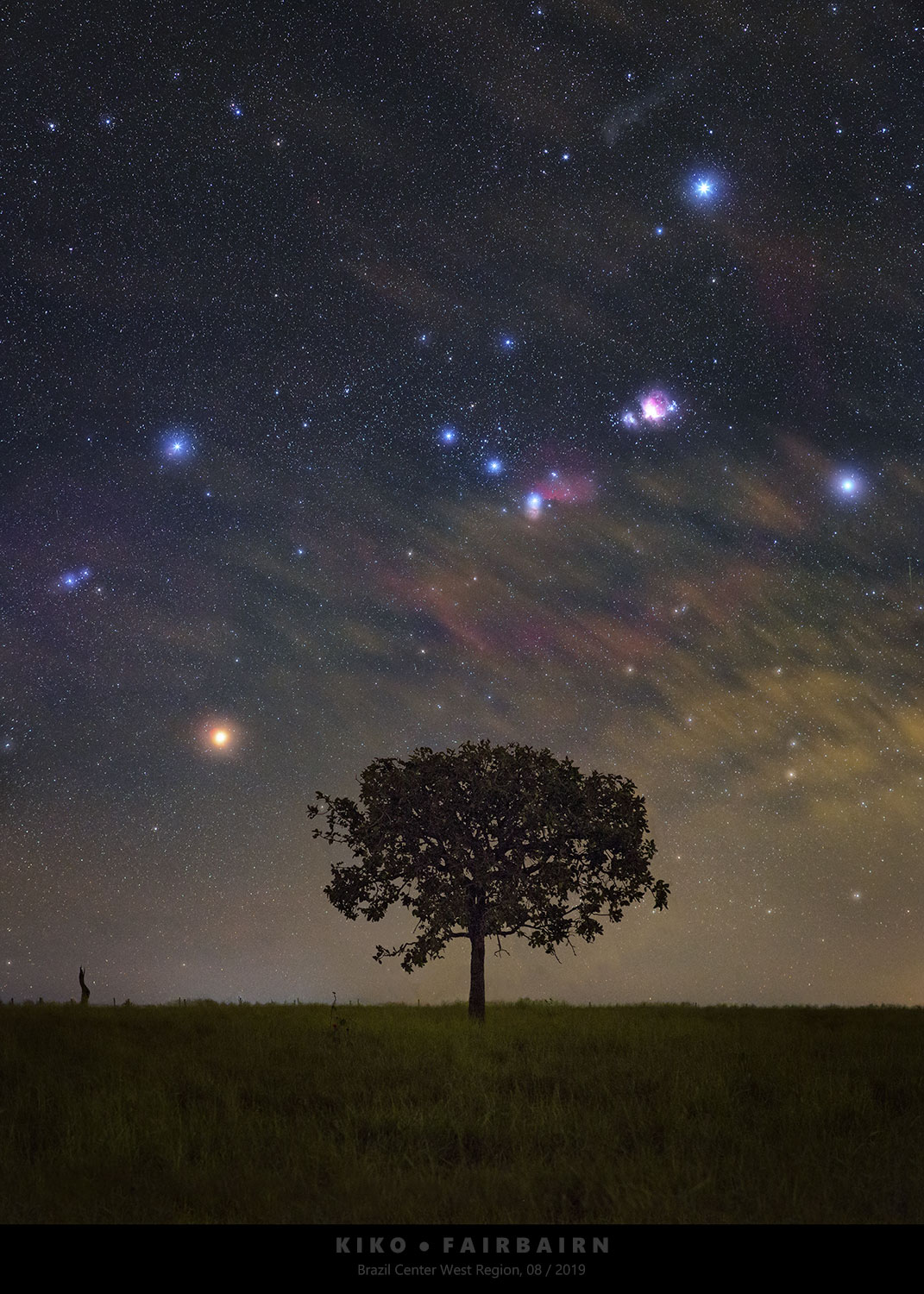
¿Has visto a Orión últimamente? Los próximos meses serán los mejores para observar esta familiar constelación, ya que se levanta cada vez más temprano durante la noche. Sin embargo, las estrellas y nebulosas de Orión no lucirán tan coloridas a simple vista como en esta asombrosa imagen capturada por una cámara. En la imagen destacada, Orión fue capturada por una cámara mostrando sus colores completos el mes pasado sobre un árbol de copal brasileño en la región centro-oeste de Brasil. Aquí, la gigante roja fría Betelgeuse adquiere un fuerte tono naranja como la estrella más brillante en el extremo izquierdo. Por otro lado, las estrellas calientes y azules de Orión son numerosas, con la supergigante Rigel equilibrando a Betelgeuse en la parte superior derecha, Bellatrix en la parte superior izquierda y Saiph en la parte inferior derecha. Alineadas en la cintura de Orión (de abajo hacia arriba) se encuentran Alnitak, Alnilam y Mintaka, todas a unos 1.500 años luz de distancia, nacidas de las bien estudiadas nubes interestelares de la constelación. Y si una "estrella" hacia la parte superior derecha de la espada de Orión te parece rojiza y borrosa, debería. Es el lugar de nacimiento estelar conocido como la Gran Nebulosa de Orión.