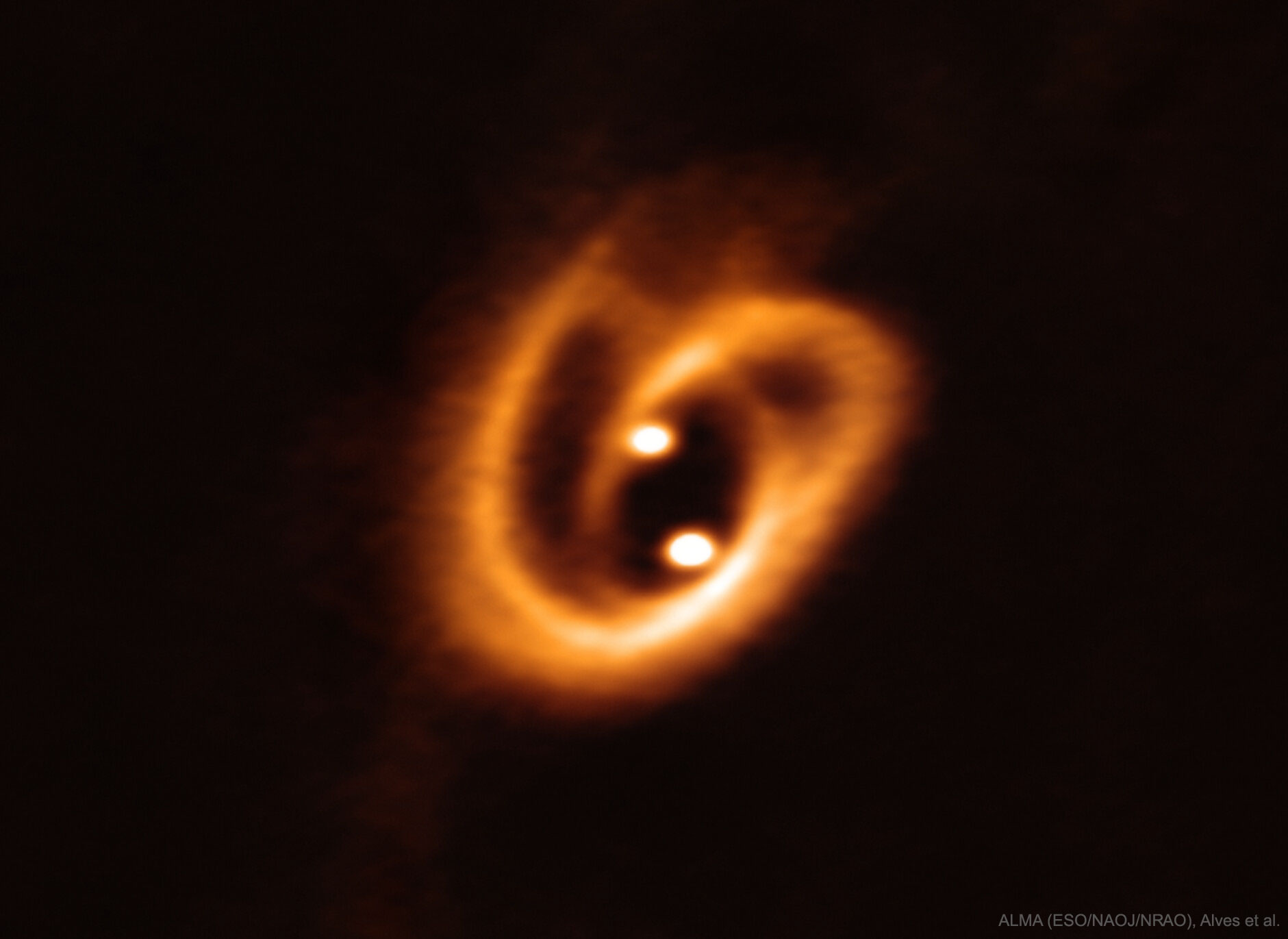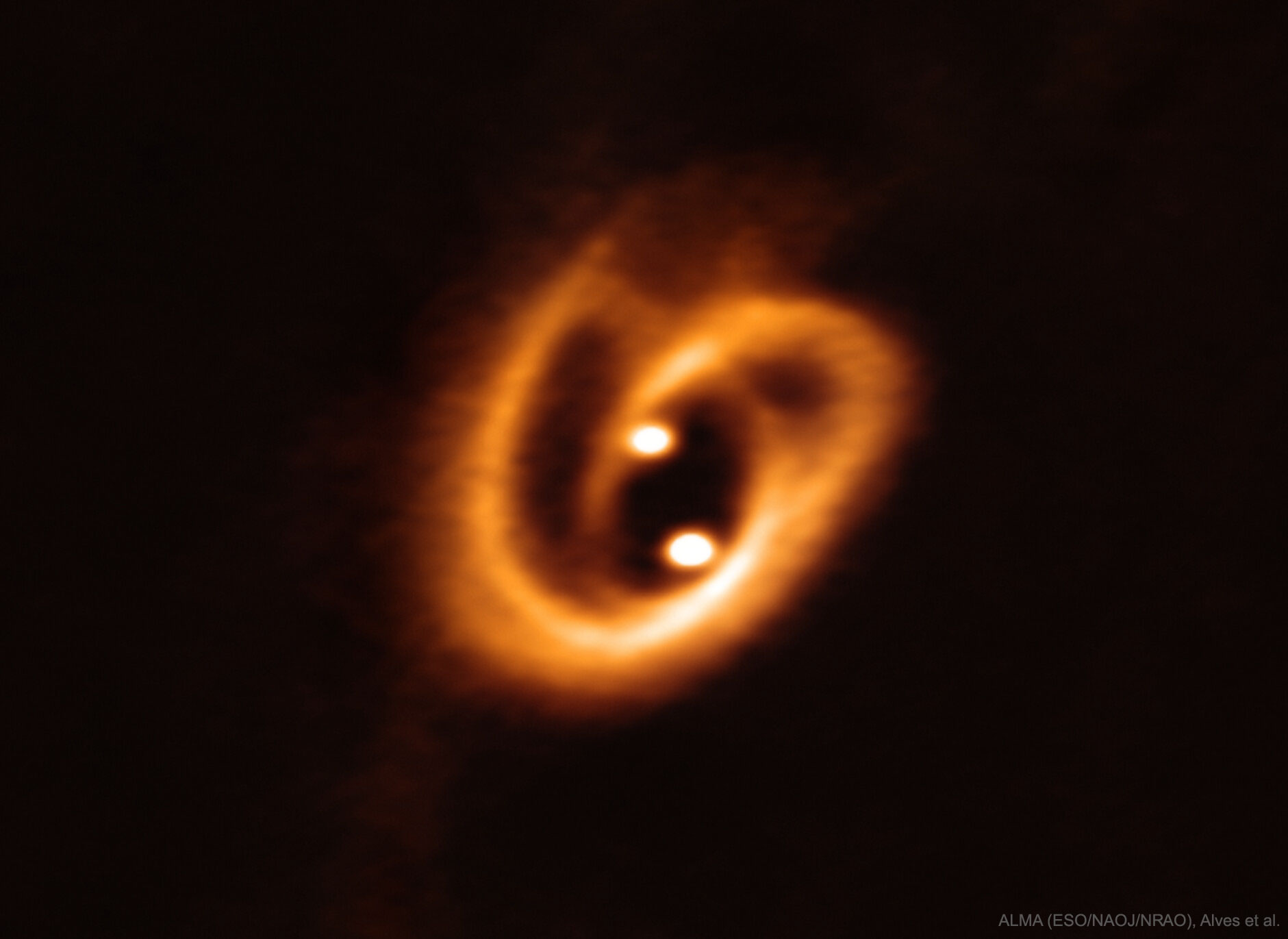
How do binary stars form? To help find out, the Atacama Large Millimeter Array (ALMA) recently captured one of the highest resolution images yet taken of a binary star system in formation. Most stars are not alone -- they typically form as part of a multiple star systems where star each orbits a common center of gravity. The two bright spots in the featured image are small disks that surround the forming proto-stars in [BHB2007] 11, while the surrounding pretzel-shaped filaments are gas and dust that have been gravitationally pulled from a larger disk. The circumstellar filaments span roughly the radius of the orbit of Neptune. The BHB2007 system is a small part of the Pipe Nebula (also known as Barnard 59), a photogenic network of dust and gas that protrudes from Milky Way's spiral disk in the constellation of Ophiuchus. The binary star formation process should be complete within a few million years.
¿Cómo se forman las estrellas binarias? Para ayudar a descubrirlo, el Atacama Large Millimeter Array (ALMA) recientemente capturó una de las imágenes de mayor resolución tomadas hasta ahora de un sistema de estrellas binarias en formación. La mayoría de las estrellas no están solas; típicamente se forman como parte de sistemas de múltiples estrellas, donde cada una orbita un centro común de gravedad. Los dos puntos brillantes en la imagen destacada son discos pequeños que rodean las protoestrellas en formación en [BHB2007] 11, mientras que los filamentos en forma de pretzel que las rodean son gas y polvo que han sido atraídos gravitacionalmente desde un disco más grande. Los filamentos circunestelares abarcan aproximadamente el radio de la órbita de Neptuno. El sistema BHB2007 es una pequeña parte de la Nebulosa Pipe (también conocida como Barnard 59), una red fotogénica de polvo y gas que se proyecta desde el disco espiral de la Vía Láctea en la constelación de Ofiuco. El proceso de formación de la estrella binaria debería completarse dentro de unos pocos millones de años.