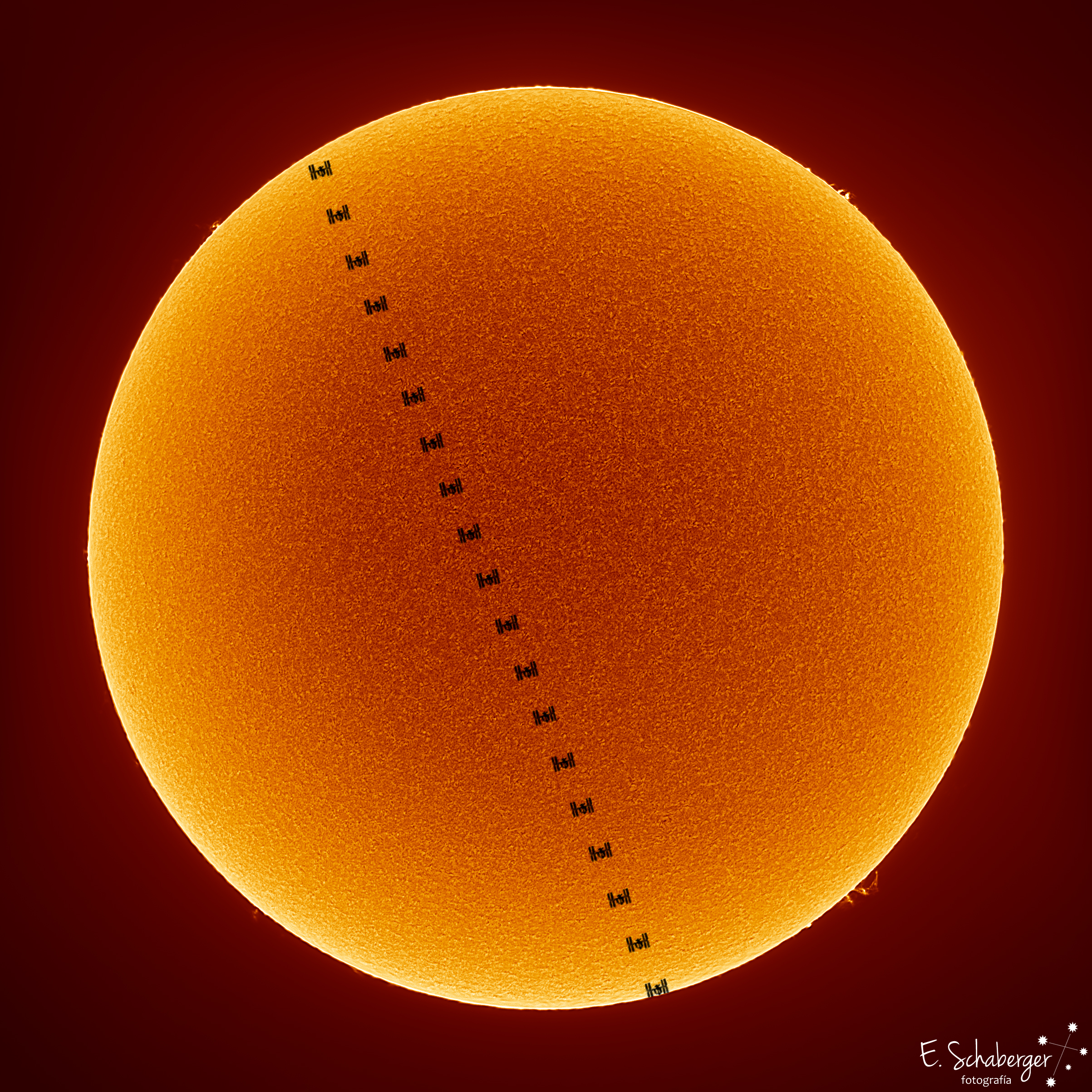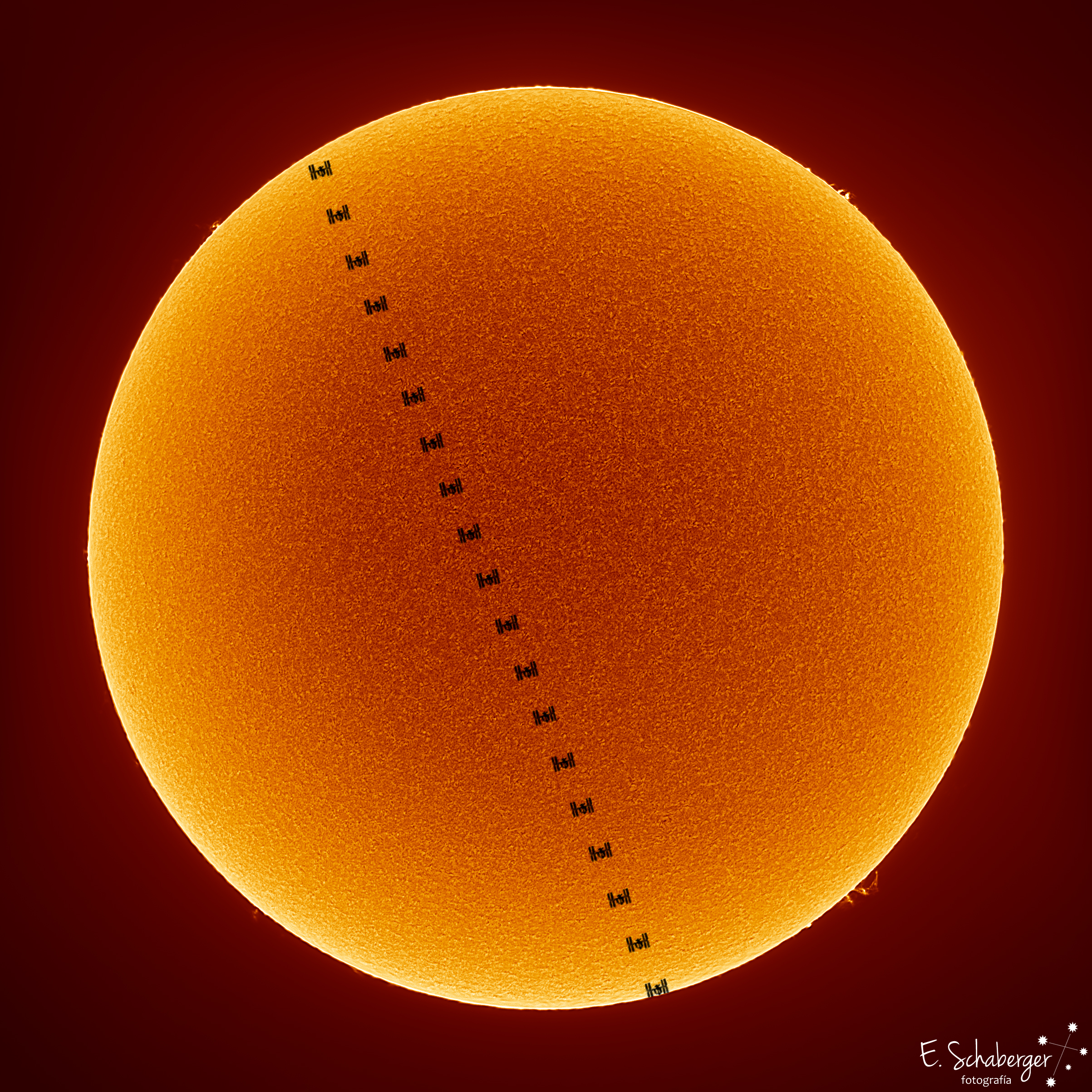
Typically, the International Space Station is visible only at night. Slowly drifting across the night sky as it orbits the Earth, the International Space Station (ISS) can be seen as a bright spot about once a month from many locations. The ISS is then visible only just after sunset or just before sunrise because it shines by reflected sunlight -- once the ISS enters the Earth's shadow, it will drop out of sight. The only occasion when the ISS is visible during the day is when it passes right in front of the Sun. Then, it passes so quickly that only cameras taking short exposures can visually freeze the ISS's silhouette onto the background Sun. The featured picture did exactly that -- it is actually a series of images taken a month ago from Santa Fe, Argentina with perfect timing. This image series was later combined with a separate image highlighting the texture of the spotless Sun, and an image bringing up the Sun's prominences around the edge. At an unusually low Solar Minimum, the Sun has gone without sunspots now for most of 2019. Follow APOD in English on: Instagram, Facebook, Reddit, or Twitter
Típicamente, la Estación Espacial Internacional es visible solo de noche. Mientras gira lentamente por el cielo nocturno al orbitar la Tierra, la Estación Espacial Internacional (ISS) puede verse como un punto brillante aproximadamente una vez al mes desde muchas localidades. La ISS solo es visible justo después de la puesta de sol o justo antes del amanecer, ya que brilla por la luz solar reflejada — una vez que la ISS entra en la sombra de la Tierra, desaparece de la vista. El único momento en que la ISS es visible durante el día es cuando pasa justo frente al Sol. Entonces, pasa tan rápidamente que solo las cámaras que toman exposiciones cortas pueden congelar visualmente la silueta de la ISS sobre el fondo del Sol. La imagen destacada hizo exactamente eso — es en realidad una serie de imágenes tomadas hace un mes desde Santa Fe, Argentina, con un tiempo perfecto. Esta serie de imágenes se combinó posteriormente con una imagen separada que resalta la textura del Sol sin manchas, y una imagen que muestra las prominencias solares alrededor del borde. En un mínimo solar inusualmente bajo, el Sol ha estado sin manchas solares durante la mayor parte de 2019.