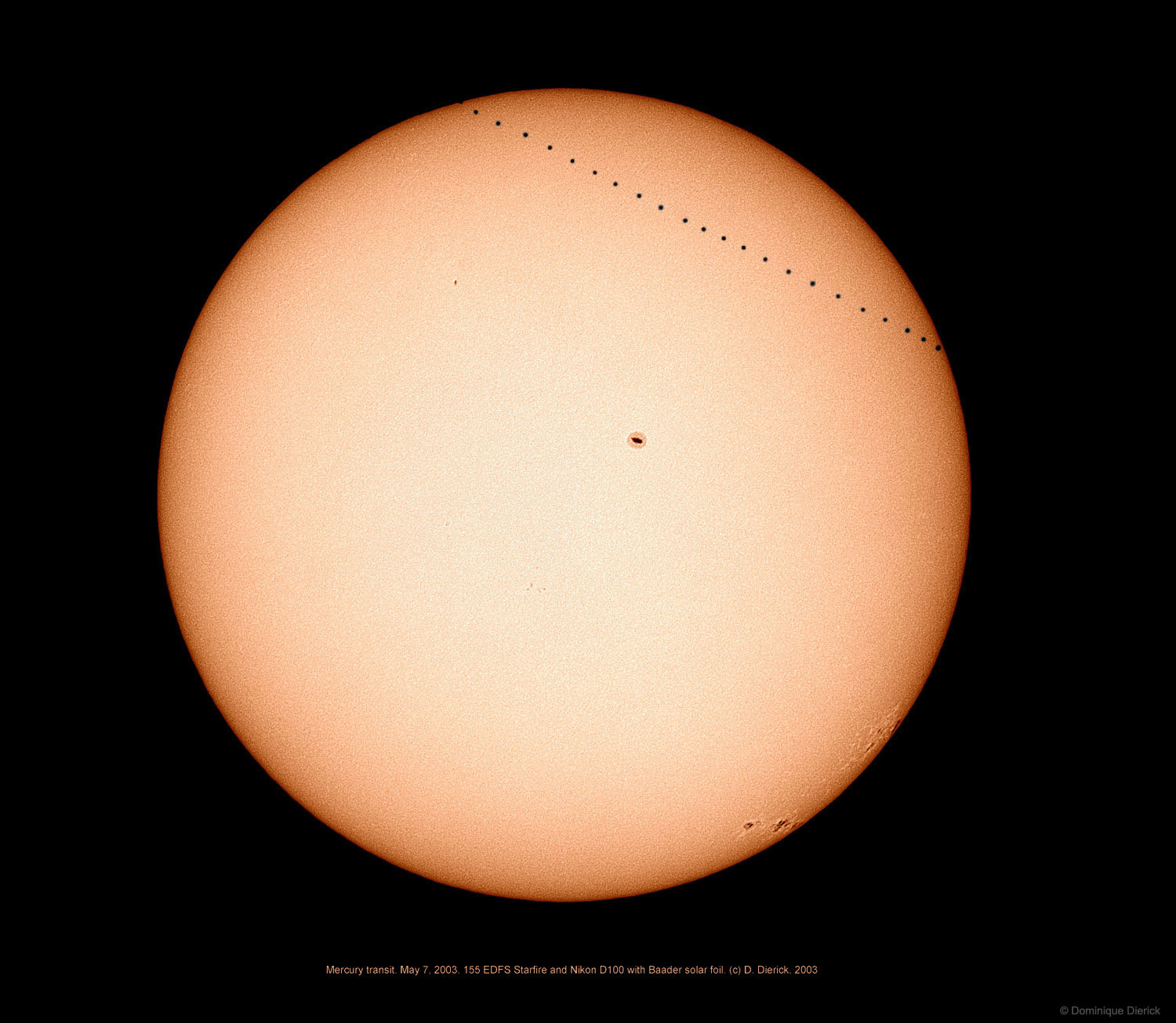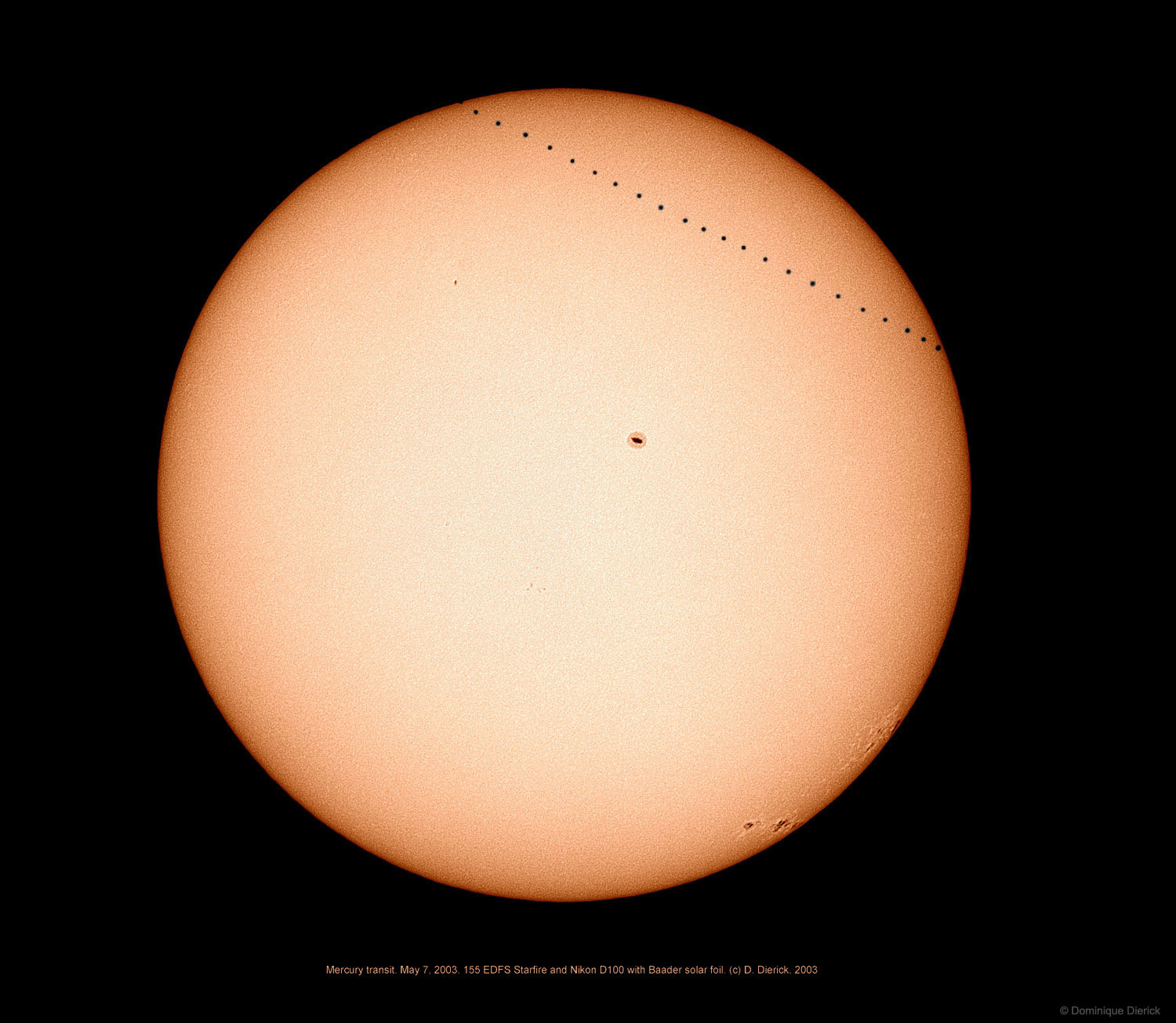
Tomorrow -- Monday -- Mercury will cross the face of the Sun, as seen from Earth. Called a transit, the last time this happened was in 2016. Because the plane of Mercury's orbit is not exactly coincident with the plane of Earth's orbit, Mercury usually appears to pass over or under the Sun. The featured time-lapse sequence, superimposed on a single frame, was taken from a balcony in Belgium shows the entire transit of 2003 May 7. That solar crossing lasted over five hours, so that the above 23 images were taken roughly 15 minutes apart. The north pole of the Sun, the Earth's orbit, and Mercury's orbit, although all different, all occur in directions slightly above the left of the image. Near the center and on the far right, sunspots are visible. After Monday, the next transit of Mercury will occur in 2032. Watch: the November 11 Transit of Mercury from Earth or from Space.
Crédito: NASA, CGRO SSC El próximo lunes, Mercurio cruzará la cara del Sol, visto desde la Tierra. Llamado un tránsito, la última vez que esto ocurrió fue en 2016. Debido a que el plano de la órbita de Mercurio no coincide exactamente con el plano de la órbita terrestre, Mercurio suele parecer que pasa por encima o por debajo del Sol. La secuencia de tiempo acelerado mostrada, superpuesta en un solo fotograma, tomada desde un balcón en Bélgica, muestra todo el tránsito del 7 de mayo de 2003. Ese cruce solar duró más de cinco horas, por lo que las 23 imágenes anteriores se tomaron aproximadamente cada 15 minutos. El polo norte del Sol, la órbita terrestre y la órbita de Mercurio, aunque todos diferentes, ocurren en direcciones ligeramente por encima de la izquierda de la imagen. Cerca del centro y en el extremo derecho, se ven manchas solares. Después del lunes, el próximo tránsito de Mercurio ocurrirá en 2032.