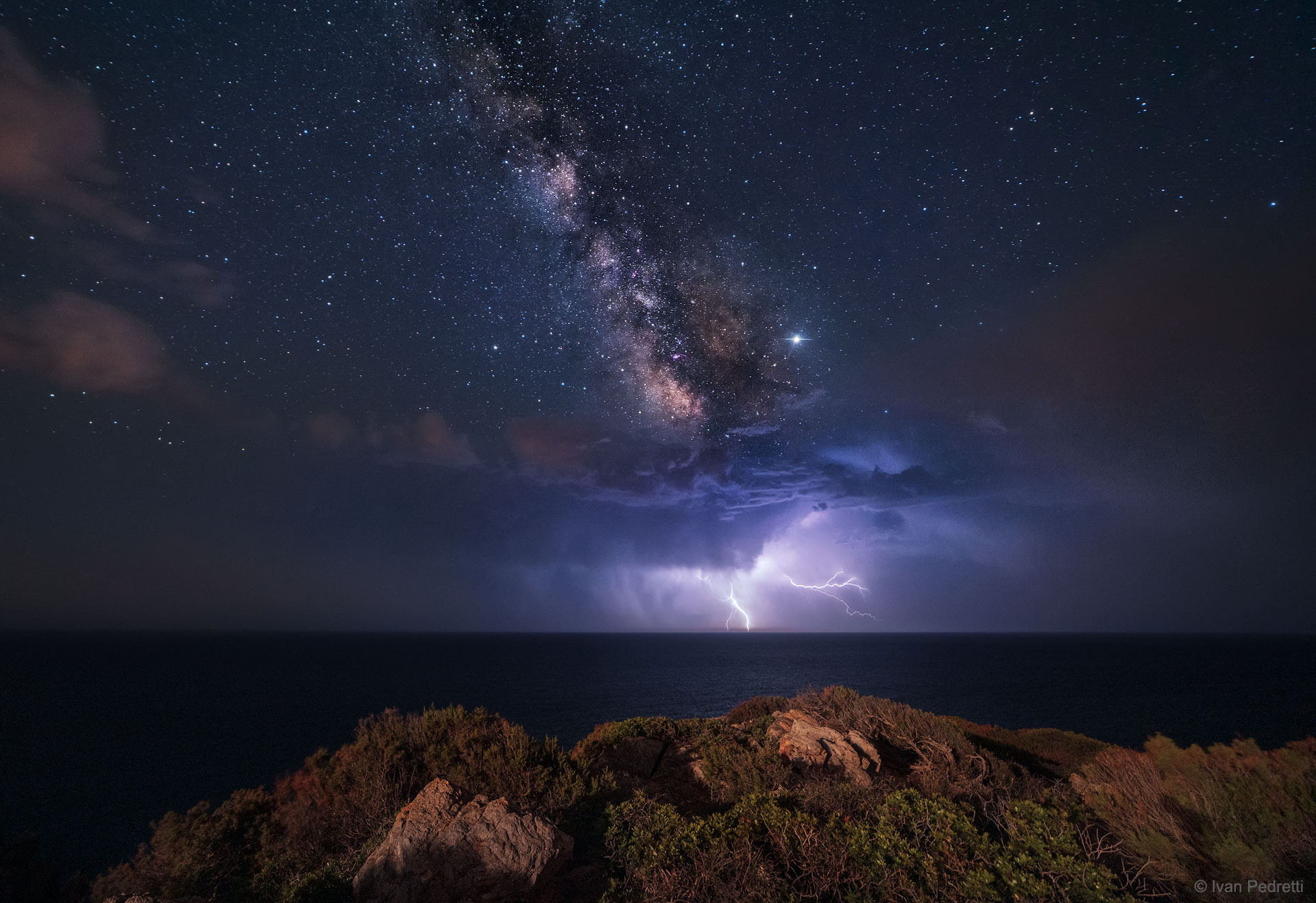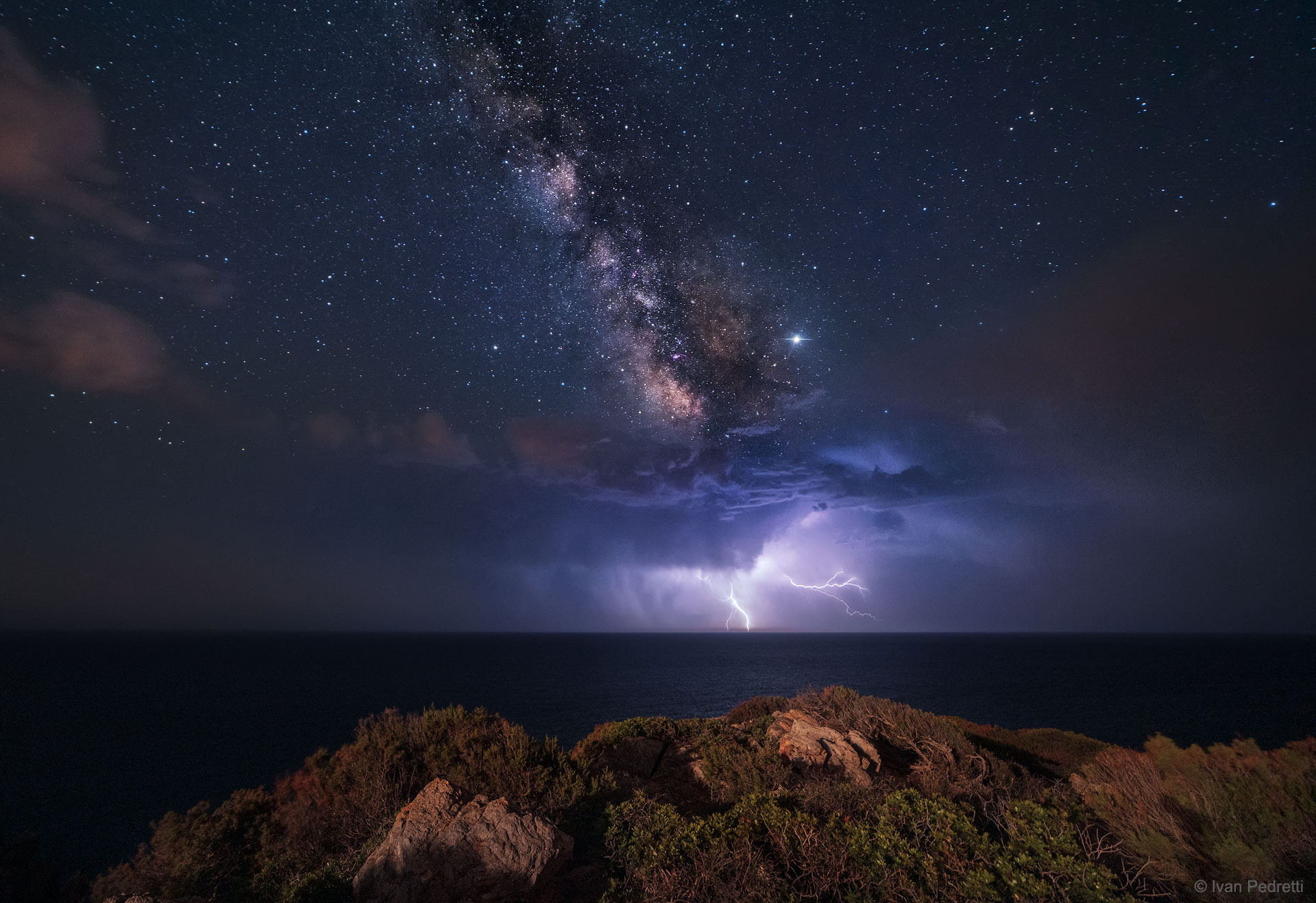
It may appear, at first, like the Galaxy is producing the lightning, but really it's the Earth. The featured nighttime landscape was taken from a southern tip of the Italian Island of Sardinia in early June. The foreground rocks and shrubs are near the famous Capo Spartivento Lighthouse, and the camera is pointed south toward Algeria in Africa. In the distance, across the Mediterranean Sea, a thunderstorm is threatening, with several electric lightning strokes caught together during this 25-second wide-angle exposure. Much farther in the distance, strewn about the sky, are hundreds of stars in the neighborhood of our Sun in the Milky Way Galaxy. Farthest away, and slanting down from the upper left, are billions of stars that together compose the central band of our Milky Way. Free Lecture: APOD editor to speak in NYC on January 3
Crédito: NASA, APOD Puede parecer, a primera vista, que la Galaxia es la que produce el relámpago, pero en realidad es la Tierra. El paisaje nocturno mostrado fue tomado desde el extremo sur de la isla italiana de Cerdeña a principios de junio. Las rocas y arbustos del primer plano se encuentran cerca del famoso faro de Capo Spartivento, y la cámara está orientada hacia el sur, hacia Argelia en África. En la distancia, a través del mar Mediterráneo, una tormenta eléctrica amenaza, con varios relámpagos capturados juntos durante esta exposición de 25 segundos con ángulo amplio. Mucho más lejos, esparcidas por el cielo, se encuentran cientos de estrellas en el entorno de nuestro Sol en la Vía Láctea. Más allá, y extendiéndose desde la esquina superior izquierda, se encuentran miles de millones de estrellas que juntas componen la banda central de nuestra Vía Láctea.