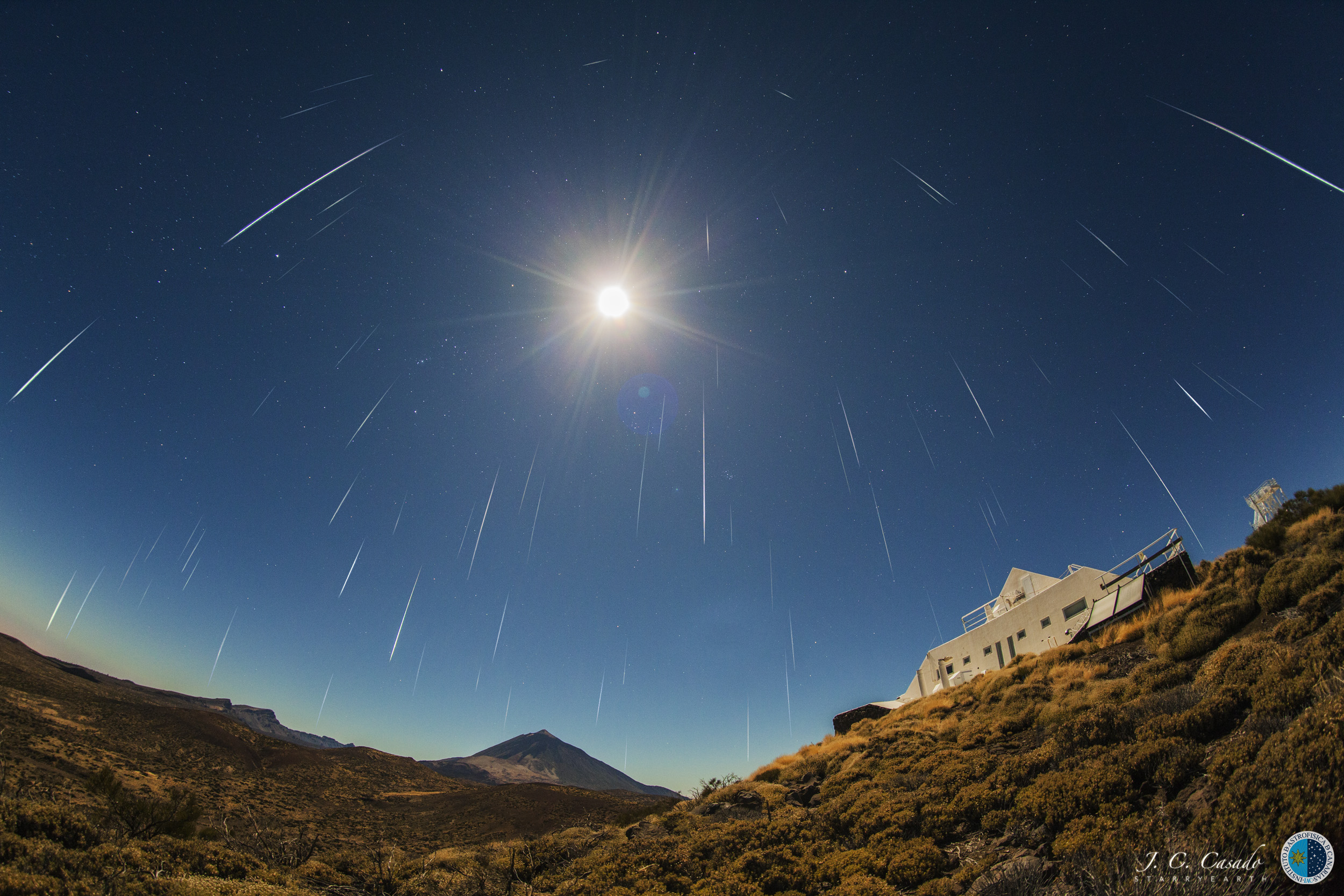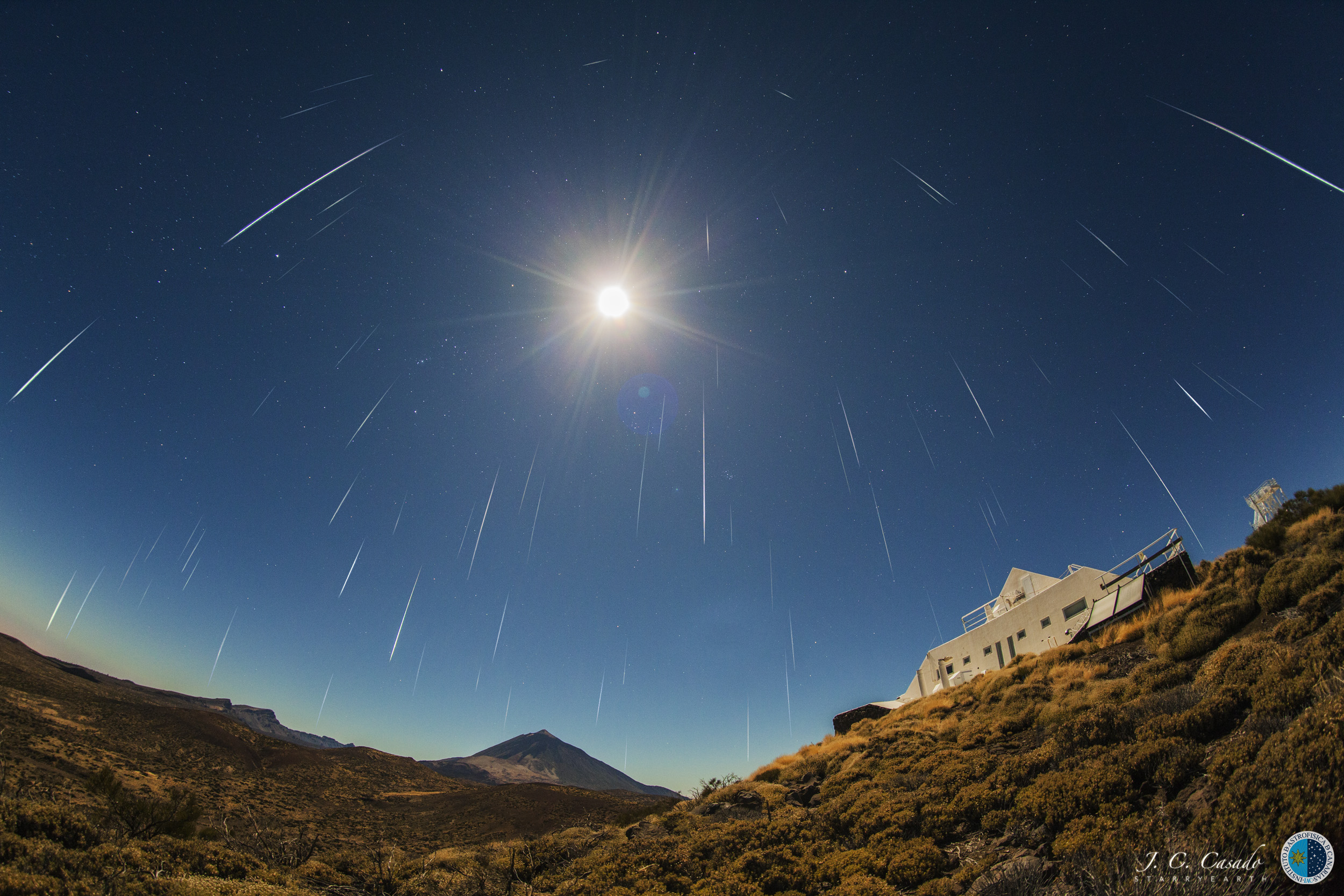
The dependable annual Geminid meteor shower will be near its peak tonight (December 13/14) and before tomorrow's dawn. As Earth crosses through the dusty trail of active asteroid 3200 Phaethon the meteors will flash through the sky from the shower's radiant in Gemini. Gemini will be pretty easy for skygazers to find too as it won't be far from a nearly full waning gibbous Moon. You don't have look at the shower's radiant to see meteors though. The almost full moonlight won't hide the brightest of the Geminids from view either, but it will substantially reduce the rate of visible meteors for those who are counting. In fact, the 2019 Geminids should look a lot like the 2016 meteor shower. This composite image from the 2016 Geminids aligns individual short exposures to capture many of the brighter Geminid meteors, inspite of a Full Moon shining near the constellation of the Twins. Along the horizon are the Teide Observatory's Solar Laboratory (right) and the Teide volcano on the Canary Island of Tenerife.
La confiable lluvia anual de meteoros Geminidas alcanzará su máximo esta noche (13/14 de diciembre) y antes del amanecer de mañana. Mientras la Tierra cruza por el rastro polvoriento del asteroide activo 3200 Phaethon, los meteoros brillarán en el cielo desde el radiante de la lluvia en la constelación de Géminis. Géminis también será bastante fácil de localizar para los observadores, ya que no estará muy lejos de una Luna menguante casi llena. No es necesario mirar directamente al radiante de la lluvia para ver los meteoros. La luz casi plena de la Luna no ocultará los meteoros más brillantes de las Geminidas, pero sí reducirá considerablemente la tasa de meteoros visibles para quienes los cuentan. De hecho, las Geminidas de 2019 deberían verse muy similares a la lluvia de meteoros de 2016. Esta imagen compuesta de las Geminidas de 2016 alinea exposiciones cortas individuales para capturar muchos de los meteoros más brillantes de las Geminidas, a pesar de que una Luna Llena brillaba cerca de la constelación de los Gemelos. A lo largo del horizonte se encuentran el Laboratorio Solar del Observatorio del Teide (a la derecha) y el volcán del Teide en la isla canaria de Tenerife.