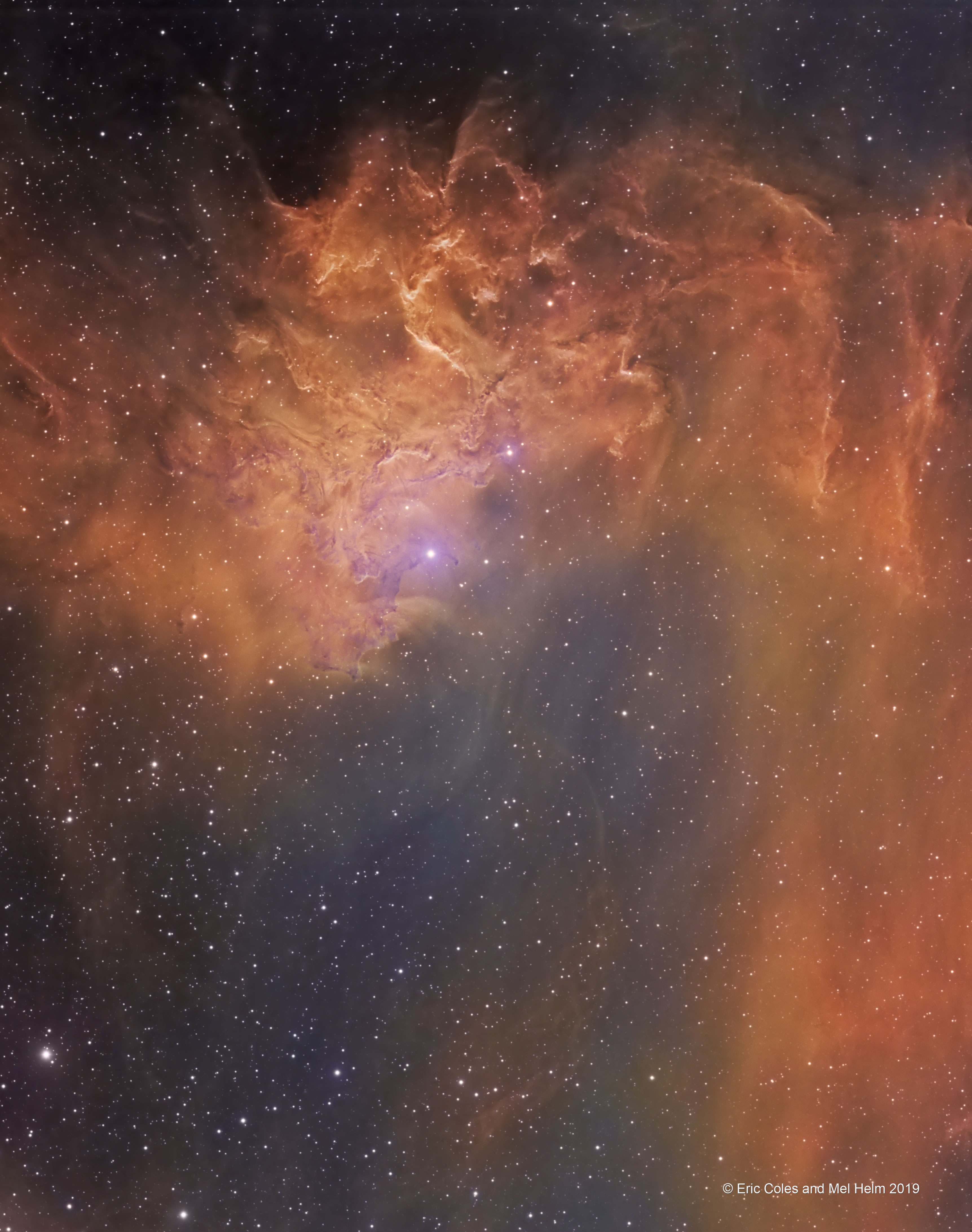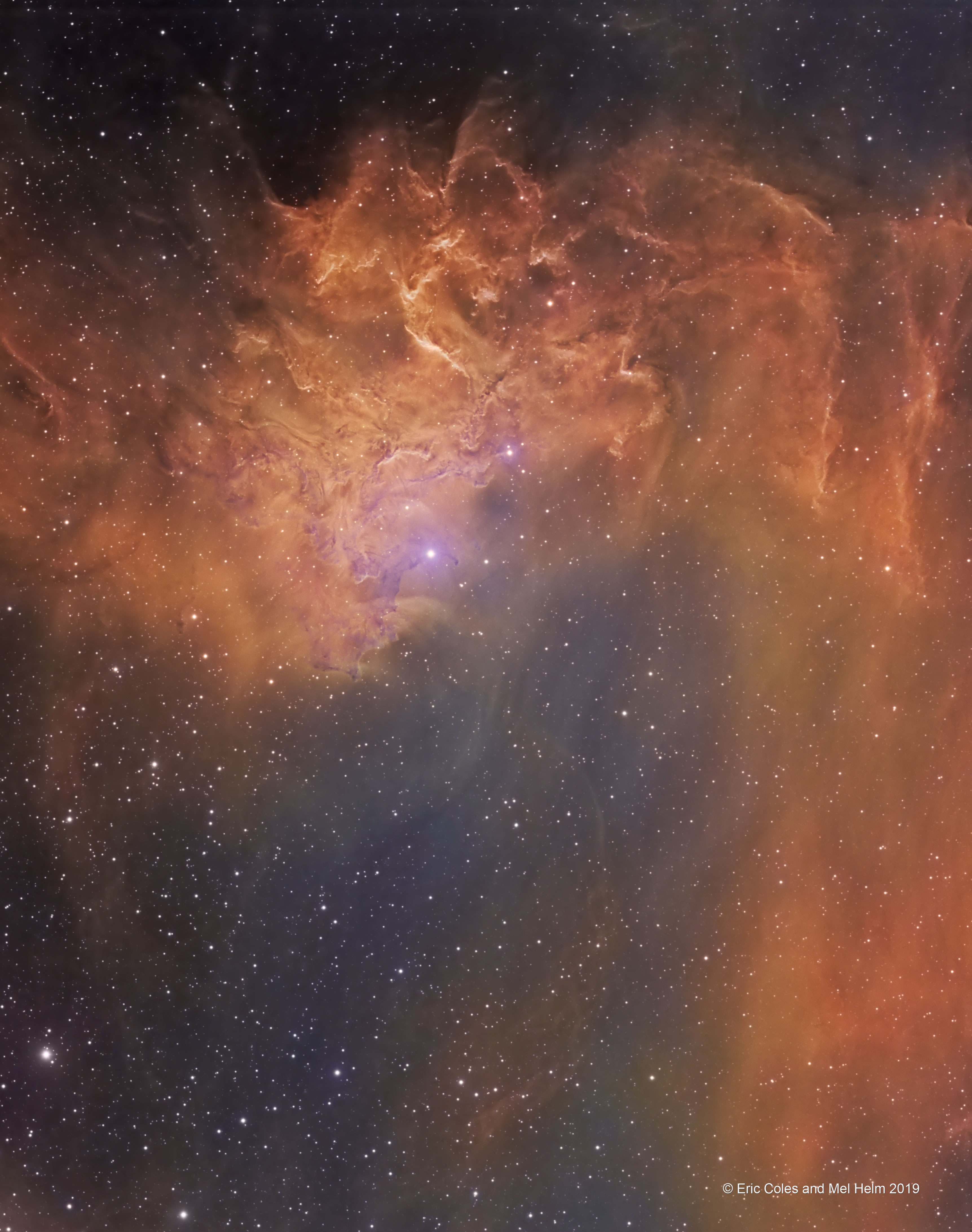
Rippling dust and gas lanes give the Flaming Star Nebula its name. The orange and purple colors of the nebula are present in different regions and are created by different processes. The bright star AE Aurigae, visible toward the image left, is so hot it is blue, emitting light so energetic it knocks electrons away from surrounding gas. When a proton recaptures an electron, red light is frequently emitted (depicted here in orange). The purple region's color is a mix of this red light and blue light emitted by AE Aurigae but reflected to us by surrounding dust. The two regions are referred to as emission nebula and reflection nebula, respectively. Pictured here in the Hubble color palette, the Flaming Star Nebula, officially known as IC 405, lies about 1500 light years distant, spans about 5 light years, and is visible with a small telescope toward the constellation of the Charioteer (Auriga).
Las vías de polvo y gas ondulantes le dan su nombre a la Nebulosa de la Estrella Flameante. Los colores naranja y púrpura de la nebulosa aparecen en diferentes regiones y son creados por procesos distintos. La estrella brillante AE Aurigae, visible hacia la izquierda de la imagen, es tan caliente que es de color azul, emitiendo luz tan energética que arranca electrones del gas circundante. Cuando un protón recaptura un electrón, con frecuencia se emite luz roja (representada aquí en naranja). El color de la región púrpura es una mezcla de esta luz roja y la luz azul emitida por AE Aurigae, pero reflejada hacia nosotros por el polvo circundante. Estas dos regiones se conocen respectivamente como nebulosa de emisión y nebulosa de reflexión. En la paleta de colores de Hubble, la Nebulosa de la Estrella Flameante, oficialmente conocida como IC 405, se encuentra a unos 1500 años luz de distancia, abarca aproximadamente 5 años luz y es visible con un telescopio pequeño hacia la constelación del Chariotero (Auriga).