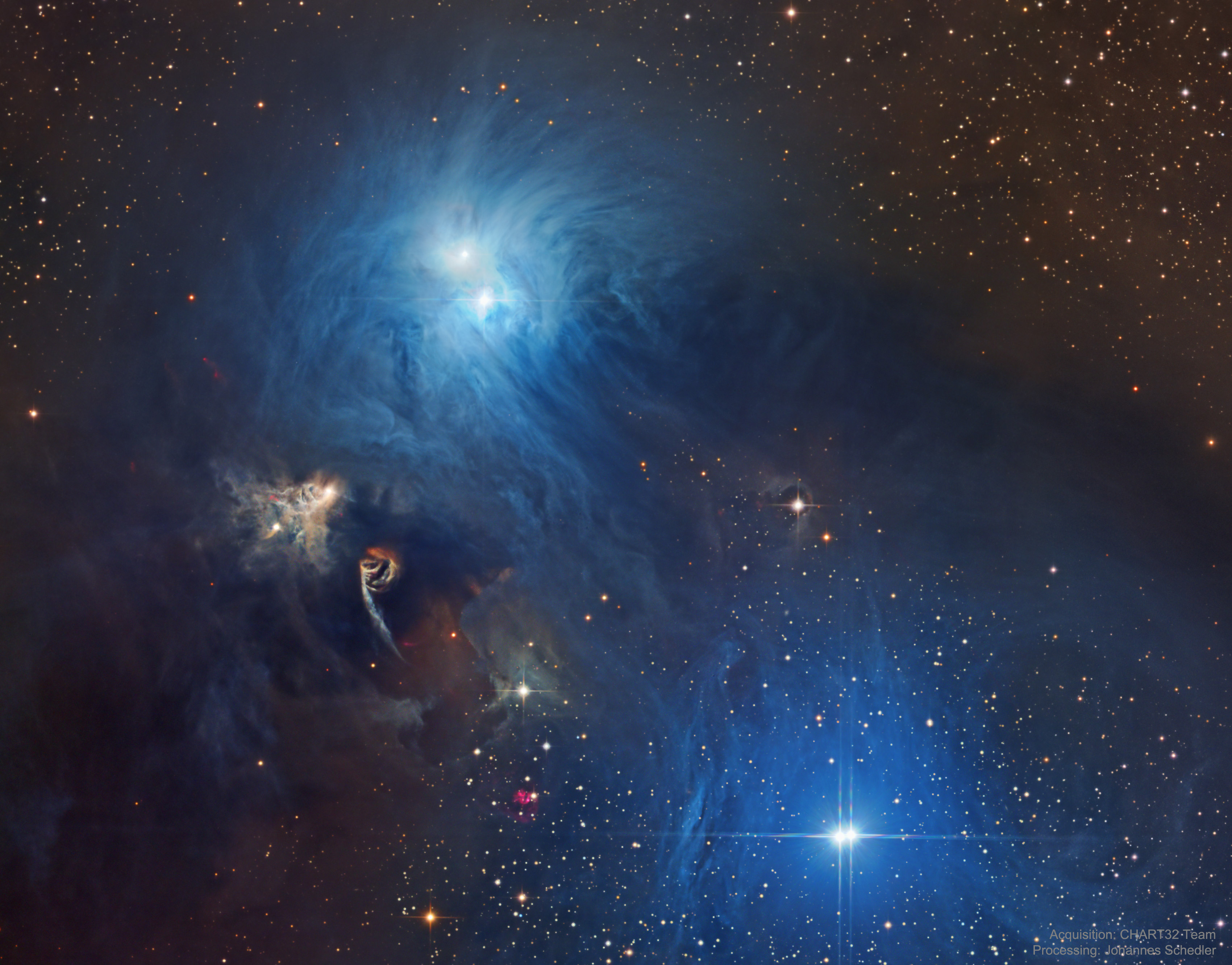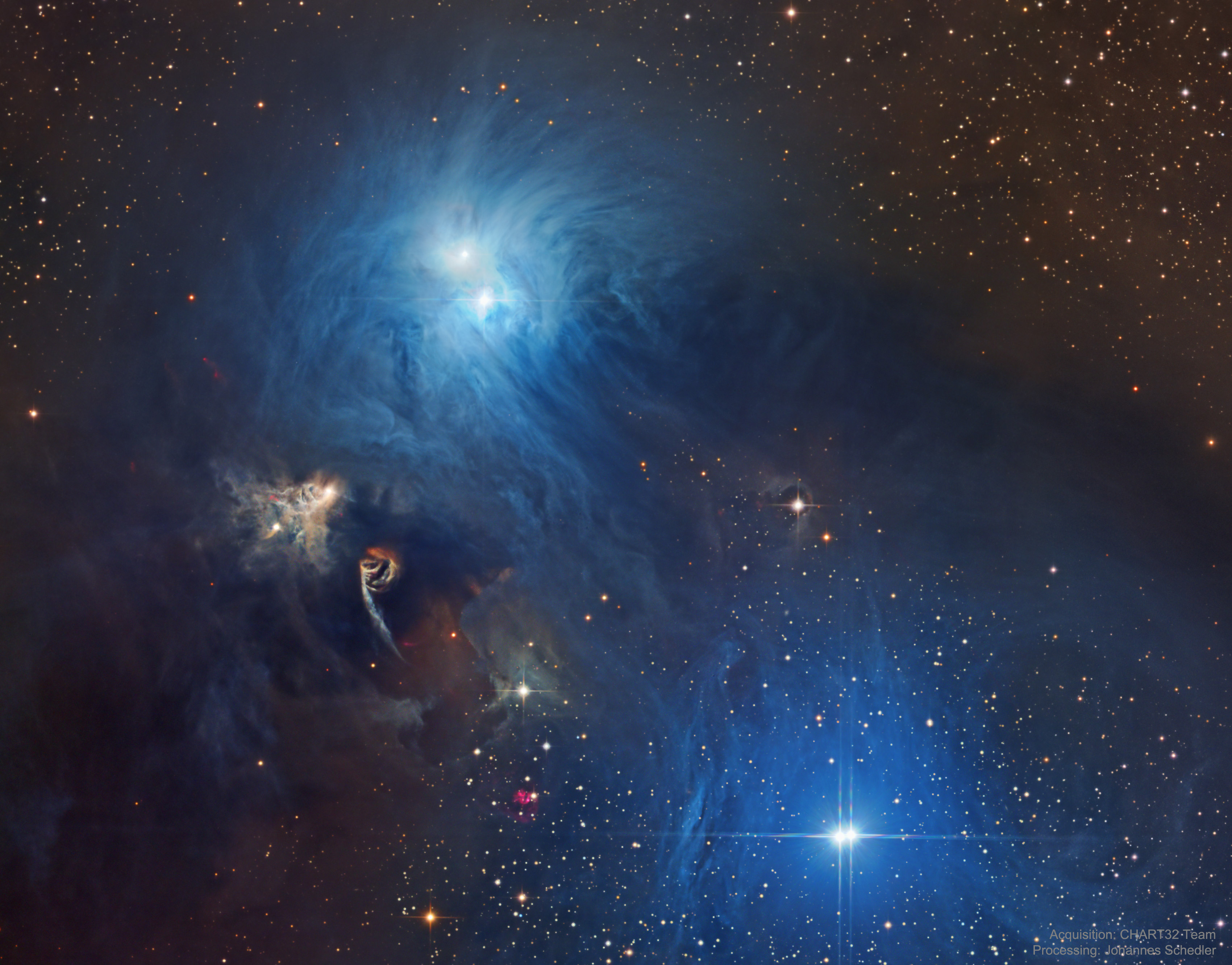
Cosmic dust clouds and young, energetic stars inhabit this telescopic vista, less than 500 light-years away toward the northern boundary of Corona Australis, the Southern Crown. The dust clouds effectively block light from more distant background stars in the Milky Way. But the striking complex of reflection nebulae cataloged as NGC 6726, 6727, and IC 4812 produce a characteristic blue color as light from the region's young hot stars is reflected by the cosmic dust. The dust also obscures from view stars still in the process of formation. At the left, smaller yellowish nebula NGC 6729 bends around young variable star R Coronae Australis. Just below it, glowing arcs and loops shocked by outflows from embedded newborn stars are identified as Herbig-Haro objects. On the sky this field of view spans about 1 degree. That corresponds to almost 9 light-years at the estimated distance of the nearby star forming region. Video: Best of APOD 2019 for the Night Sky Network
Nubes de polvo cósmico y estrellas jóvenes y energéticas habitan esta vista obtenida con telescopio, a menos de 500 años luz de distancia, hacia el límite norte de Corona Australis, la Corona Austral. Las nubes de polvo bloquean eficazmente la luz de estrellas de fondo más distantes de la Vía Láctea. Pero el complejo de nebulosas de reflexión catalogadas como NGC 6726, 6727 y IC 4812 producen un color azul característico, ya que la luz de las estrellas jóvenes y calientes de la región es reflejada por el polvo cósmico. El polvo también oculta estrellas aún en proceso de formación. A la izquierda, la nebulosa más pequeña y amarillenta NGC 6729 se curva alrededor de la joven estrella variable R Coronae Australis. Justo debajo, arcos y bucles luminosos impactados por vientos eyectados de estrellas recién nacidas se identifican como objetos Herbig-Haro. En el cielo, este campo de visión abarca aproximadamente 1 grado. Eso corresponde a casi 9 años luz a la distancia estimada de la región cercana de formación estelar.