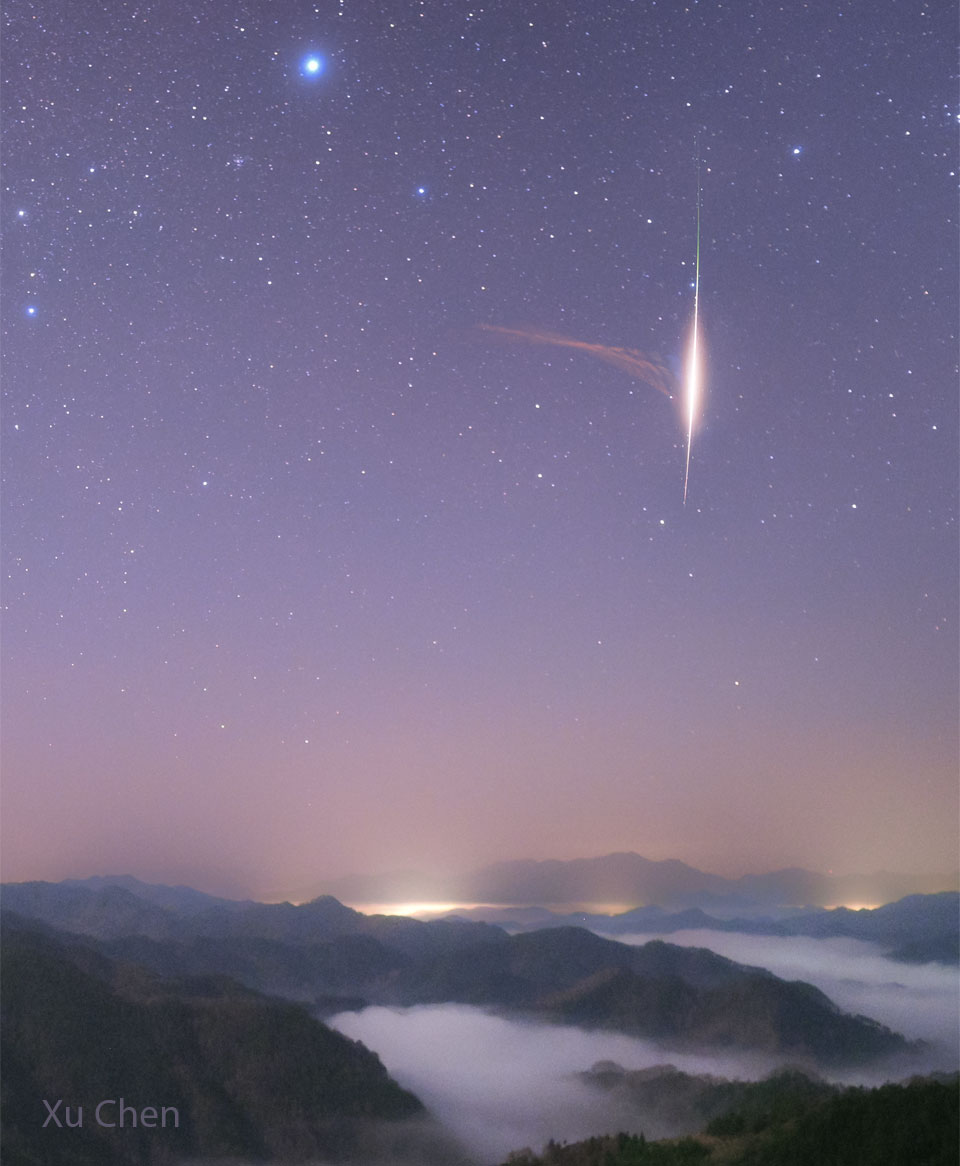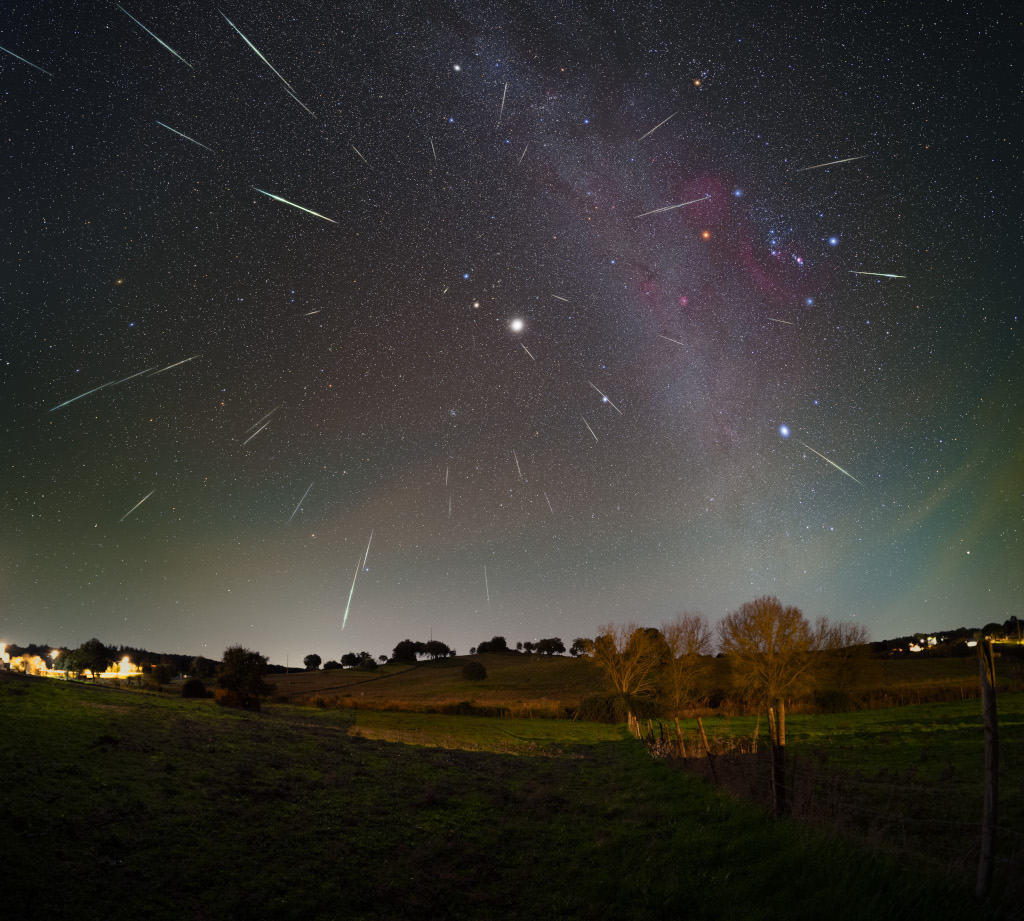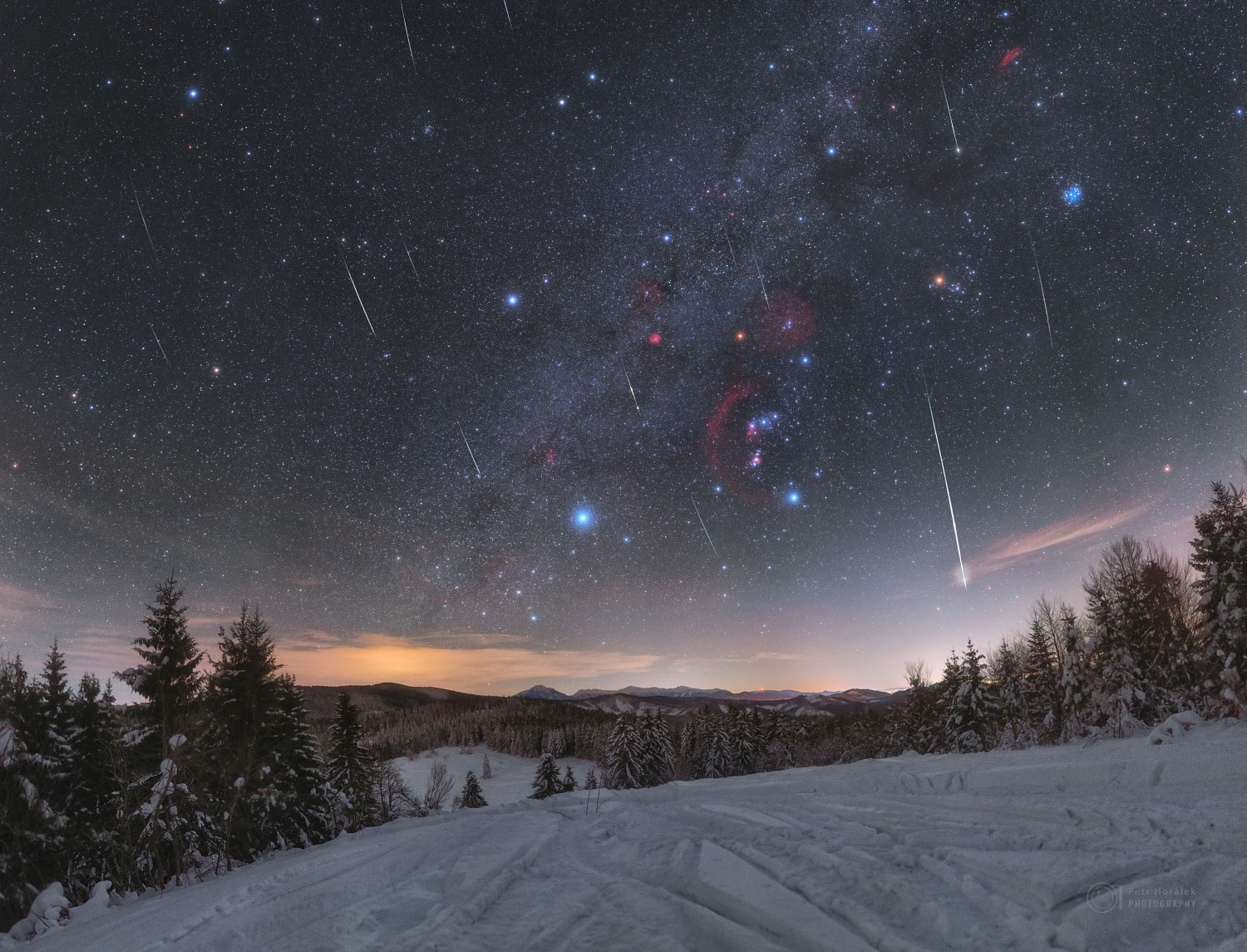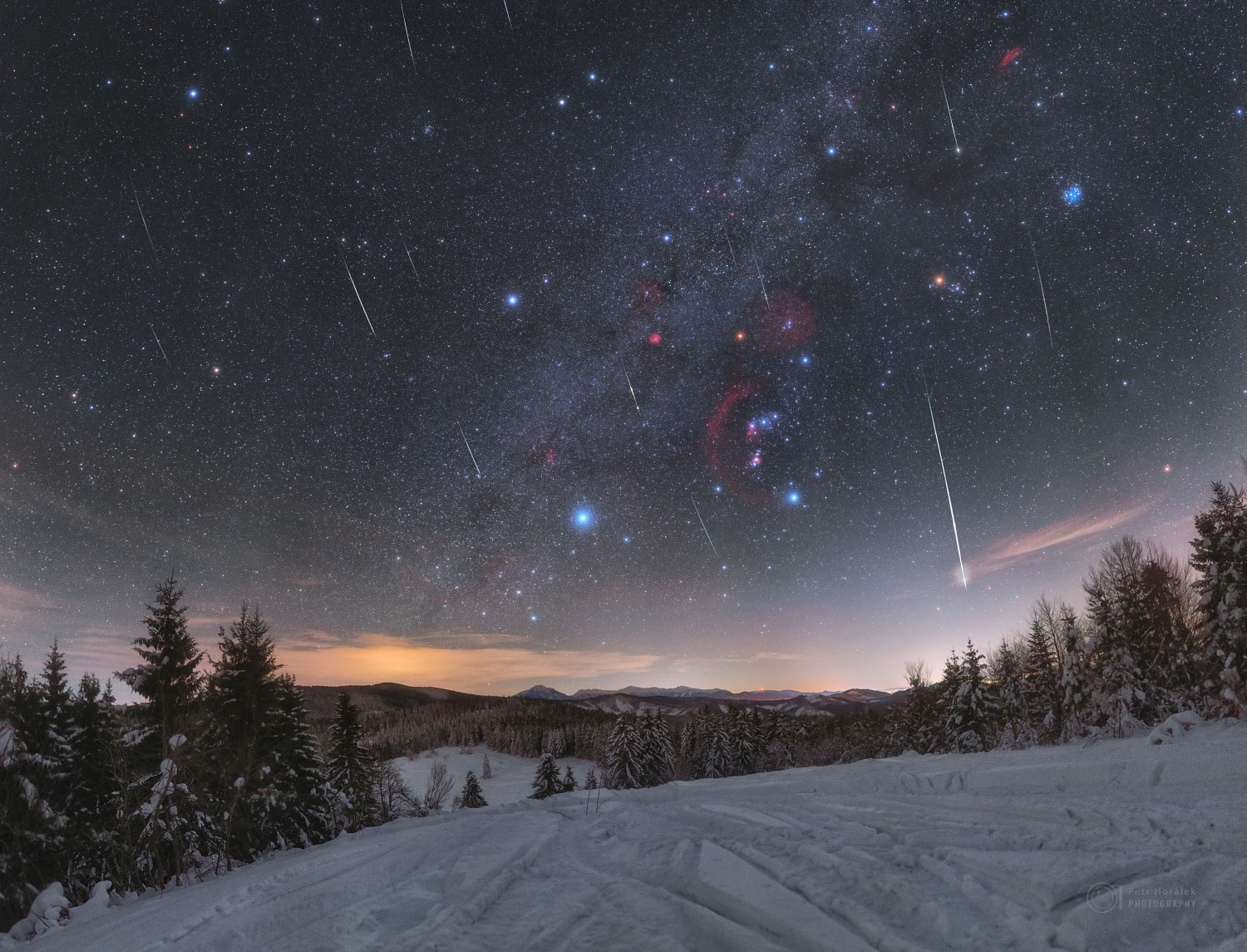
Why are these meteor trails nearly parallel? Because they were all shed by the same space rock and so can be traced back to the same direction on the sky: the radiant of the Quadrantid Meteor Shower. This direction used to be toward the old constellation of Quadrans Muralis, hence the name Quadrantids, but when the International Astronomical Union formulated its list of modern constellations in 1922, this constellation did not make the list. Even though the meteors are now considered to originate from the recognized constellation of Bootes, the old name stuck. Regardless of the designation, every January the Earth moves through a dust stream and bits of this dust glow as meteors as they heat up in Earth's atmosphere. The featured image composite was taken on January 4 with a picturesque snowy Slovakian landscape in the foreground, and a deep-exposure sky prominently featuring the constellation Orion in the background. The red star Betelgeuse appears unusually dim -- its fading over the past few months is being tracked by astronomers. Teachers: APOD in the Classroom
¿Por qué estos rastros de meteoros son casi paralelos? Porque todos fueron expulsados por la misma roca espacial y, por lo tanto, pueden ser trazados hacia la misma dirección en el cielo: el radiante de la lluvia de meteoros Quadrantids. Esta dirección apuntaba originalmente hacia la antigua constelación de Quadrans Muralis, de donde proviene el nombre de los Quadrantids, pero cuando la Unión Astronómica Internacional formuló su lista de constelaciones modernas en 1922, esta constelación no fue incluida. Aunque ahora se considera que los meteoros provienen de la constelación reconocida de Boötes, el antiguo nombre persistió. Independientemente del nombre, cada enero la Tierra atraviesa un flujo de polvo, y partículas de este polvo brillan como meteoros al calentarse en la atmósfera terrestre. La imagen compuesta mostrada fue tomada el 4 de enero, con un paisaje nevado de Eslovaquia en primer plano, y un cielo de larga exposición que destaca prominentemente la constelación de Orión en el fondo. La estrella roja Betelgeuse aparece inusualmente tenue — su atenuación en los últimos meses está siendo monitoreada por los astrónomos.