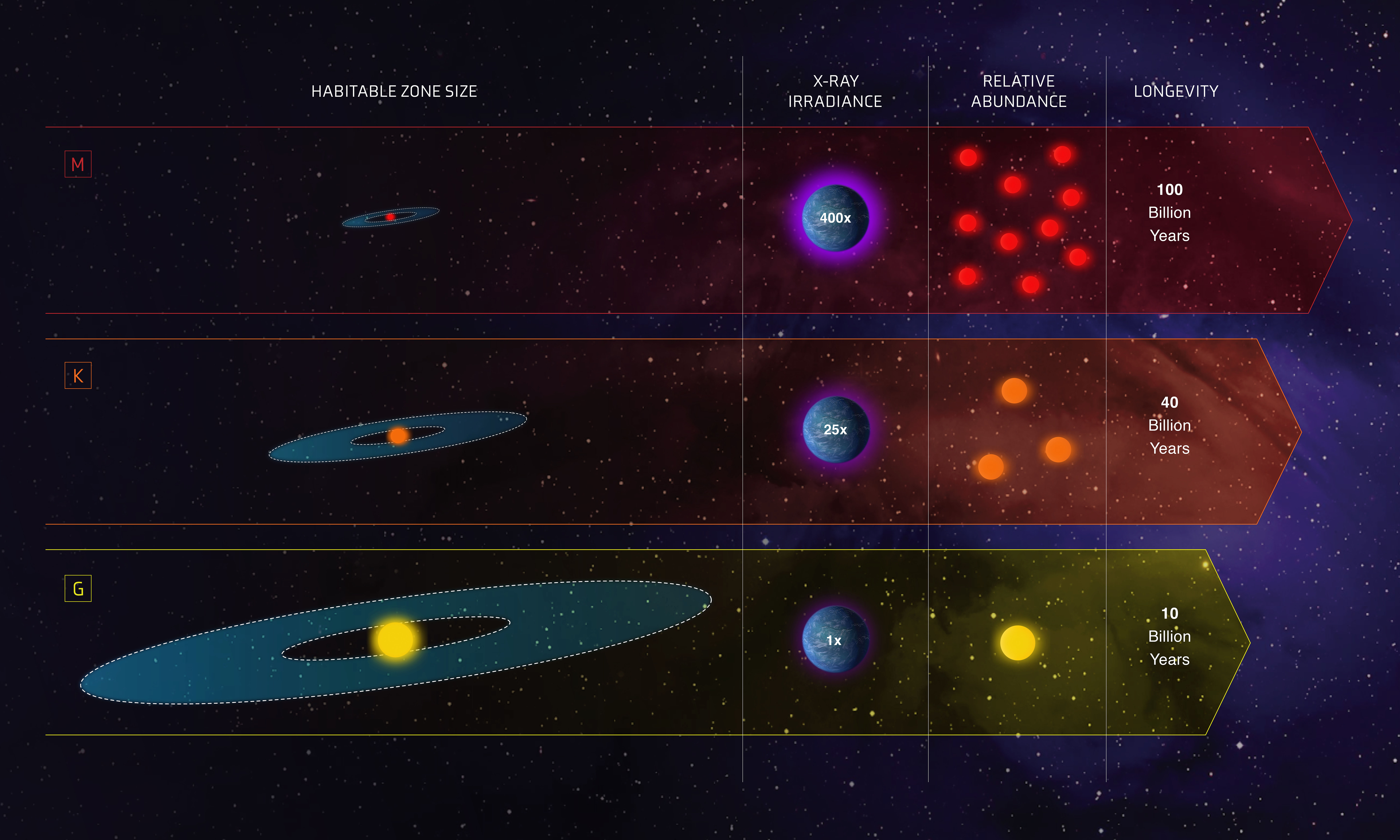
The Goldilocks zone is the habitable zone around a star where it's not too hot and not too cold for liquid water to exist on the surface of orbiting planets. This intriguing infographic includes relative sizes of those zones for yellow G stars like the Sun, along with orange K dwarf stars and red M dwarf stars, both cooler and fainter than the Sun. M stars (top) have small, close-in Goldilocks zones. They are also seen to live long (100 billion years or so) and are very abundant, making up about 73 percent of the stars in the Milky Way. Still, they have very active magnetic fields and may produce too much radiation harmful to life, with an estimated X-ray irradiance 400 times the quiet Sun. Sun-like G stars (bottom) have large Goldilocks zones and are relatively calm, with low amounts of harmful radiation. But they only account for 6 percent of Milky Way stars and are much shorter lived. In the search for habitable planets, K dwarf stars could be just right, though. Not too rare they have 40 billion year lifetimes, much longer than the Sun. With a relatively wide habitable zone they produce only modest amounts of harmful radiation. These Goldilocks stars account for about 13 percent of the stars of the Milky Way.
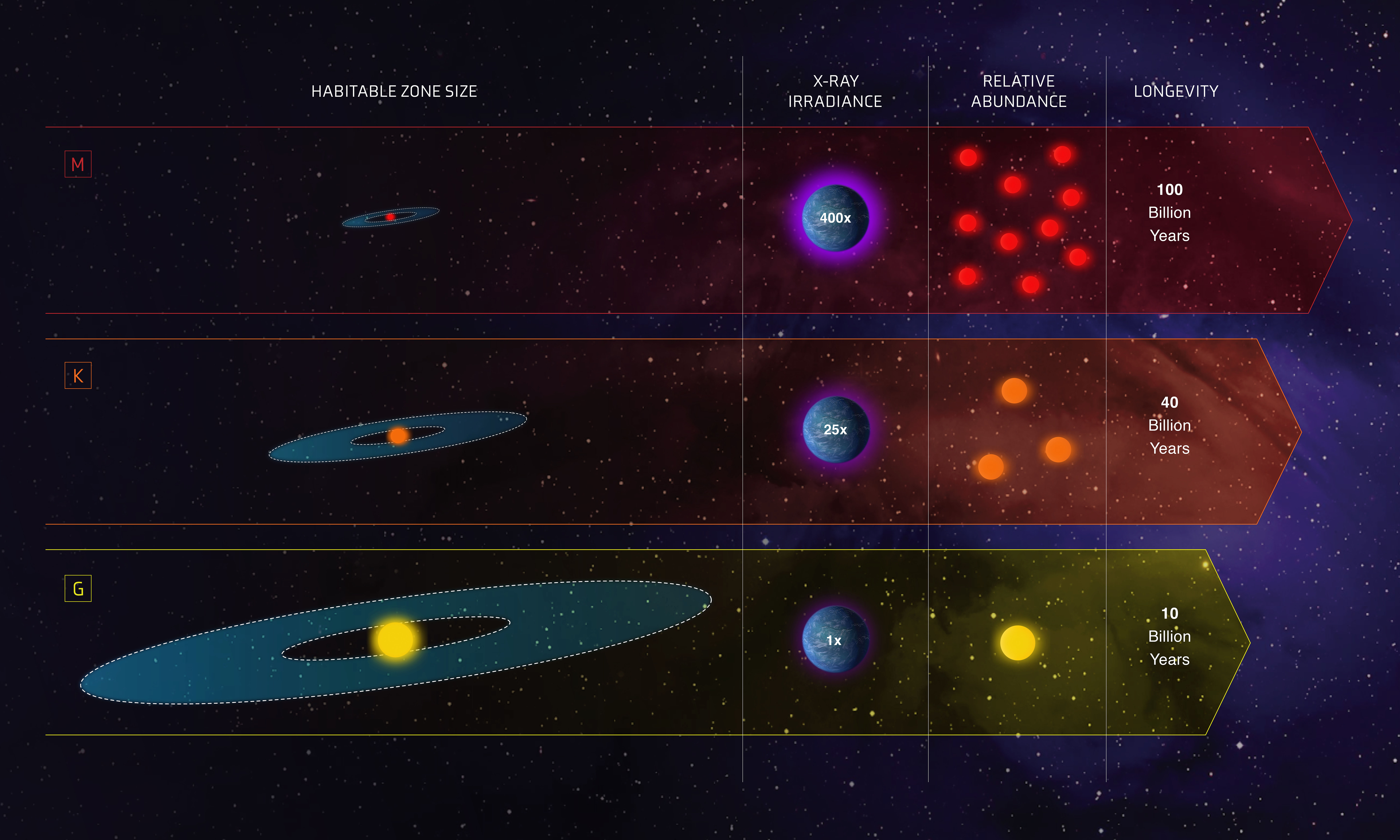
La zona de Goldilocks es la zona habitable alrededor de una estrella donde no es demasiado caliente ni demasiado frío para que exista agua líquida en la superficie de los planetas que orbitan. Esta intrigante infografía incluye las dimensiones relativas de esas zonas para estrellas amarillas tipo G como el Sol, junto con estrellas enanas naranjas tipo K y estrellas enanas rojas tipo M, ambas más frías y más tenues que el Sol. Las estrellas tipo M (arriba) tienen zonas de Goldilocks pequeñas y cercanas. También se observa que viven mucho tiempo (alrededor de 100 mil millones de años) y son muy abundantes, representando aproximadamente el 73 por ciento de las estrellas en la Vía Láctea. Sin embargo, tienen campos magnéticos muy activos y podrían producir demasiada radiación perjudicial para la vida, con una irradiancia en rayos X estimada 400 veces la del Sol tranquilo. Las estrellas tipo G similares al Sol (abajo) tienen zonas de Goldilocks grandes y son relativamente tranquilas, con cantidades bajas de radiación perjudicial. Pero solo representan el 6 por ciento de las estrellas de la Vía Láctea y tienen una vida mucho más corta. En la búsqueda de planetas habitables, las estrellas enanas tipo K podrían ser justas. No son demasiado raras y tienen vidas de 40 mil millones de años, mucho más largas que las del Sol. Con una zona habitable relativamente amplia, producen solo cantidades moderadas de radiación perjudicial. Estas estrellas de Goldilocks representan aproximadamente el 13 por ciento de las estrellas de la Vía Láctea.