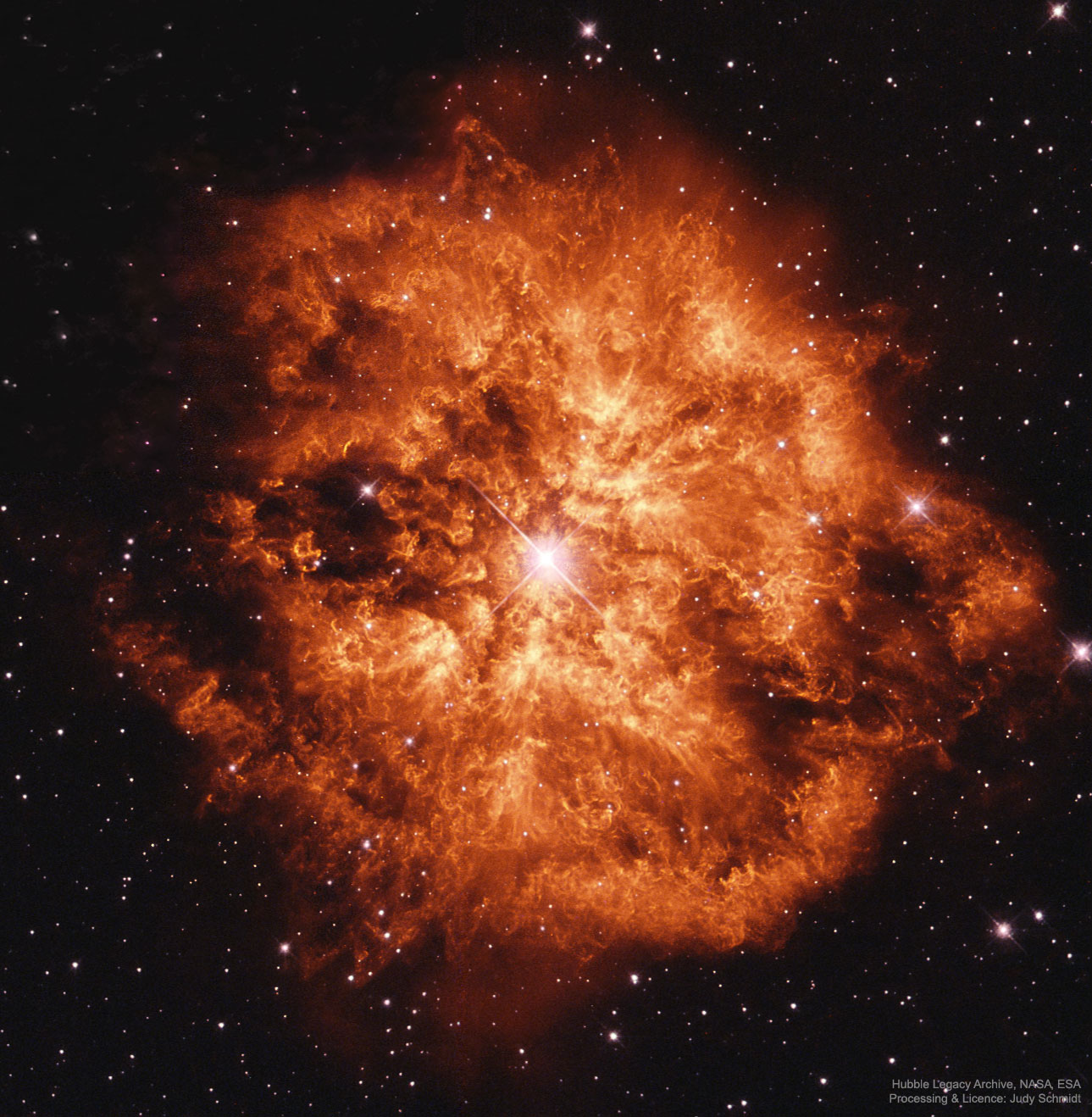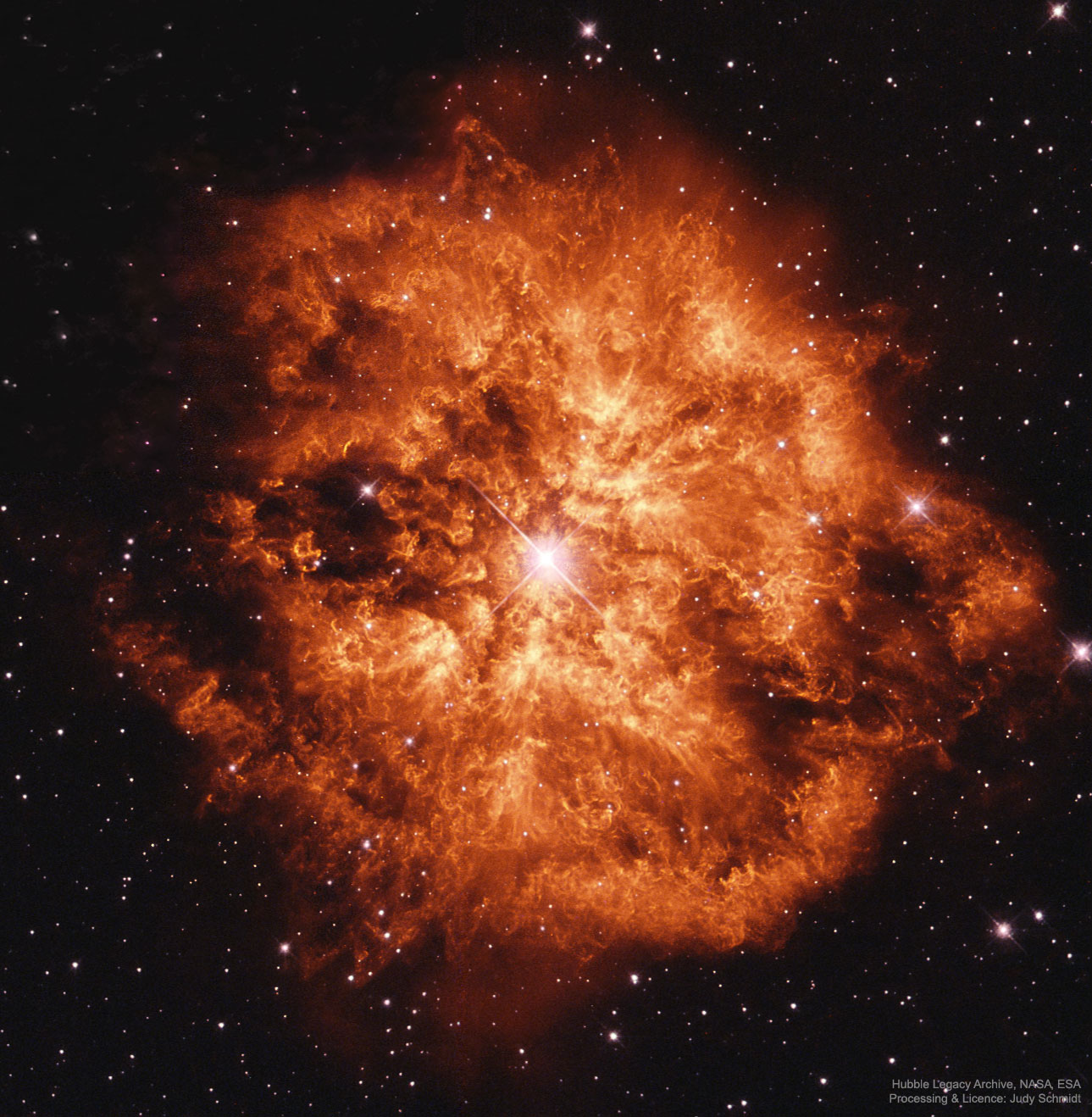
Some stars explode in slow motion. Rare, massive Wolf-Rayet stars are so tumultuous and hot that they are slowly disintegrating right before our telescopes. Glowing gas globs each typically over 30 times more massive than the Earth are being expelled by violent stellar winds. Wolf-Rayet star WR 124, visible near the featured image center spanning six light years across, is thus creating the surrounding nebula known as M1-67. Details of why this star has been slowly blowing itself apart over the past 20,000 years remains a topic of research. WR 124 lies 15,000 light-years away towards the constellation of the Arrow (Sagitta). The fate of any given Wolf-Rayet star likely depends on how massive it is, but many are thought to end their lives with spectacular explosions such as supernovas or gamma-ray bursts.
Algunas estrellas explotan en movimiento lento. Las raras y masivas estrellas Wolf-Rayet son tan tumultuosas y calientes que se están desintegrando lentamente ante nuestros telescopios. Globos de gas brillante, cada uno típicamente más de 30 veces más masivo que la Tierra, son expulsados por violentos vientos estelares. La estrella Wolf-Rayet WR 124, visible cerca del centro de la imagen destacada, que abarca seis años luz de ancho, está creando así la nebulosa que la rodea conocida como M1-67. Los detalles sobre por qué esta estrella ha estado desgarrándose lentamente durante los últimos 20,000 años sigue siendo un tema de investigación. WR 124 se encuentra a 15,000 años luz de distancia hacia la constelación de la Flecha (Sagitta). El destino de cualquier estrella Wolf-Rayet probablemente depende de su masa, pero muchas se piensa que terminan sus vidas con explosiones espectaculares como supernovas o estallidos de rayos gamma.