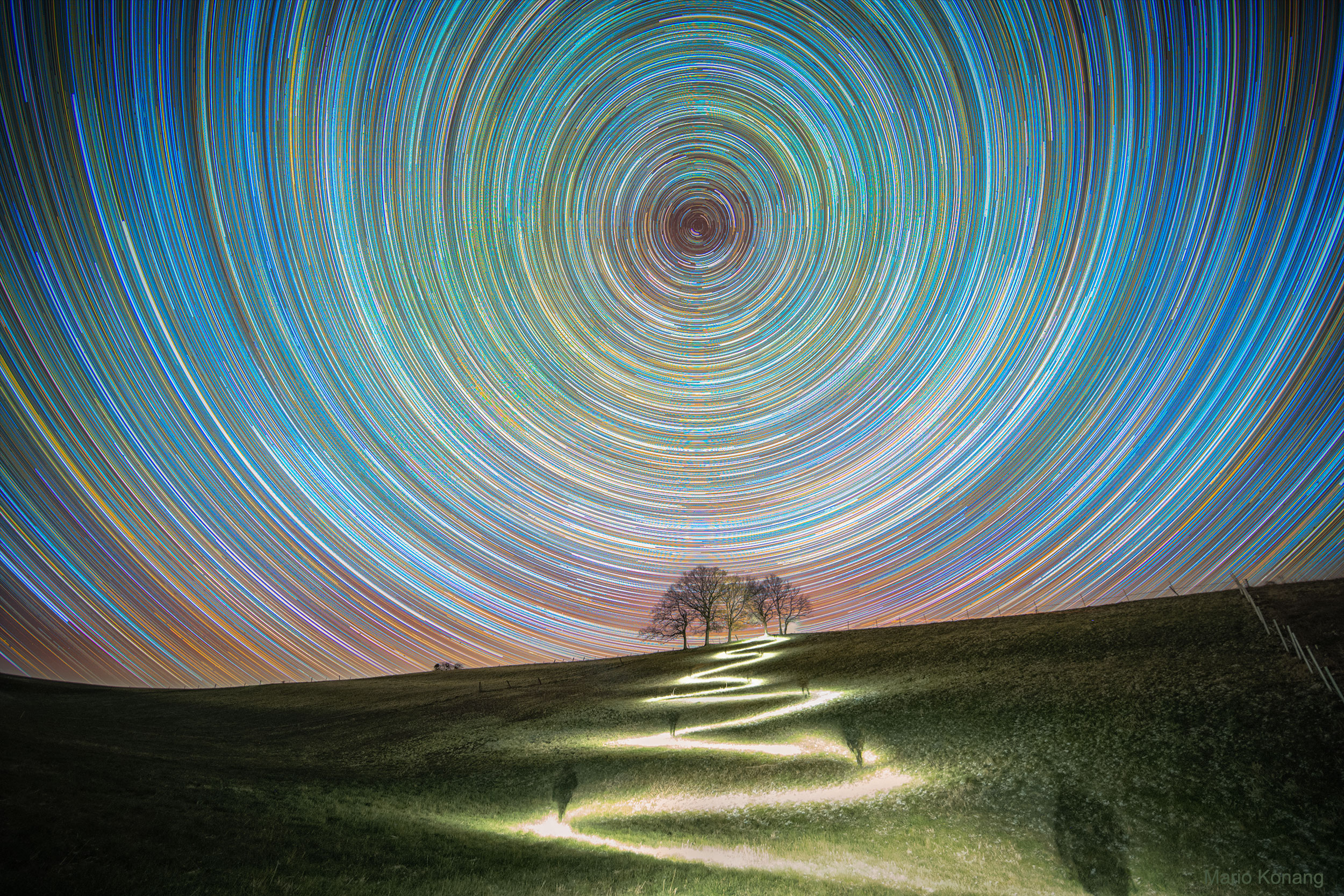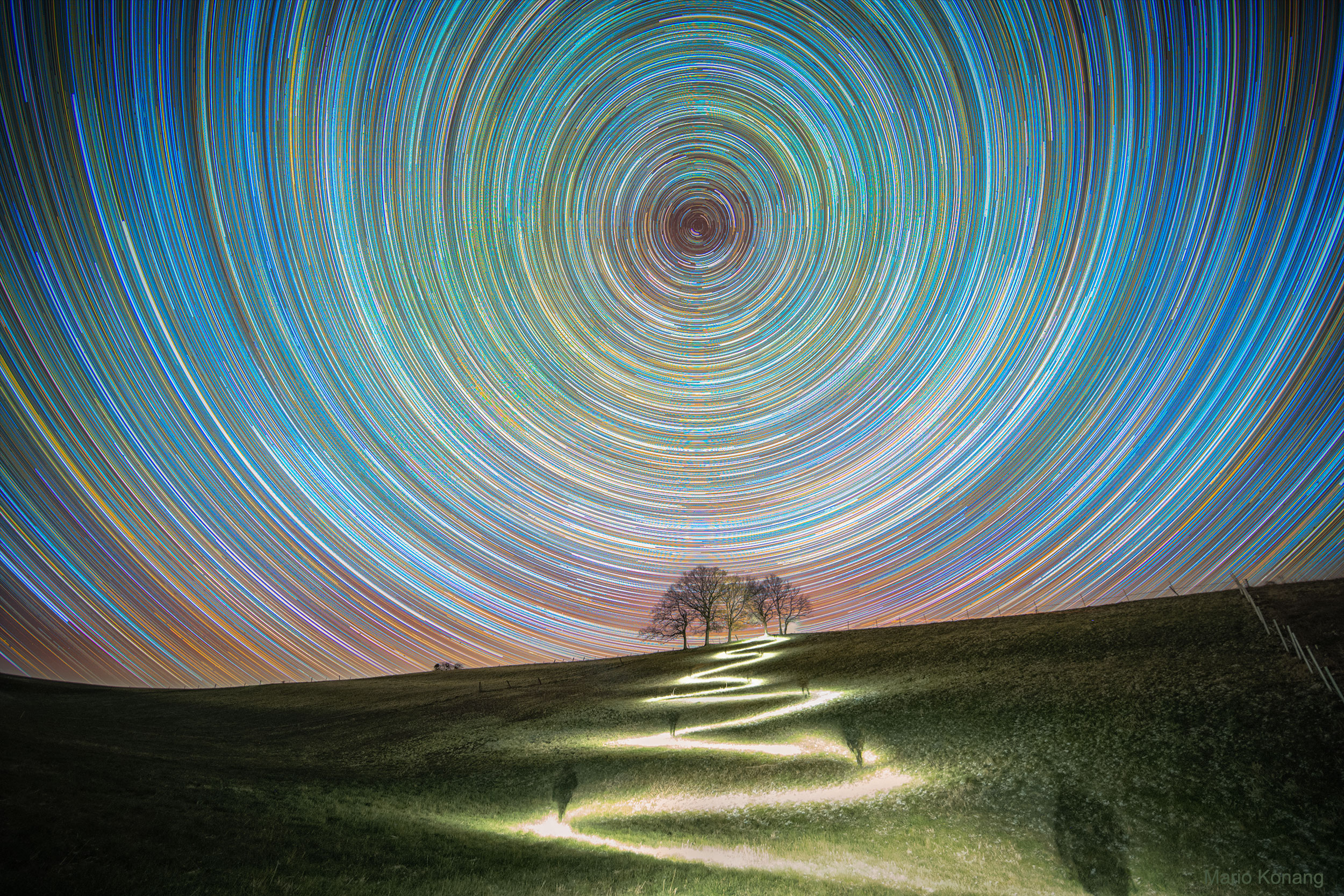
What happens if you keep going north? The direction north on the Earth, the place on your horizon below the northern spin pole of the Earth -- around which other stars appear to slowly swirl, will remain the same. This spin-pole-of-the-north will never move from its fixed location on the sky -- night or day -- and its height will always match your latitude. The further north you go, the higher the north spin pole will appear. Eventually, if you can reach the Earth's North Pole, the stars will circle a point directly over your head. Pictured, a four-hour long stack of images shows stars trailing in circles around this north celestial pole. The bright star near the north celestial pole is Polaris, known as the North Star. The bright path was created by the astrophotographer's headlamp as he zigzagged up a hill just over a week ago in Lower Saxony, Germany. The astrophotographer can be seen, at times, in shadow. Actually, the Earth has two spin poles -- and much the same would happen if you started below the Earth's equator and went south.
¿Qué ocurre si sigues viajando hacia el norte? La dirección norte en la Tierra, el punto en tu horizonte debajo del polo de rotación norte de la Tierra — alrededor del cual las otras estrellas parecen girar lentamente — permanecerá constante. Este polo de rotación norte nunca se moverá de su ubicación fija en el cielo — de noche o de día — y su altura siempre coincidirá con tu latitud. Cuanto más al norte vayas, más alto aparecerá el polo de rotación norte. Finalmente, si puedes llegar al Polo Norte de la Tierra, las estrellas girarán alrededor de un punto directamente sobre tu cabeza. En la imagen, una pila de imágenes de cuatro horas muestra las estrellas describiendo círculos alrededor de este polo celeste norte. La estrella brillante cerca del polo celeste norte es Polaris, conocida como la Estrella Polar. El camino brillante fue creado por la linterna del fotógrafo astronómico mientras zigzagueaba hacia arriba por una colina hace poco más de una semana en Baja Sajonia, Alemania. En algunas ocasiones se puede ver la sombra del fotógrafo astronómico. De hecho, la Tierra tiene dos polos de rotación — y ocurriría algo muy similar si comenzaras por debajo del ecuador terrestre y viajaras hacia el sur.