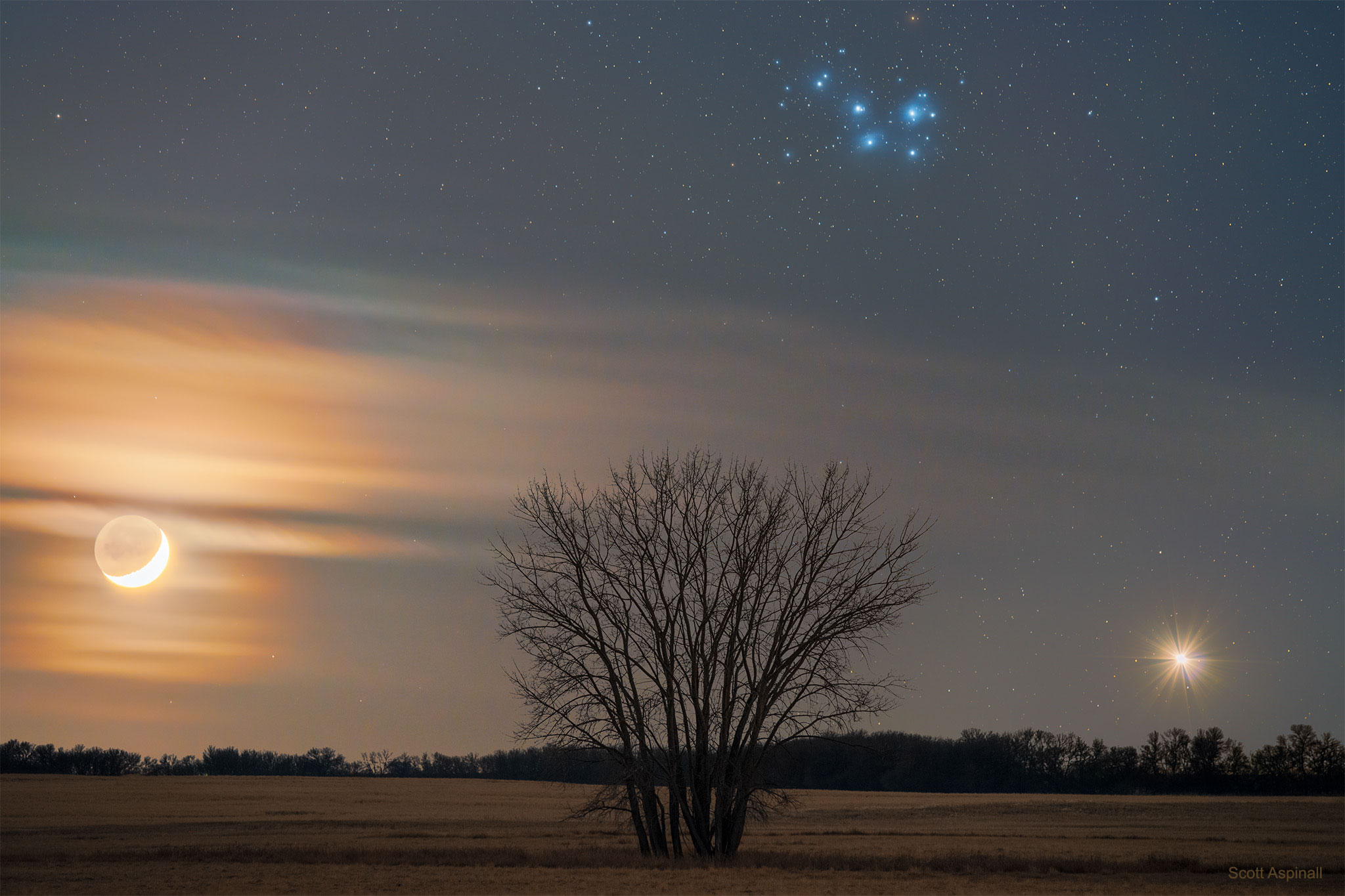
It was an astronomical triple play. Setting on the left, just after sunset near the end of last month, was our Moon -- showing a bright crescent phase. Setting on the right was Venus, the brightest planet in the evening sky last month -- and this month, too. With a small telescope, you could tell that Venus' phase was half, meaning that only half of the planet, as visible from Earth, was exposed to direct sunlight and brightly lit. High above and much further in the distance was the Pleiades star cluster. Although the Moon and Venus move with respect to the background stars, the Pleiades do not -- because they are background stars. In the beginning of this month, Venus appeared to move right in front of the Pleiades, a rare event that happens only once every eight years. The featured image captured this cosmic triangle with a series of exposures taken from the same camera over 70 minutes near Avonlea, Saskatchewan, Canada. The positions of the celestial objects was predicted. The only thing unpredicted was the existence of the foreground tree -- and the astrophotographer is still unsure what type of tree that is.
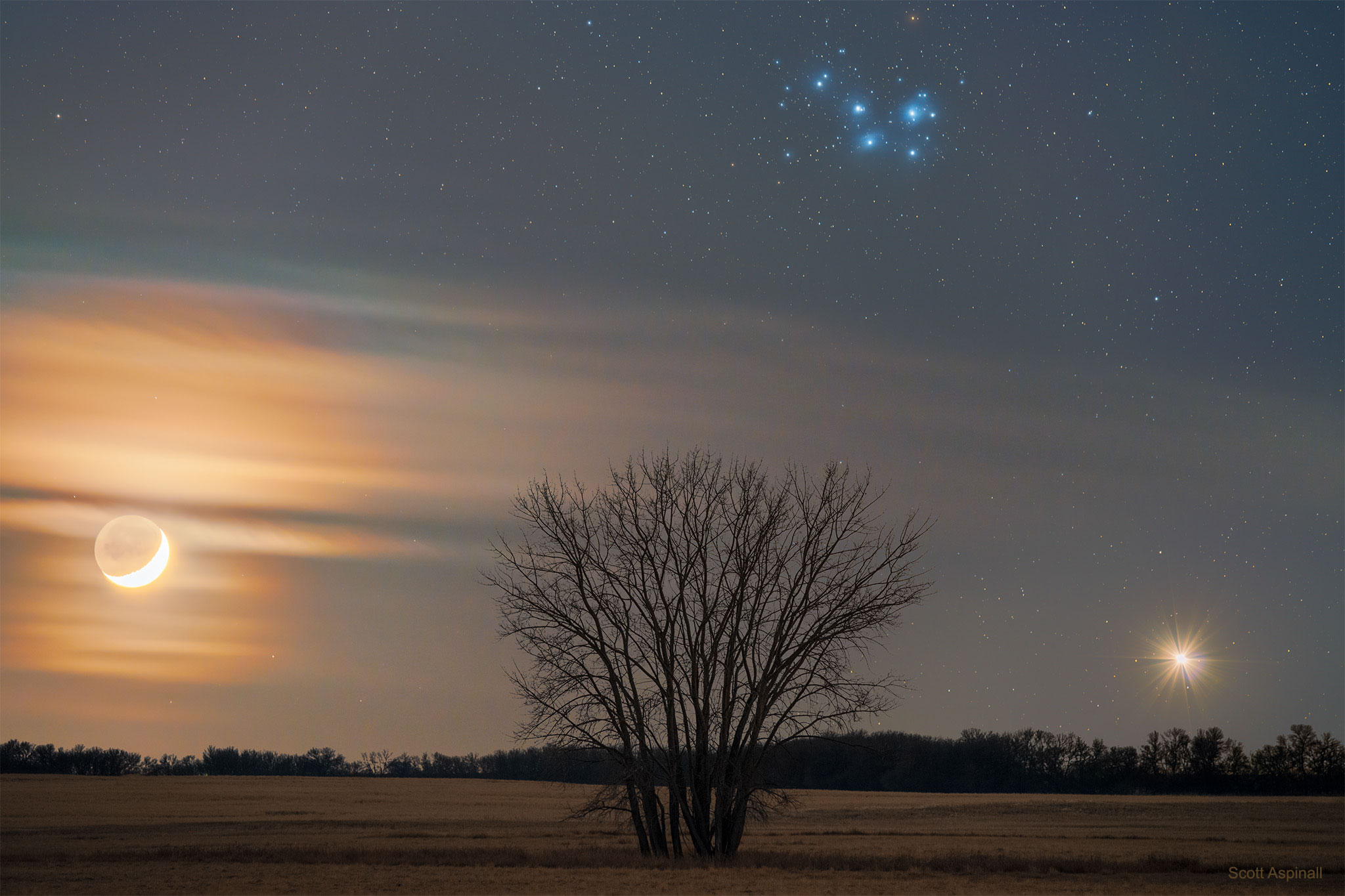
Fue un triple evento astronómico. En el lado izquierdo, justo después del atardecer, hacia el final del mes pasado, se encontraba nuestra Luna, mostrando una fase creciente brillante. En el lado derecho se encontraba Venus, el planeta más brillante del cielo nocturno del mes pasado, y también del mes actual. Con un pequeño telescopio, se podía apreciar que la fase de Venus era media, lo que significa que solo la mitad del planeta, visible desde la Tierra, estaba expuesta a la luz solar directa y brillantemente iluminada. Altamente elevado y mucho más lejos se encontraba el cúmulo estelar de las Pléyades. Aunque la Luna y Venus se mueven en relación con las estrellas de fondo, las Pléyades no lo hacen, ya que ellas mismas son estrellas de fondo. Al comienzo de este mes, Venus aparentemente se movió justo frente a las Pléyades, un evento raro que ocurre solo una vez cada ocho años. La imagen destacada capturó este triángulo cósmico mediante una serie de exposiciones tomadas desde la misma cámara durante 70 minutos cerca de Avonlea, Saskatchewan, Canadá. Las posiciones de los objetos celestes fueron predichas. Lo único imprevisto fue la existencia del árbol en primer plano, y el fotógrafo astronómico aún no está seguro de qué tipo de árbol es.