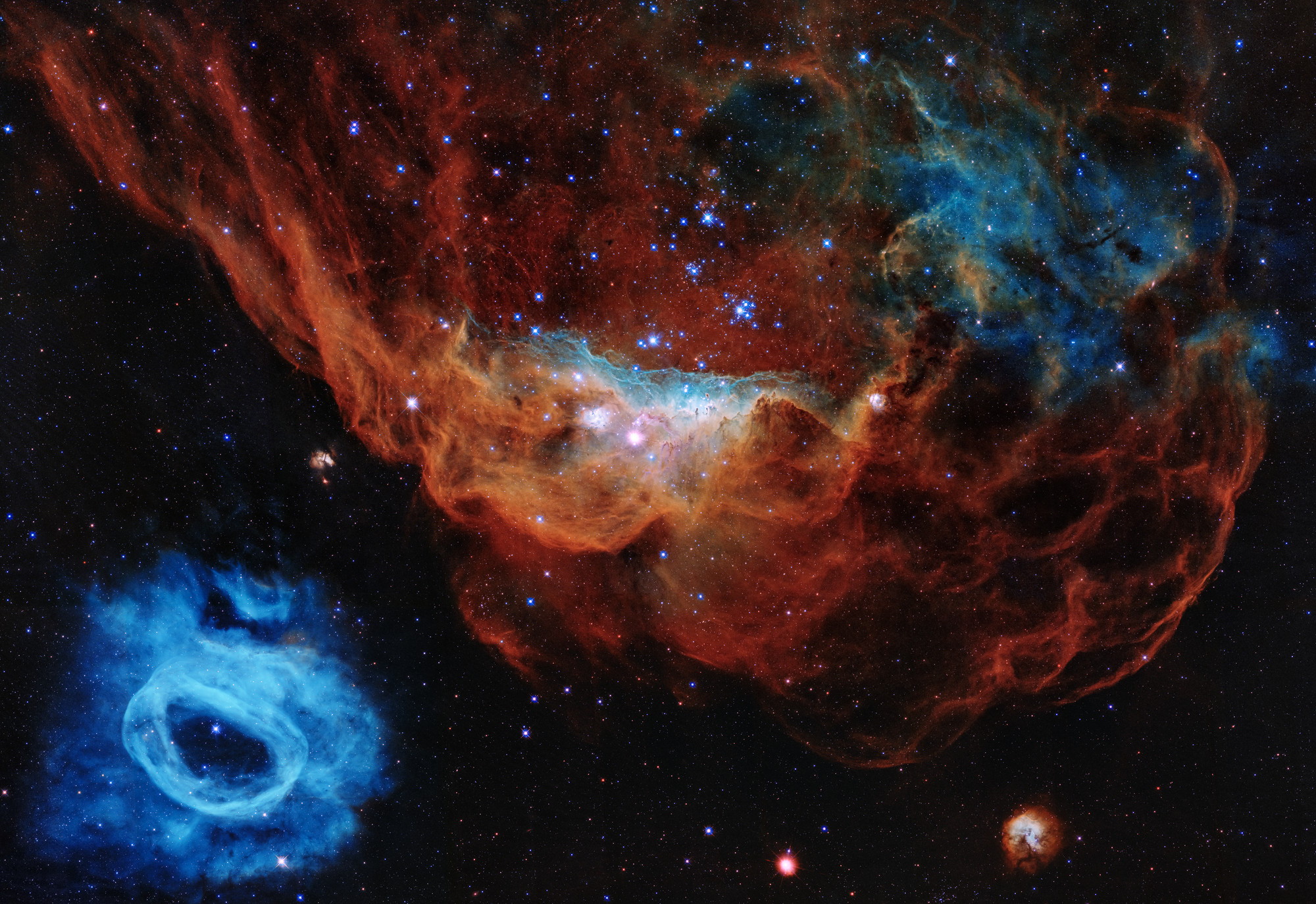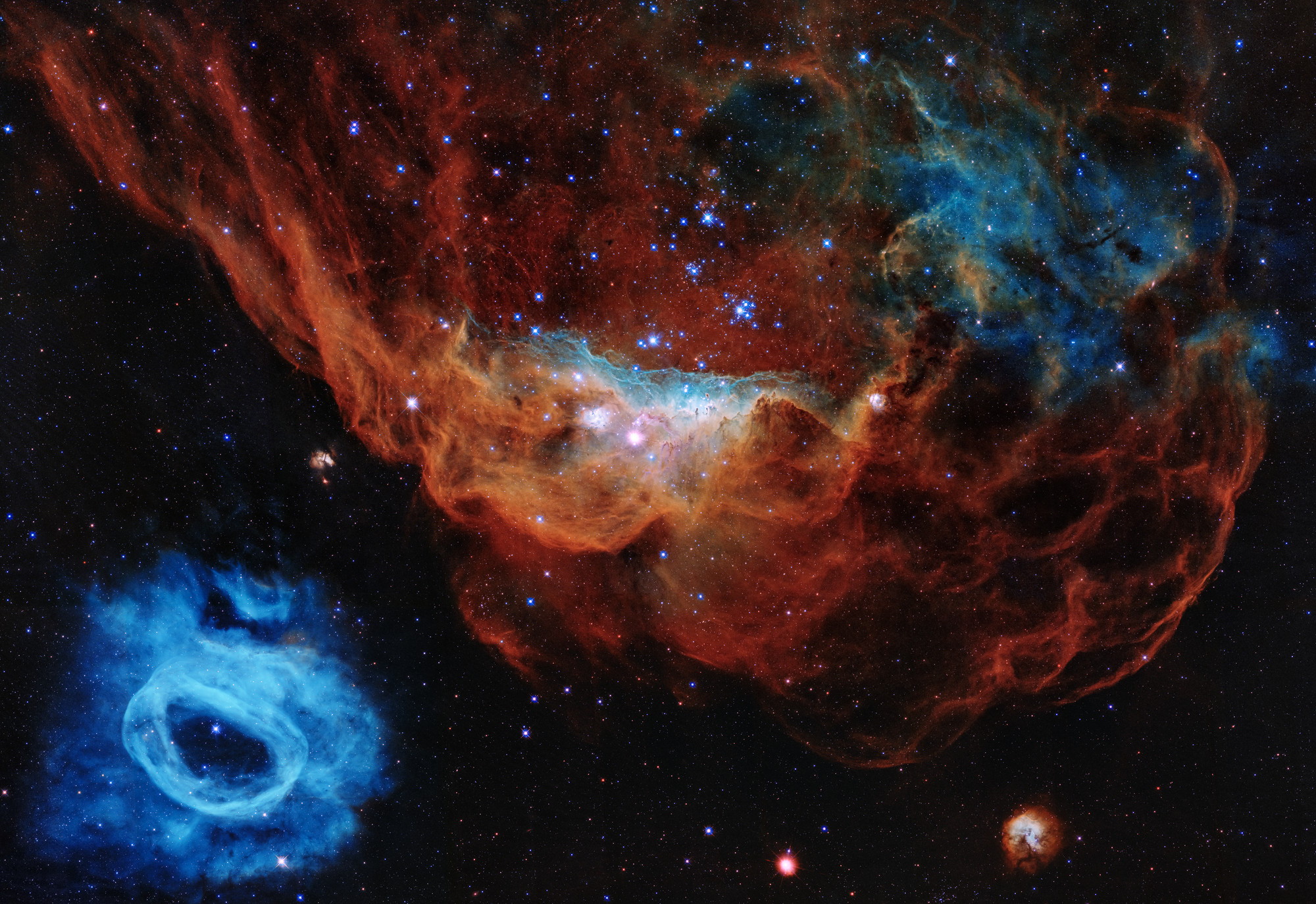
These bright ridges of interstellar gas and dust are bathed in energetic starlight. With its sea of young stars, the massive star-forming region NGC 2014 has been dubbed the Cosmic Reef. Drifting just off shore, the smaller NGC 2020, is an expansive blue-hued structure erupting from a single central Wolf-Rayet star, 200,000 times brighter than the Sun. The cosmic frame spans some 600 light-years within the Large Magellanic Cloud 160,000 light-years away, a satellite galaxy of our Milky Way. A magnificent Hubble Space Telescope portrait, the image was released this week as part of a celebration to mark Hubble's 30th year exploring the Universe from Earth orbit.
Estas brillantes crestas de gas y polvo interestelar están bañadas por la luz energética de las estrellas. Con su mar de estrellas jóvenes, la gran región de formación estelar NGC 2014 ha sido apodada el Arrecife Cósmico. A flote justo fuera de costa, el más pequeño NGC 2020 es una estructura de color azulado expansiva que emerge de una única estrella central de tipo Wolf-Rayet, 200 000 veces más brillante que el Sol. El marco cósmico abarca aproximadamente 600 años luz dentro de la Nube de Magallanes Grande, situada a 160 000 años luz de distancia, una galaxia satélite de nuestra Vía Láctea. Una magnífica imagen capturada por el Telescopio Espacial Hubble, la imagen fue publicada esta semana como parte de una celebración con motivo del 30º aniversario de Hubble explorando el Universo desde órbita terrestre.