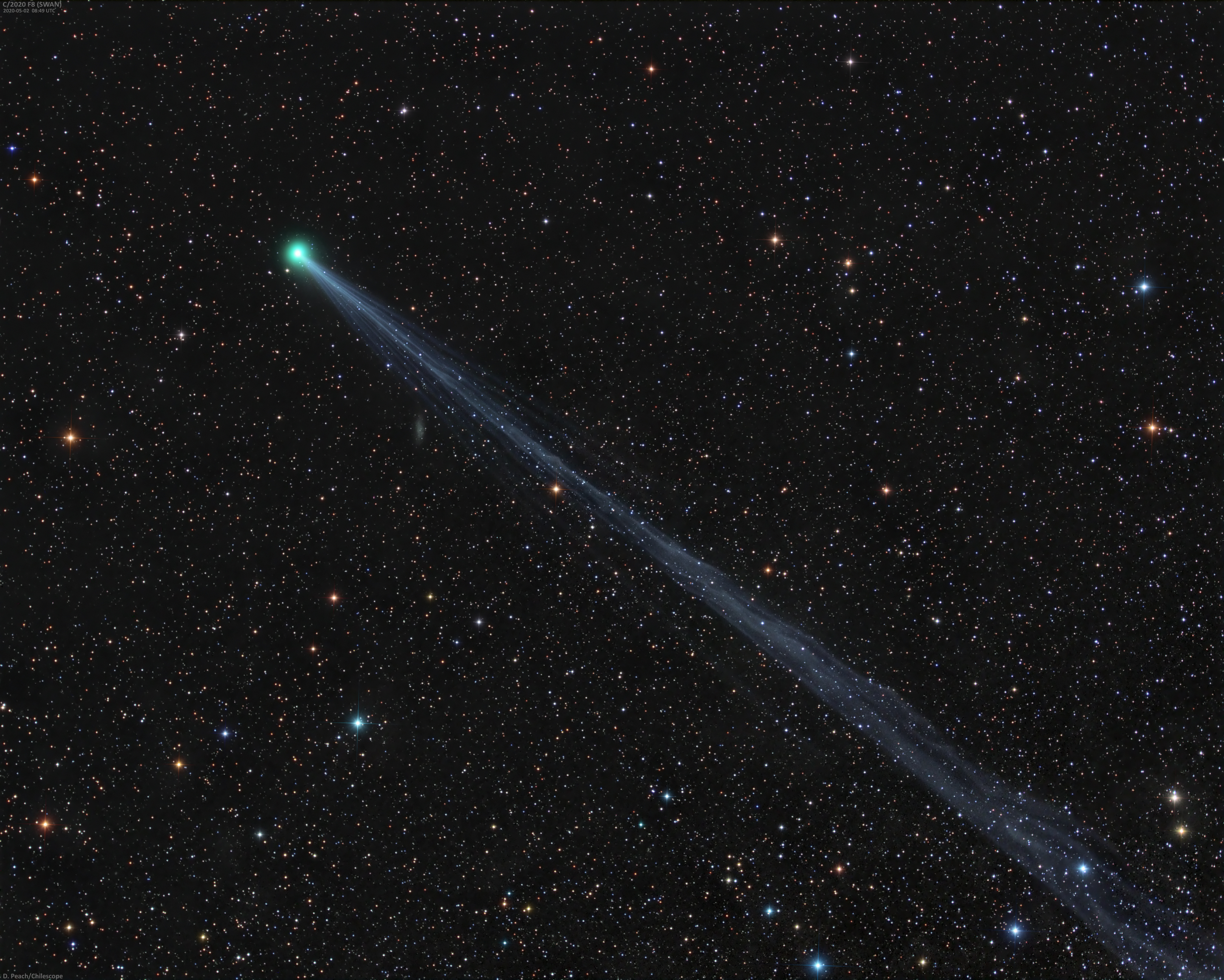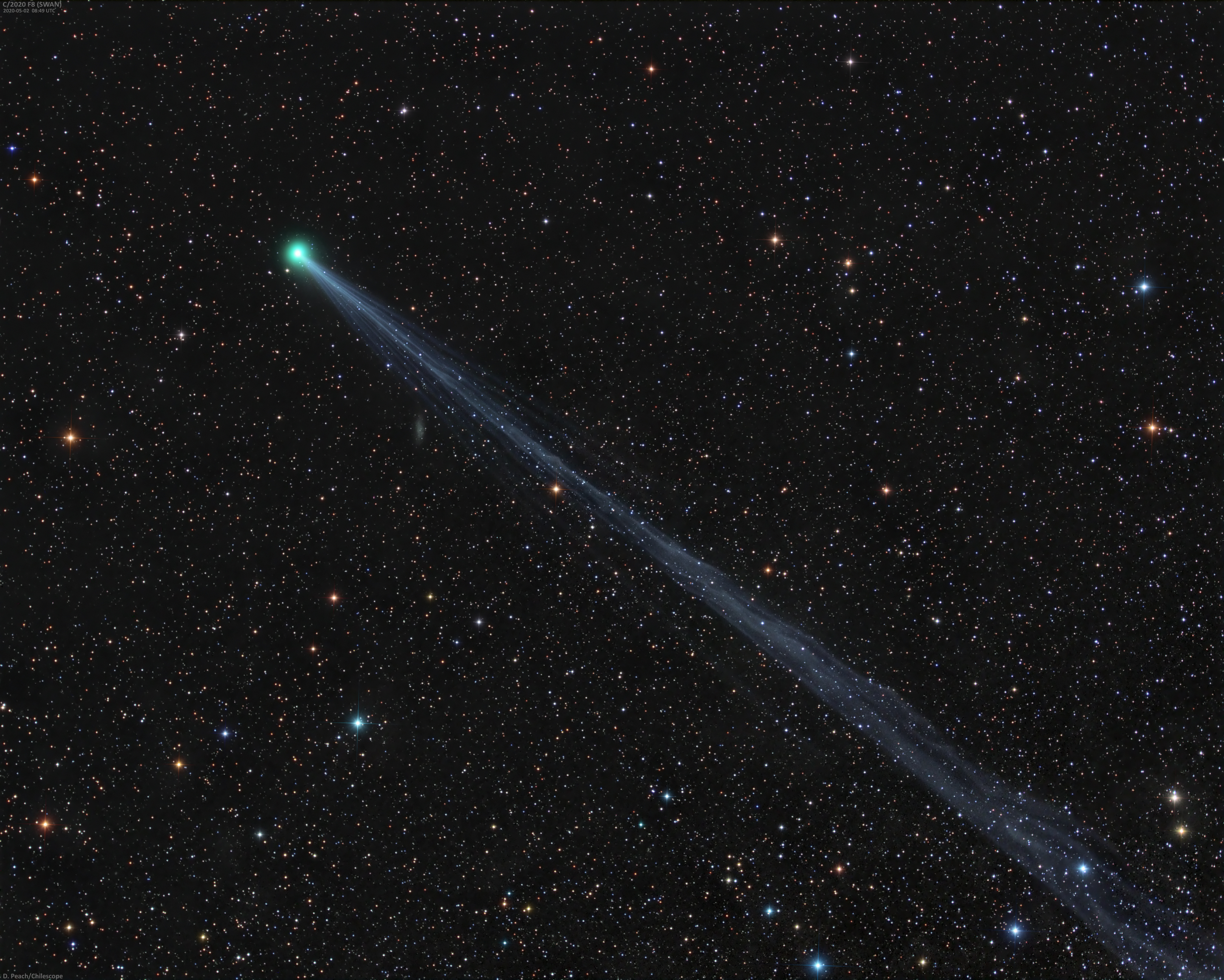
Blowing in the solar wind the spectacular ion tail of Comet SWAN (C/2020 F8) extends far across this 10 degree wide telephoto field of view. Captured on May 2 its greenish coma was about 6 light-minutes from Earth. The pretty background starfield lies near the border of the constellations Cetus and Aquarius. This comet SWAN was discovered at home by Australian amateur Michael Mattiazzo by checking images from the Sun-staring SOHO spacecraft's SWAN (Solar Wind ANisotropies) camera. The comet has now become just visible to the naked-eye as it sweeps from southern to northern skies. Appearing in morning twilight near the eastern horizon, Comet SWAN will make its closest approach to planet Earth on May 12 and reach perihelion on May 27.
A la deriva con el viento solar, la espectacular cola iónica del cometa SWAN (C/2020 F8) se extiende lejos a través de este campo de visión de 10 grados capturado con teleobjetivo. Capturado el 2 de mayo, su coma de color verde estaba a unos 6 minutos luz de la Tierra. El bonito campo estelar de fondo se encuentra cerca del límite entre las constelaciones de Cetus y Acuario. Este cometa SWAN fue descubierto desde casa por el aficionado australiano Michael Mattiazzo al revisar imágenes del telescopio SWAN (Solar Wind ANisotropies) de la nave espacial SOHO que observa al Sol. El cometa ahora es apenas visible a simple vista a medida que se desplaza desde el hemisferio sur hacia el norte. Apareciendo en la aurora matutina cerca del horizonte oriental, el cometa SWAN alcanzará su punto más cercano a la Tierra el 12 de mayo y llegará al perihelio el 27 de mayo.