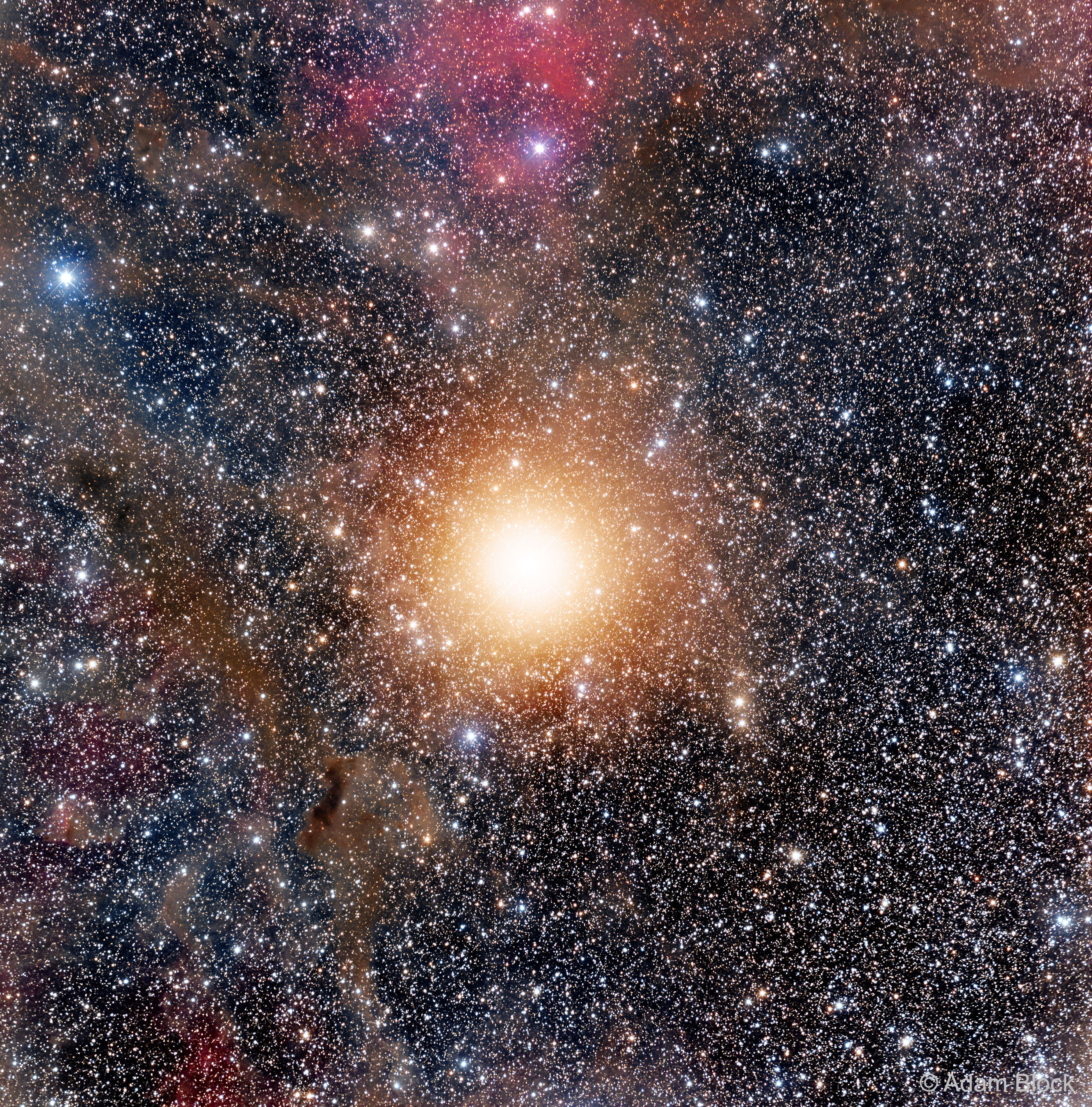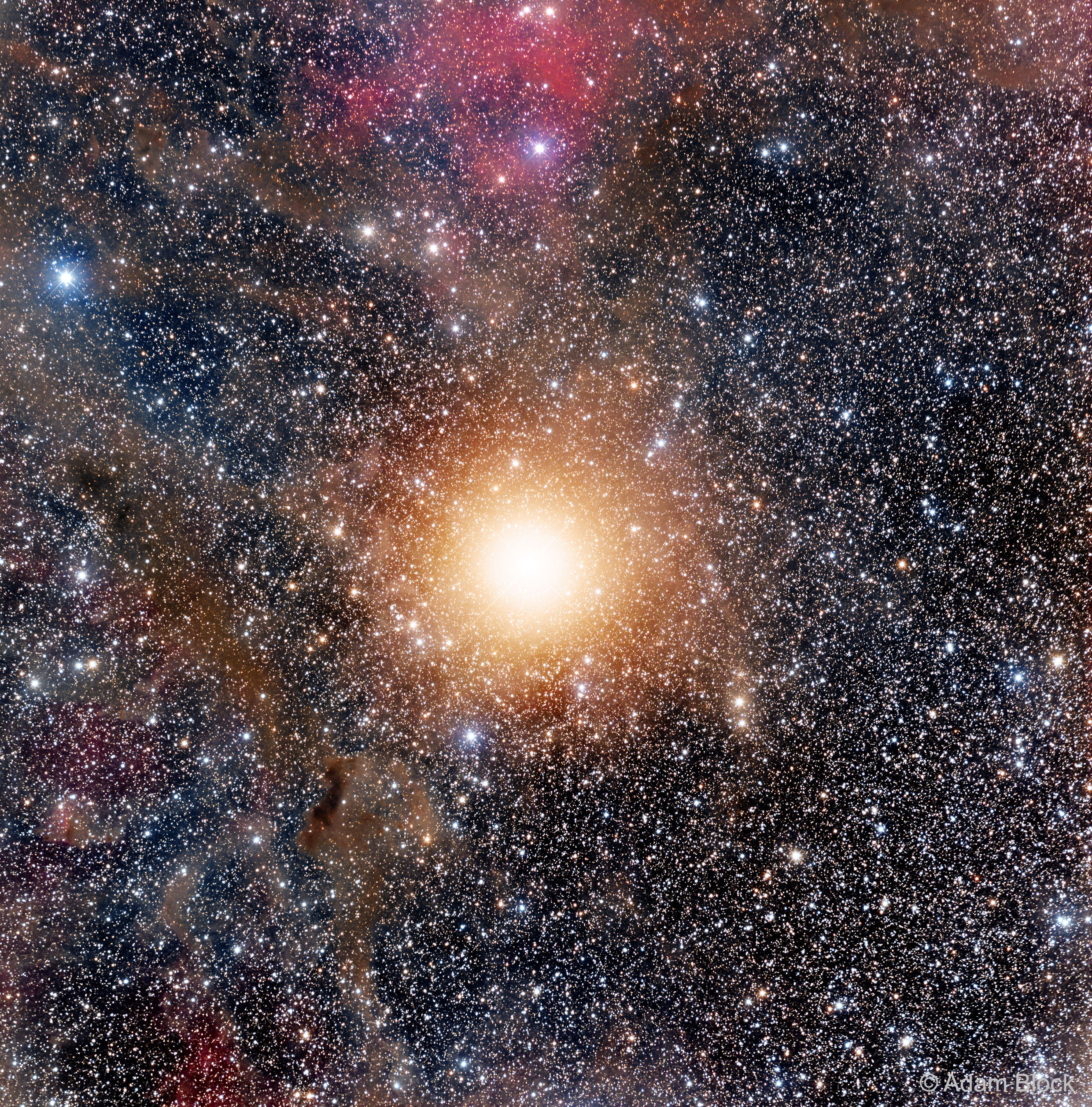
What's behind Betelgeuse? One of the brighter and more unusual stars in the sky, the red supergiant star Betelgeuse can be found in the direction of famous constellation Orion. Betelgeuse, however, is actually well in front of many of the constellation's other bright stars, and also in front of the greater Orion Molecular Cloud Complex. Numerically, light takes about 700 years to reach us from Betelgeuse, but about 1,300 years to reach us from the Orion Nebula and its surrounding dust and gas. All but the largest telescopes see Betelgeuse as only a point of light, but a point so bright that the inherent blurriness created by the telescope and Earth's atmosphere make it seem extended. In the featured long-exposure image, thousands of stars in our Milky Way Galaxy can be seen in the background behind Betelgeuse, as well as dark dust from the Orion Molecular Cloud, and some red-glowing emission from hydrogen gas on the outskirts of the more distant Lambda Orionis Ring. Betelgeuse has recovered from appearing unusually dim over the past six months, but is still expected to explode in a spectacular supernova sometime in the next (about) 100,000 years.
¿Qué hay detrás de Betelgeuse? Una de las estrellas más brillantes y peculiares del cielo, la supergigante roja Betelgeuse se encuentra en la dirección de la famosa constelación de Orión. Sin embargo, Betelgeuse está en realidad bastante delante de muchas otras estrellas brillantes de la constelación, y también delante del complejo molecular de Orión. Numéricamente, la luz tarda unos 700 años en llegar hasta nosotros desde Betelgeuse, pero unos 1300 años en llegar desde la Nebulosa de Orión y su entorno de polvo y gas. Todos los telescopios, excepto los más grandes, ven Betelgeuse como solo un punto de luz, pero un punto tan brillante que la borrosidad inherente creada por el telescopio y la atmósfera terrestre hace que parezca extendido. En la imagen de larga exposición destacada, se pueden ver miles de estrellas de nuestra galaxia, la Vía Láctea, en el fondo detrás de Betelgeuse, así como polvo oscuro del complejo molecular de Orión, y cierta emisión de color rojo de gas hidrógeno en los bordes del anillo Lambda Oriónis, que se encuentra más lejos. Betelgeuse ha recuperado su brillo después de haber aparecido inusualmente tenue durante los últimos seis meses, pero se espera que aún explote en una espectacular supernova en algún momento de los próximos (aproximadamente) 100 000 años.