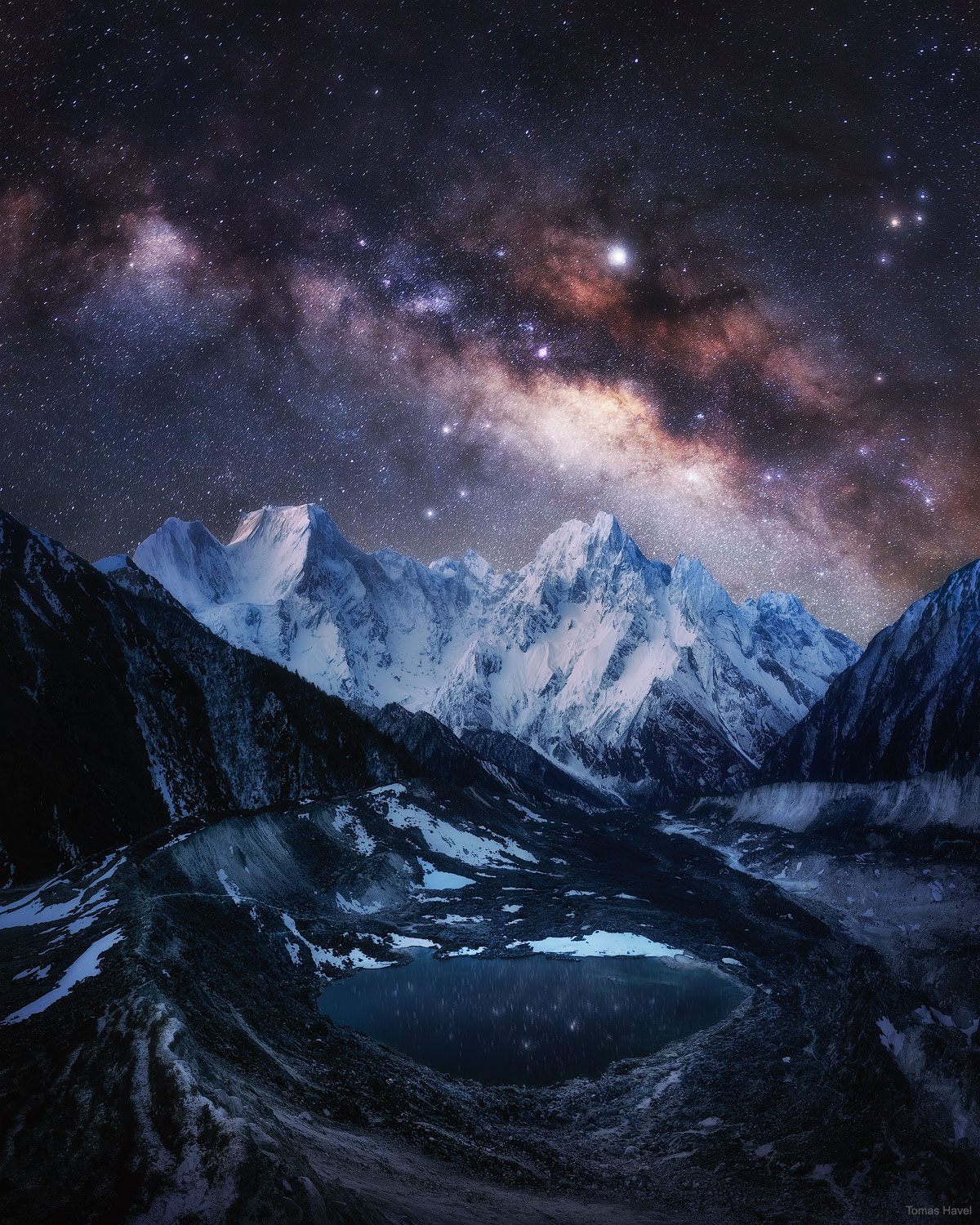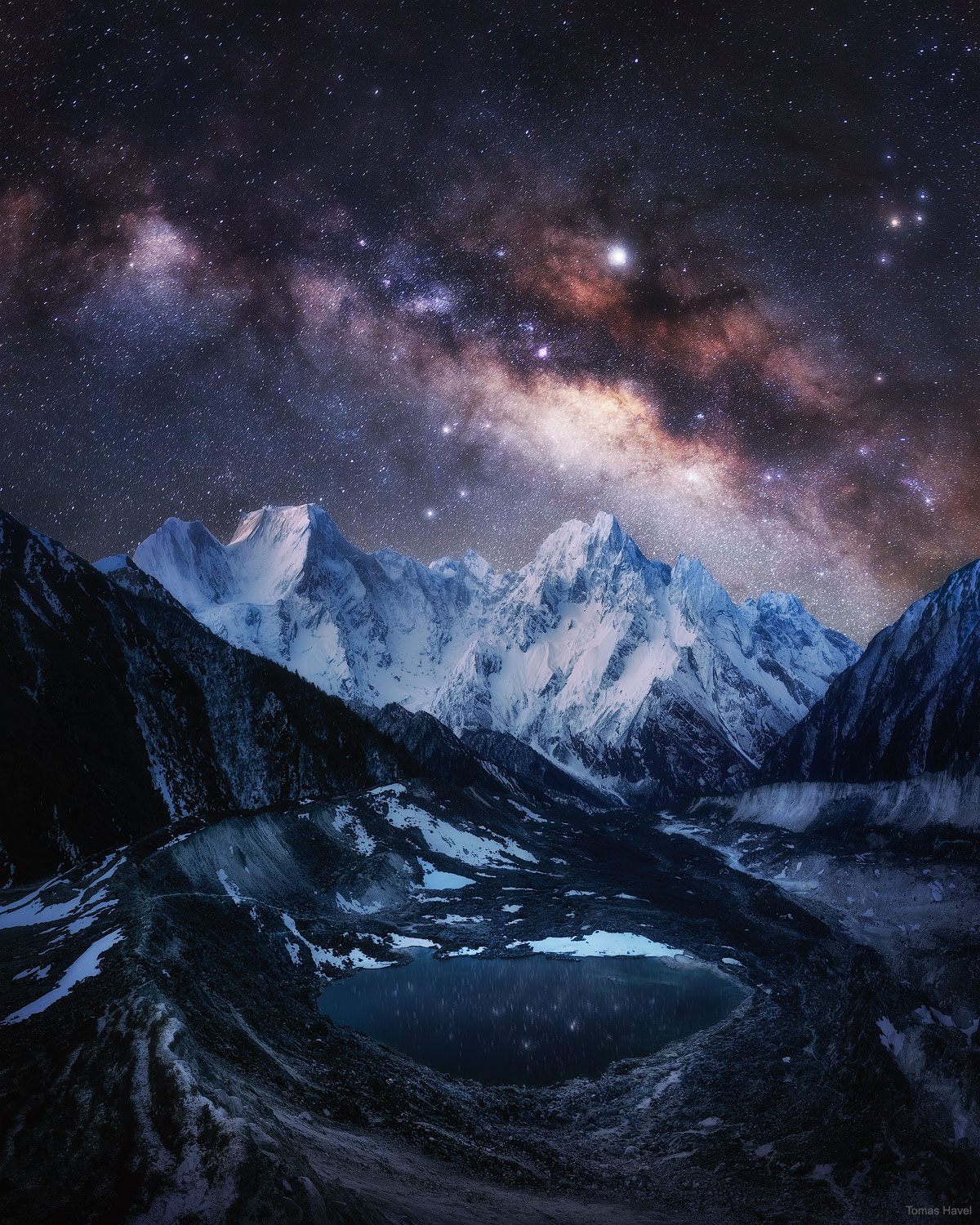
What’s higher than the Himalayas? Although the Himalayan Mountains are the tallest on planet Earth, they don't measure up to the Milky Way. Visible above the snow-capped mountains in the featured image is the arcing central band of our home galaxy. The bright spot just above the central plane is the planet Jupiter, while the brightest orange spot on the upper right is the star Antares. The astrophotographer braved below-zero temperatures at nearly 4,000-meters altitude to take the photographs that compose this image. The featured picture is a composite of eight exposures taken with same camera and from the same location over three hours, just after sunset, in 2019 April, from near Bimtang Lake in Nepal. Over much of planet Earth, the planets Mercury (faint) and Venus (bright) will be visible this week after sunset. Experts Debate: How will humanity first discover extraterrestrial life?
¿Qué es más alto que los Himalayas? Aunque las montañas del Himalaya son las más altas del planeta Tierra, no llegan a la altura de la Vía Láctea. Sobre las montañas nevadas que aparecen en la imagen se extiende el cinturón central arqueado de nuestra galaxia. El punto brillante justo por encima del plano central es el planeta Júpiter, mientras que el punto naranja más brillante en la esquina superior derecha es la estrella Antares. El fotógrafo astronómico soportó temperaturas bajo cero a una altitud de casi 4.000 metros para tomar las fotografías que componen esta imagen. La imagen destacada es un compuesto de ocho exposiciones tomadas con la misma cámara y desde el mismo lugar durante tres horas, poco después de la puesta de sol, en abril de 2019, cerca del lago Bimtang en Nepal. En gran parte del planeta Tierra, los planetas Mercurio (tenue) y Venus (brillante) serán visibles esta semana después de la puesta de sol.