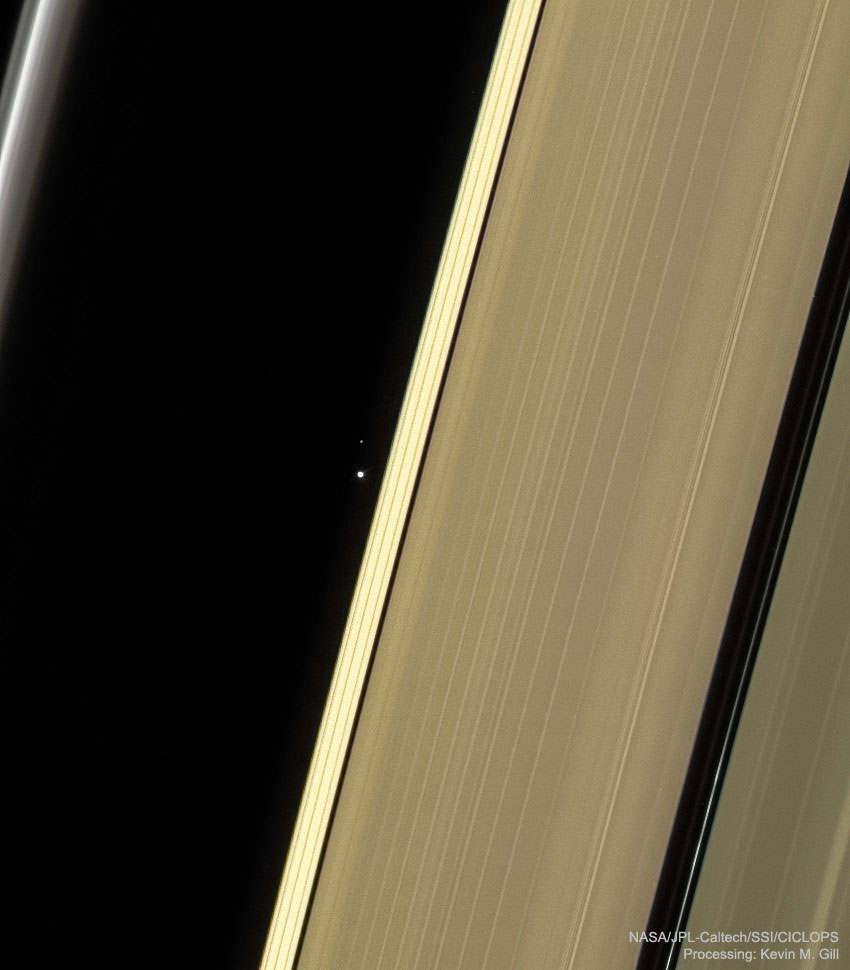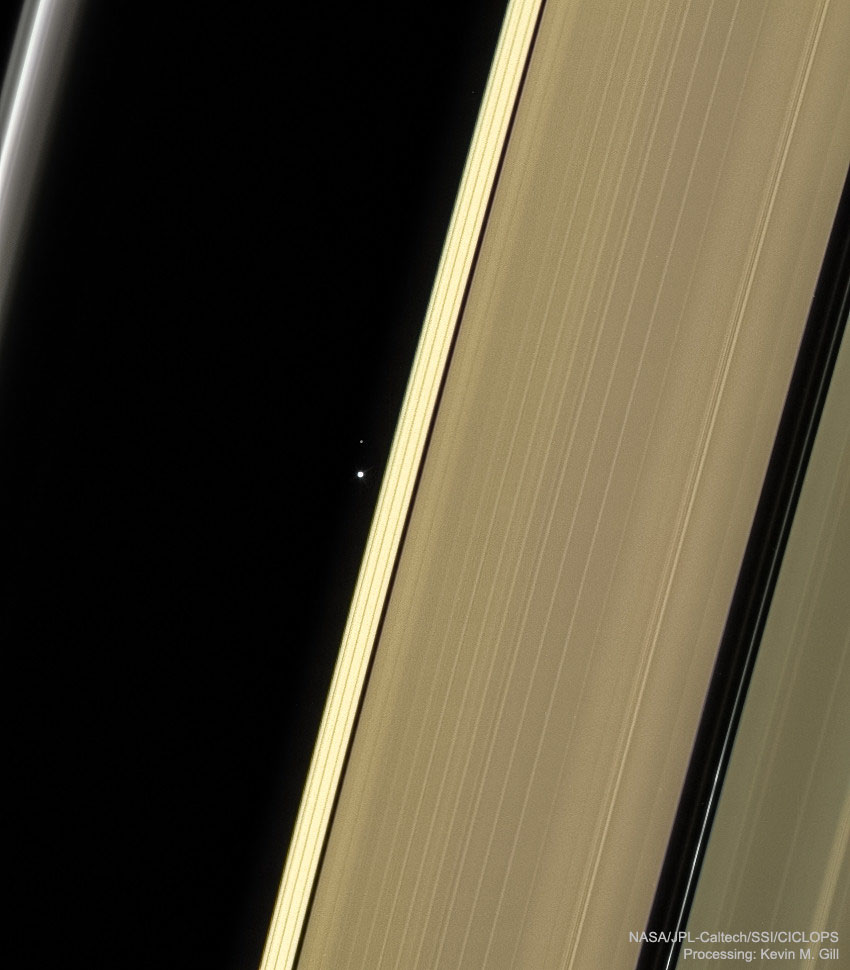
What are those dots between Saturn's rings? Our Earth and Moon. Just over three years ago, because the Sun was temporarily blocked by the body of Saturn, the robotic Cassini spacecraft was able to look toward the inner Solar System. There, it spotted our Earth and Moon -- just pin-pricks of light lying about 1.4 billion kilometers distant. Toward the right of the featured image is Saturn's A ring, with the broad Encke Gap on the far right and the narrower Keeler Gap toward the center. On the far left is Saturn's continually changing F Ring. From this perspective, the light seen from Saturn's rings was scattered mostly forward , and so appeared backlit. After more than a decade of exploration and discovery, the Cassini spacecraft ran low on fuel in 2017 and was directed to enter Saturn's atmosphere, where it surely melted. Gallery: Notable Venus & Mercury Conjunction 2020 Images submitted to APOD
¿Qué son esos puntos entre los anillos de Saturno? Nuestra Tierra y Luna. Hace apenas más de tres años, debido a que el Sol fue temporalmente bloqueado por el cuerpo de Saturno, la nave espacial robótica Cassini pudo mirar hacia el interior del Sistema Solar. Allí, logró captar nuestra Tierra y Luna —apenas diminutos puntos de luz situados a unos 1.400 millones de kilómetros de distancia. A la derecha de la imagen destacada se encuentra el anillo A de Saturno, con el amplio hueco de Encke en el extremo derecho y el más estrecho hueco de Keeler hacia el centro. En el extremo izquierdo se encuentra el continuamente cambiante anillo F de Saturno. Desde esta perspectiva, la luz que se ve proveniente de los anillos de Saturno fue dispersada principalmente hacia adelante, y por lo tanto aparece con retroiluminación. Después de más de una década de exploración y descubrimiento, la nave espacial Cassini se quedó sin combustible en 2017 y fue dirigida a entrar en la atmósfera de Saturno, donde seguramente se fundió.