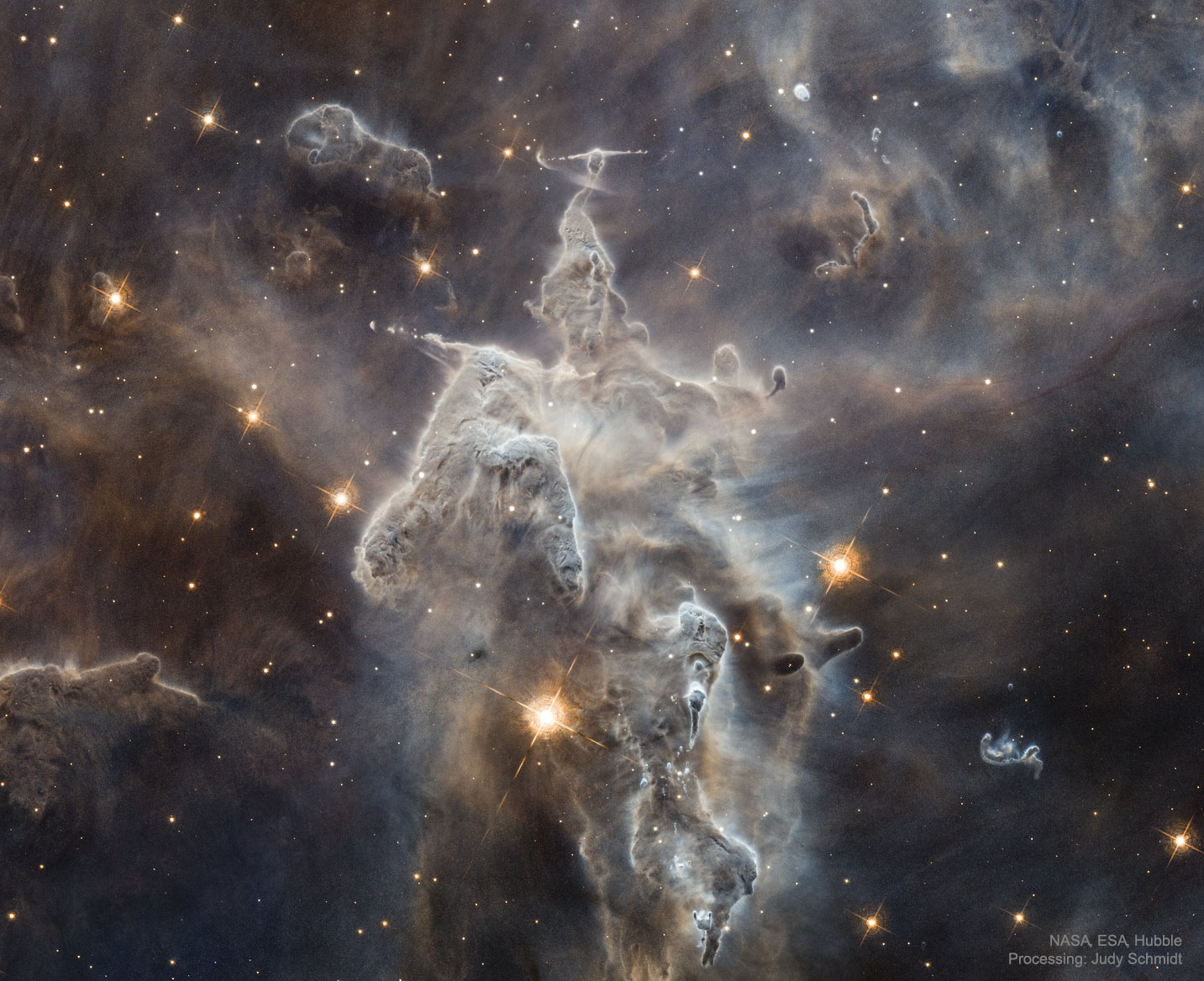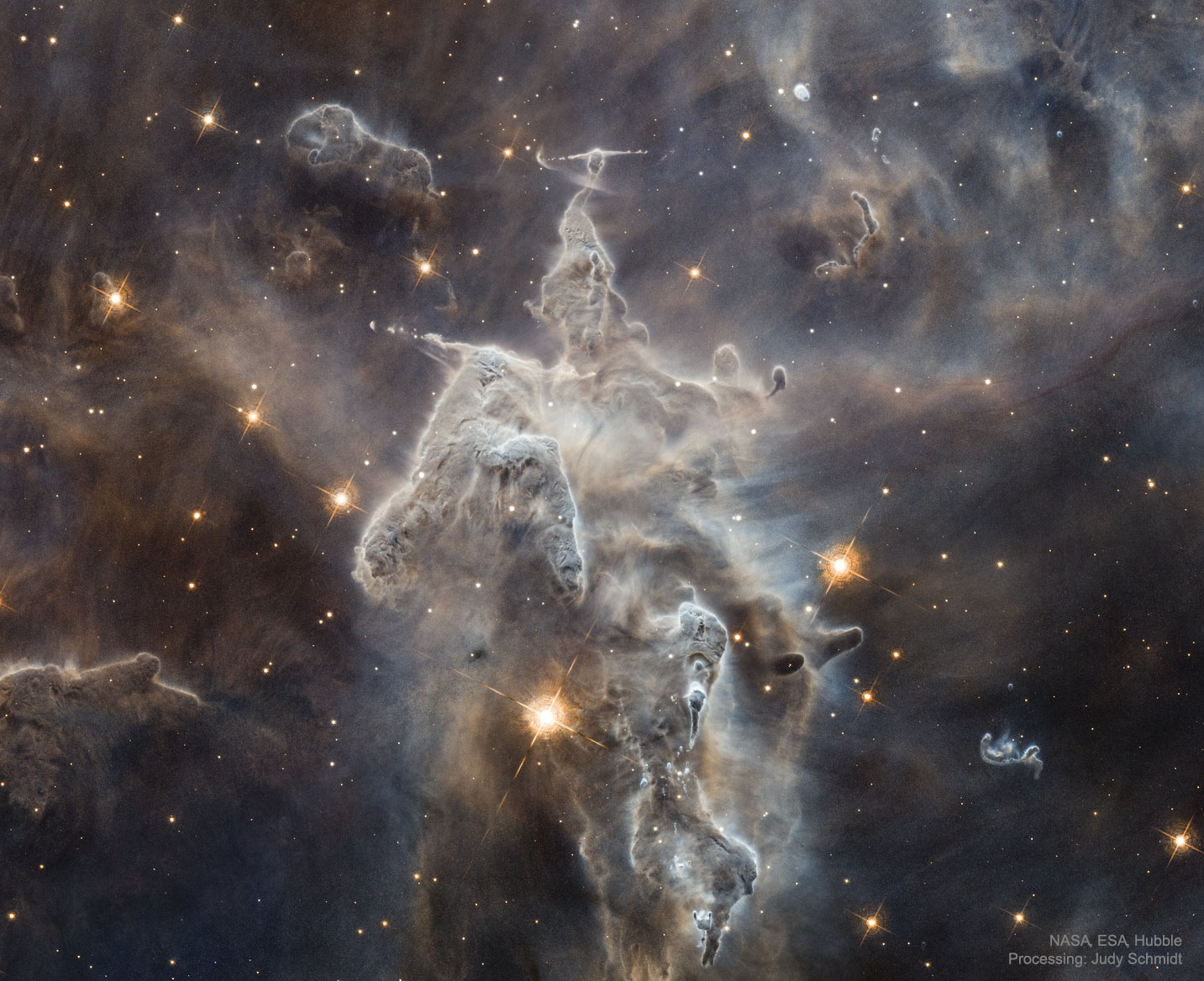
Inside the head of this interstellar monster is a star that is slowly destroying it. The huge monster, actually an inanimate series of pillars of gas and dust, measures light years in length. The in-head star is not itself visible through the opaque interstellar dust but is bursting out partly by ejecting opposing beams of energetic particles called Herbig-Haro jets. Located about 7,500 light years away in the Carina Nebula and known informally as Mystic Mountain, the appearance of these pillars is dominated by dark dust even though they are composed mostly of clear hydrogen gas. The featured image was taken with the Hubble Space Telescope. All over these pillars, the energetic light and winds from massive newly formed stars are evaporating and dispersing the dusty stellar nurseries in which they formed. Within a few million years, the head of this giant, as well as most of its body, will have been completely evaporated by internal and surrounding stars. APOD across world languages: Arabic, Catalan, Chinese (Beijing), Chinese (Taiwan), Croatian, Czech, Dutch, Farsi, French, French, German, Hebrew, Indonesian, Japanese, Korean, Montenegrin, Polish, Russian, Serbian, Slovenian, Spanish and Ukrainian
Crédito: Telescopio Espacial Hubble Dentro de la cabeza de este monstruo interestelar hay una estrella que lo está destruyendo lentamente. El enorme monstruo, en realidad una serie inanimada de pilares de gas y polvo, tiene una longitud de varios años luz. La estrella en la cabeza no es visible en sí misma a través del polvo interestelar opaco, pero se manifiesta parcialmente mediante chorros opuestos de partículas energéticas llamados chorros Herbig-Haro. Ubicado a unos 7.500 años luz de distancia en la Nebulosa de Carina y conocido informalmente como Montaña Mística, la apariencia de estos pilares está dominada por el oscuro polvo, aunque están compuestos principalmente por gas de hidrógeno transparente. La imagen destacada fue tomada con el Telescopio Espacial Hubble. En toda estas columnas, la luz y los vientos energéticos de estrellas recién formadas están evaporando y dispersando las naves estelares polvorientas en las que se formaron. En unos pocos millones de años, la cabeza de este gigante, así como gran parte de su cuerpo, habrá sido completamente evaporada por estrellas internas y circundantes.