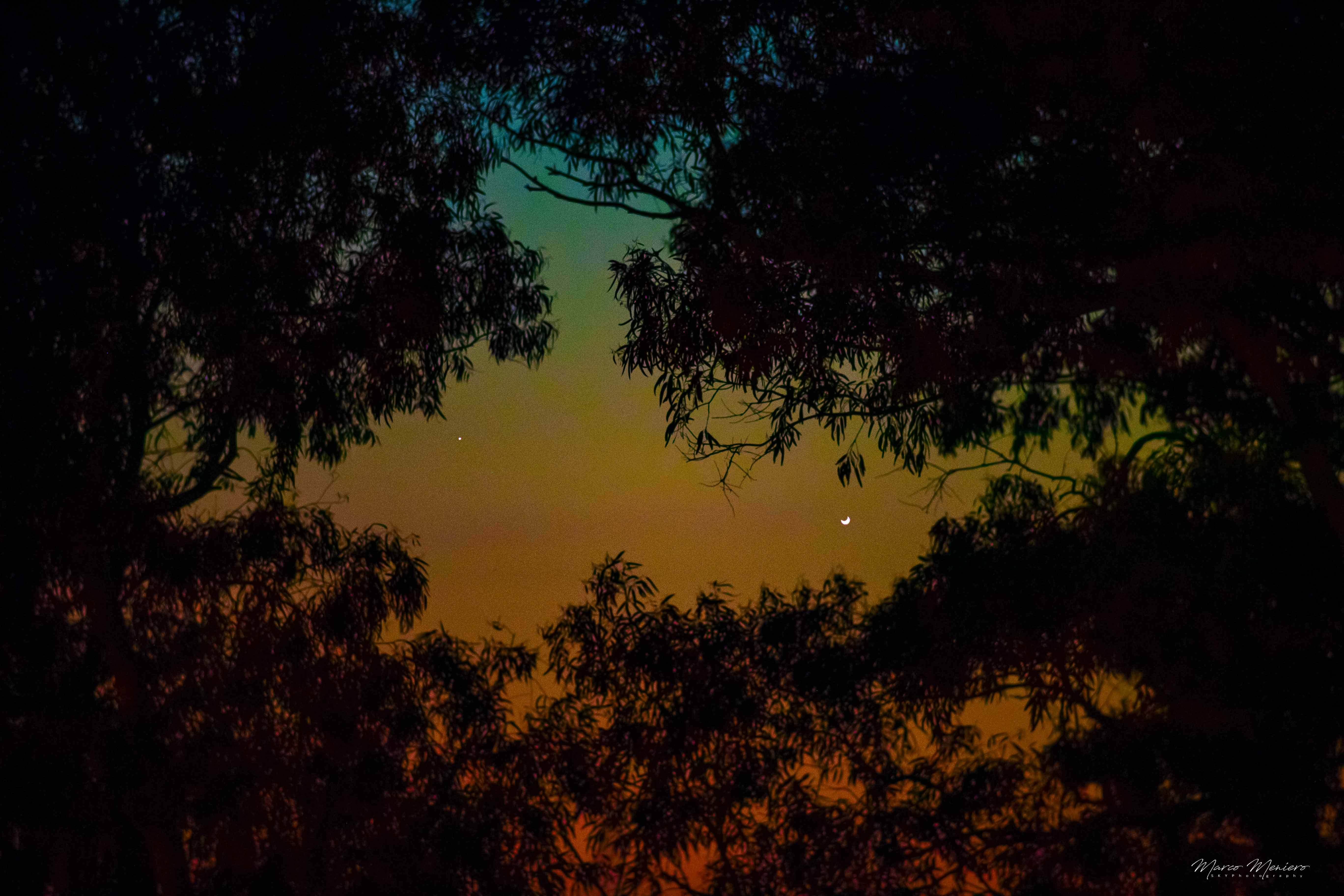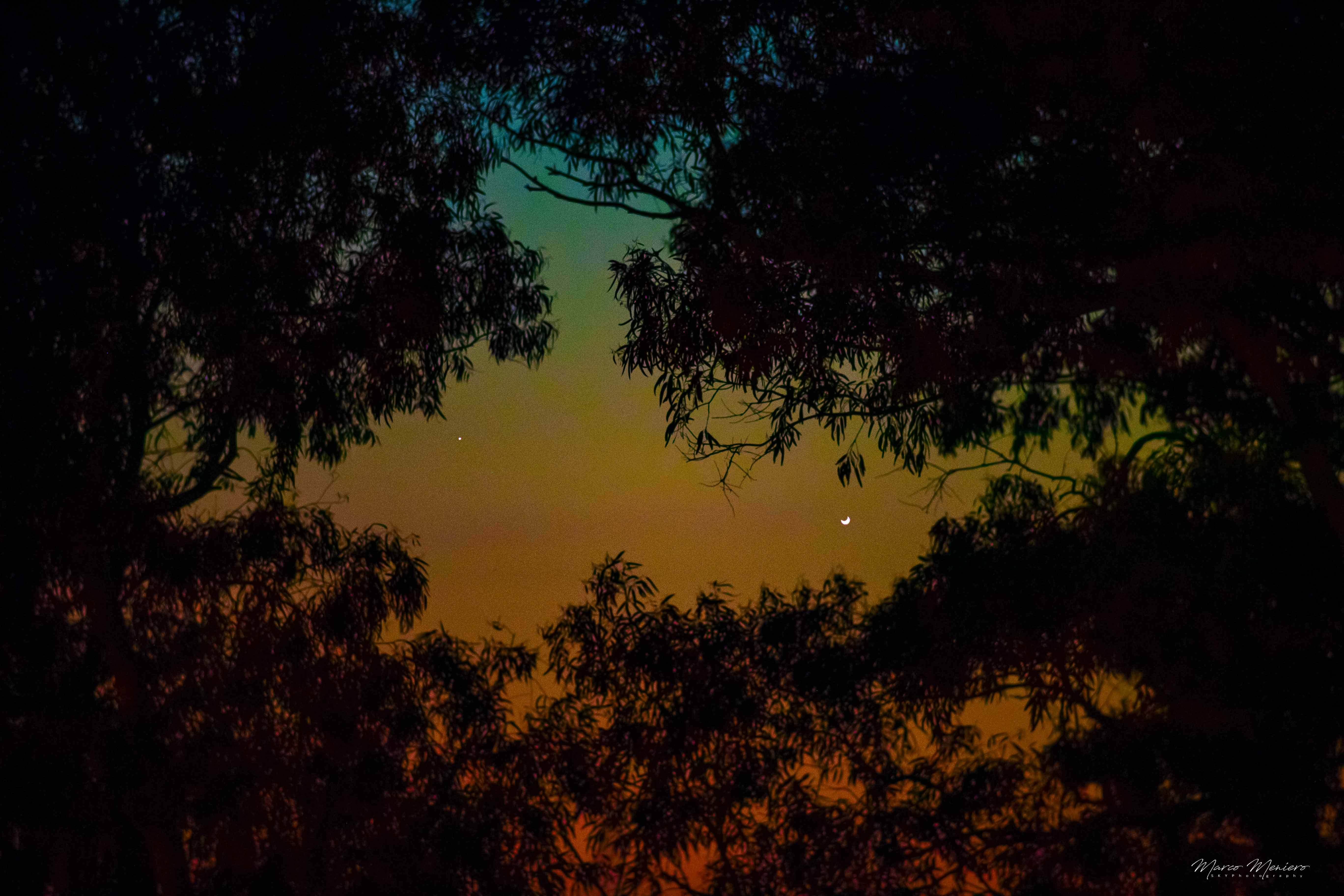
That's not a bright star and crescent Moon caught between branches of a eucalyptus tree. It's Venus in a crescent phase and Mercury. Near the western horizon after sunset, the two inner planets closely shared this telescopic field of view on May 22, seen from a balcony in Civitavecchia, Italy. Venus, the very bright celestial beacon, is wandering lower into the evening twilight. It grows larger in apparent size and shows a thinner crescent as it heads toward its inferior conjunction, positioned between Earth and Sun on June 3. Mercury, in a fuller phase, is climbing in the western sky though, reaching its maximum angular distance from the Sun on June 4 Still, this remarkably close pairing with brilliant Venus made Mercury, usually lost in bright twilight skies, easier to spot from planet Earth. Gallery: Notable Venus & Mercury Conjunction 2020 Images submitted to APOD
Eso no es una estrella brillante y un creciente en cuarto creciente atrapados entre las ramas de un árbol de eucalipto. Es Venus en fase creciente y Mercurio. Cerca del horizonte occidental después de la puesta de sol, los dos planetas interiores compartieron estrechamente este campo de visión telescópico el 22 de mayo, visto desde un balcón en Civitavecchia, Italia. Venus, la brillante señal celeste, se está desplazando hacia abajo en la tarde vespertina. Aumenta en tamaño aparente y muestra un creciente más delgado a medida que se acerca a su conjunción inferior, posicionado entre la Tierra y el Sol el 3 de junio. Mercurio, en una fase más completa, está ascendiendo en el cielo occidental, alcanzando su máxima distancia angular del Sol el 4 de junio. Sin embargo, esta combinación notablemente cercana con brillante Venus hizo que Mercurio, normalmente perdido en los cielos vespertinos brillantes, fuera más fácil de observar desde la Tierra.