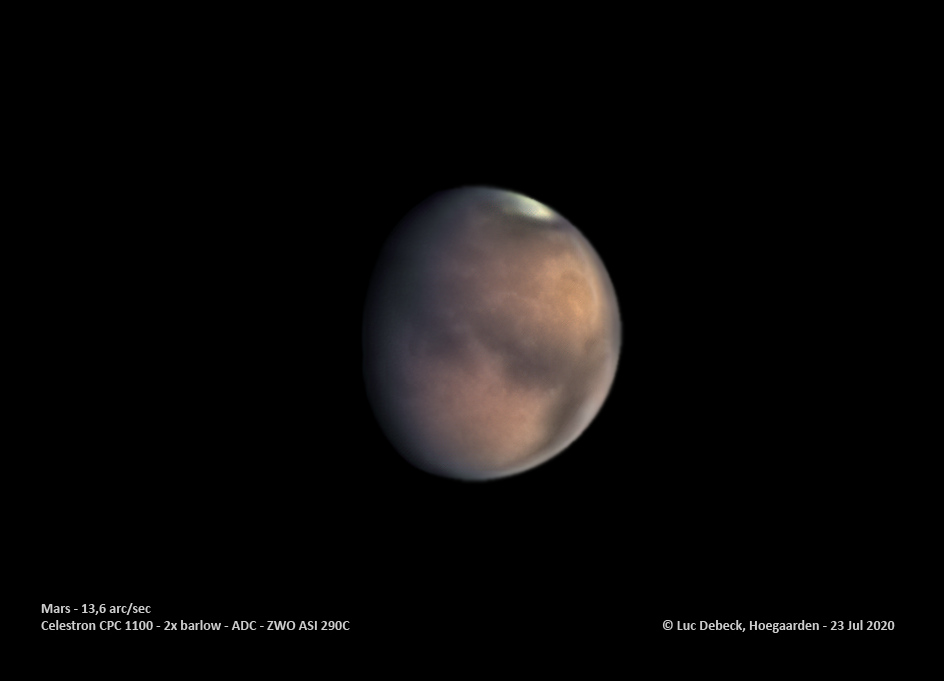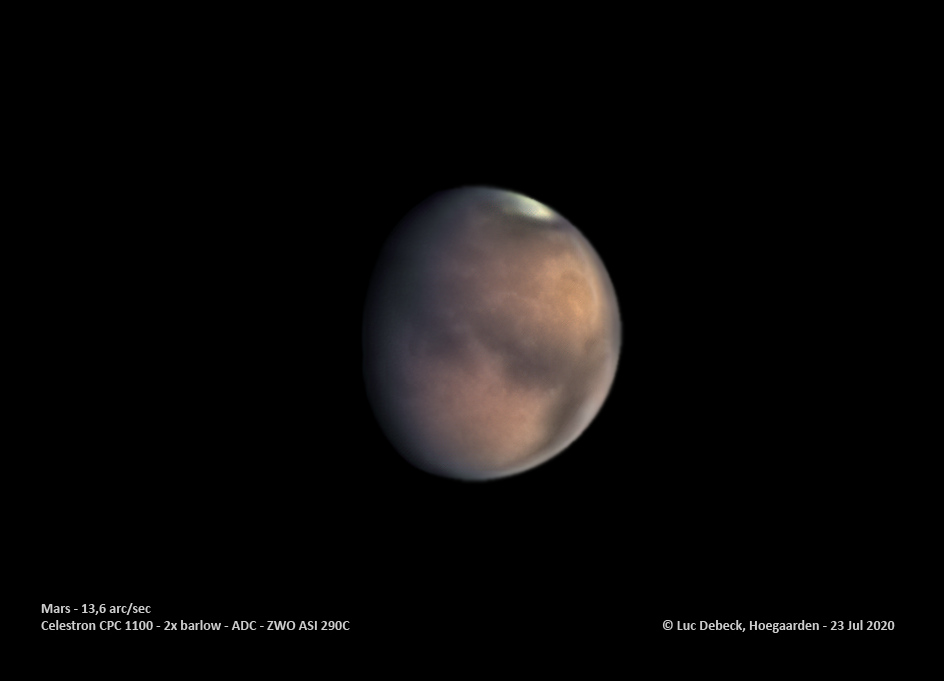
Mars looks pretty sharp in this backyard telescope image captured on July 23 from Hoegaarden, Belgium, planet Earth. The Red Planet's bright south polar cap is bathed in sunlight at the top of the inverted view, while the dark feature known as Syrtis Major extends toward the right (eastern) edge. Rising around midnight for now, the Red Planet is months away from its own opposition in early October. Telescopic views will improve even more as Earth, in its faster orbit, catches up to Mars, the ruddy disk growing larger and brighter still. The martian Jezero Crater is within the Syrtis Major region. That's the landing site for NASA's 2020 Mars Rover Perseverance, scheduled for launch today. Comet NEOWISE images from planet Earth: July 29, 28, 27, 26, 25, 24
Marte se ve bastante nítido en esta imagen capturada con un telescopio desde un jardín el 23 de julio en Hoegaarden, Bélgica, en la Tierra. El brillante casquete polar sur de Marte, rojo, está bañado por la luz solar en la parte superior de la vista invertida, mientras que la característica oscura conocida como Syrtis Major se extiende hacia el borde derecho (orientado al este). Marte ahora se levanta alrededor de la medianoche, y aún le faltan meses para su oposición de principios de octubre. Las vistas telescópicas mejorarán aún más a medida que la Tierra, en su órbita más rápida, alcance a Marte, haciendo que el disco rojizo crezca aún más grande y brillante. El cráter marciano Jezero se encuentra dentro de la región de Syrtis Major. Ese es el lugar de aterrizaje del rover de Marte Perseverance de la NASA, programado para su lanzamiento hoy.