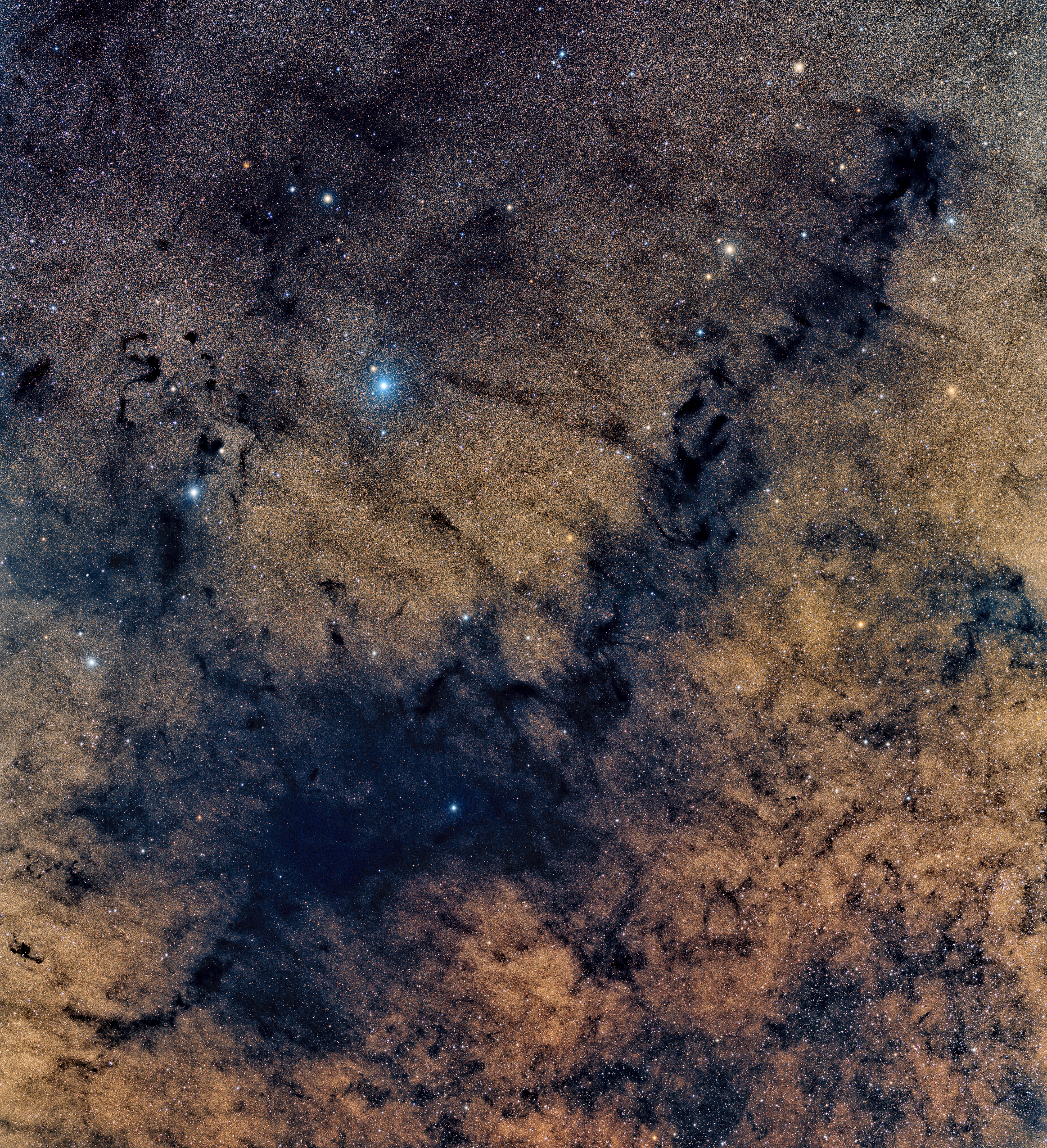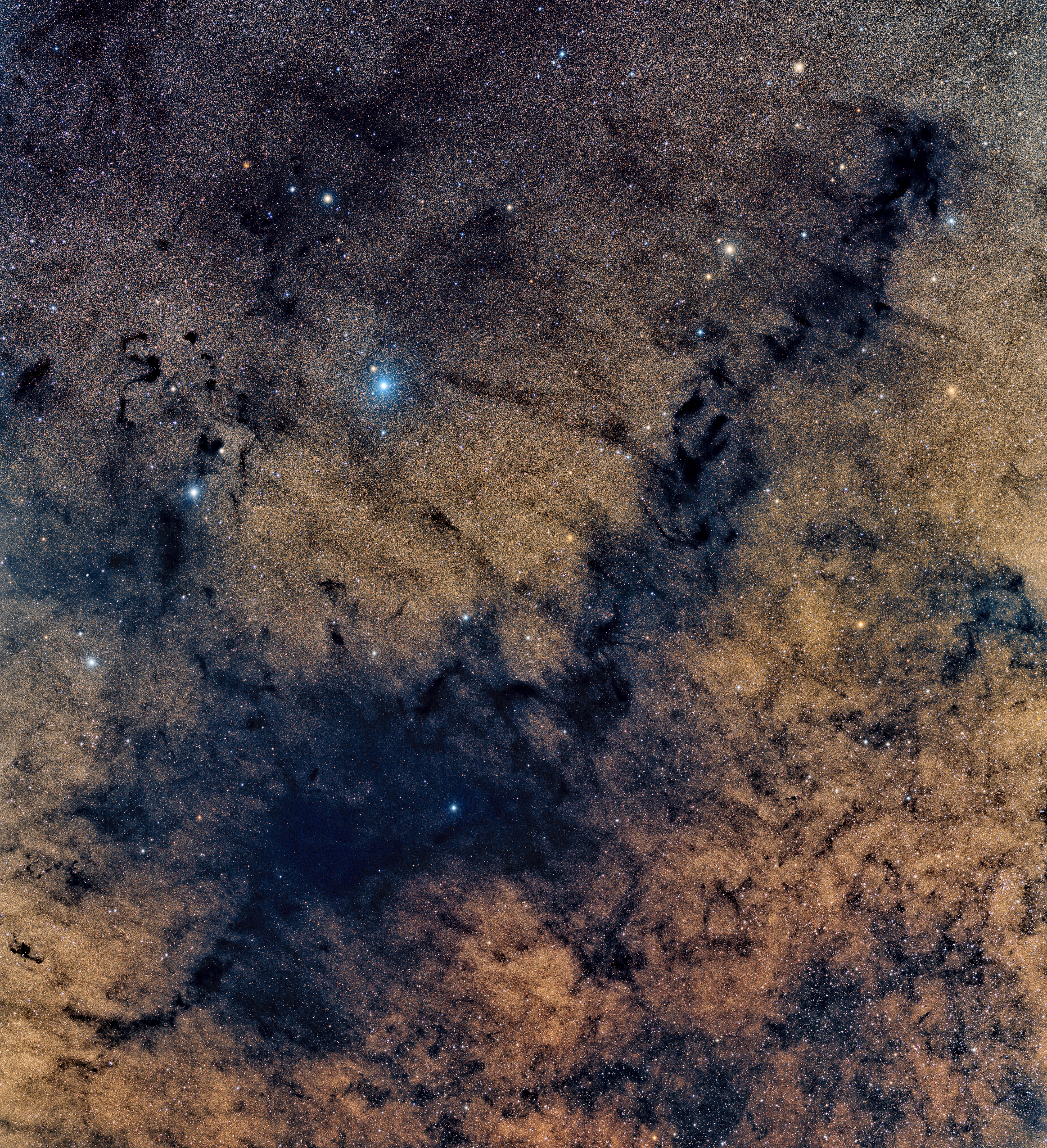
st of Antares, dark markings sprawl through crowded star fields toward the center of our Milky Way Galaxy. Cataloged in the early 20th century by astronomer E. E. Barnard, the obscuring interstellar dust clouds include B59, B72, B77 and B78, seen in against the starry background. Here, their combined shape suggests a pipe stem and bowl, and so the dark nebula's popular name is the Pipe Nebula. The deep and expansive view covers a full 10 by 10 degree field in the pronounceable constellation Ophiuchus. The Pipe Nebula is part of the Ophiuchus dark cloud complex located at a distance of about 450 light-years. Dense cores of gas and dust within the Pipe Nebula are collapsing to form stars.
Cerca de Antares, marcas oscuras se extienden a través de campos estelares densos hacia el centro de nuestra Galaxia Vía Láctea. Catalogadas a principios del siglo XX por el astrónomo E. E. Barnard, las nubes de polvo interestelar que oscurecen incluyen B59, B72, B77 y B78, visibles contra el fondo estrellado. Aquí, su forma combinada sugiere un tallo y una boquilla de caña, y por eso el nombre popular de esta nebulosa oscura es la Nebulosa de la Caña. Esta profunda y amplia vista cubre un campo completo de 10 por 10 grados en la constelación pronunciable Ophiuchus. La Nebulosa de la Caña forma parte del complejo de nubes oscuras de Ophiuchus, ubicado a una distancia de aproximadamente 450 años luz. Núcleos densos de gas y polvo dentro de la Nebulosa de la Caña se están colapsando para formar estrellas.