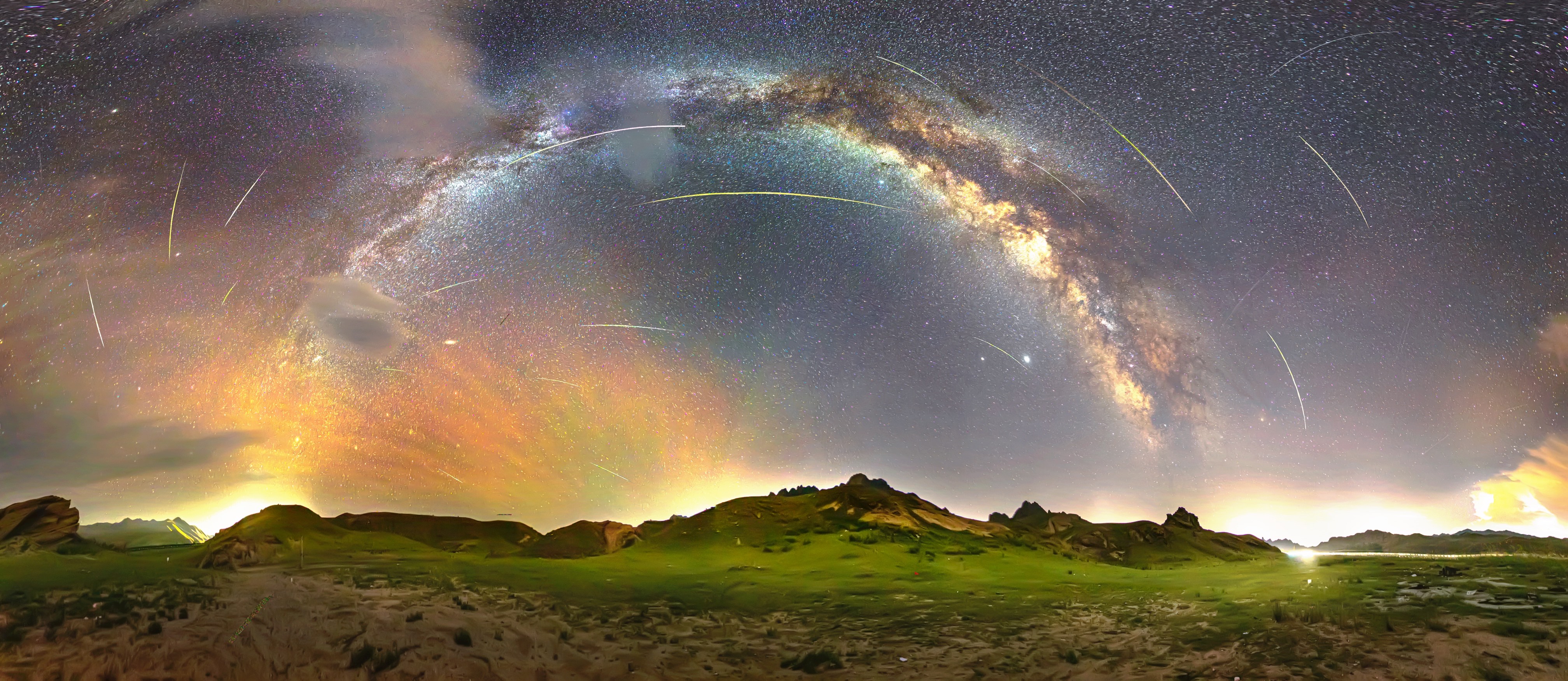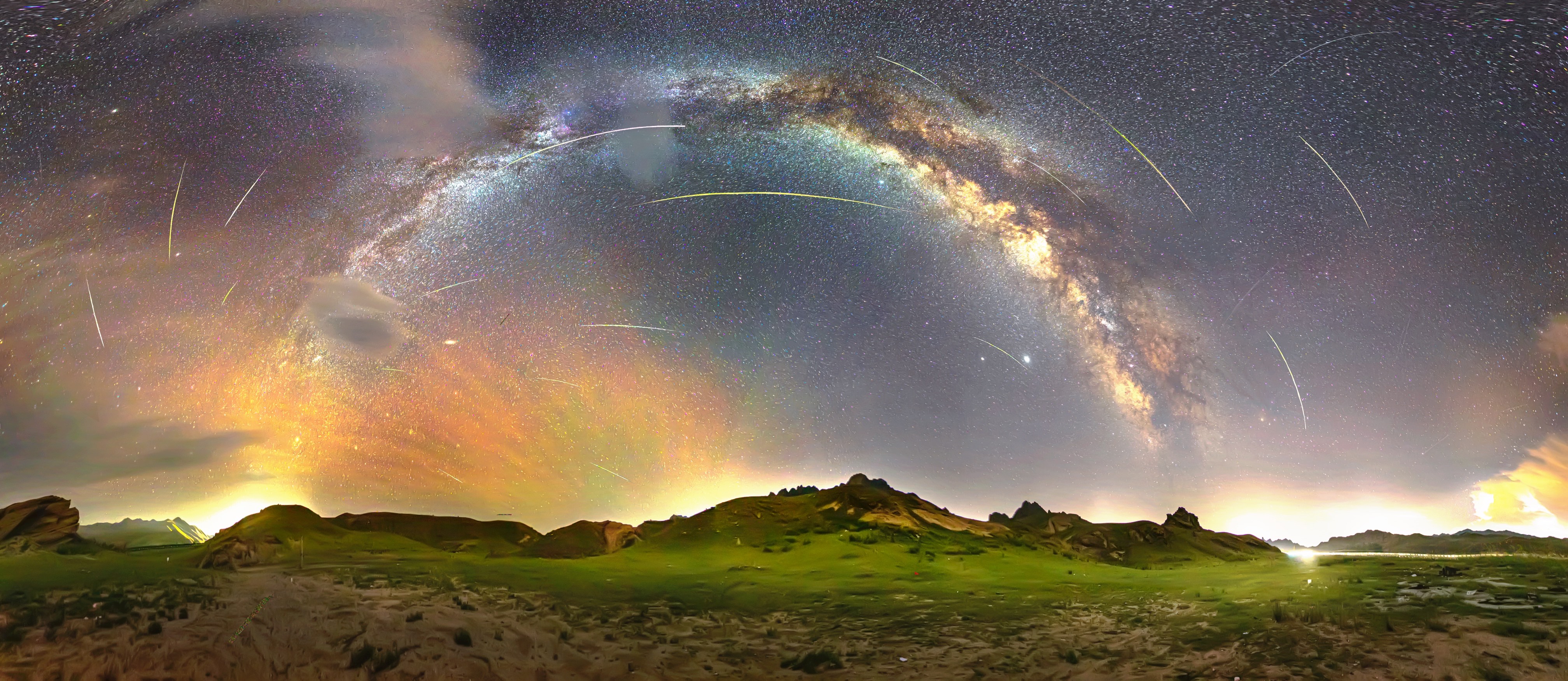
Why would meteor trails appear curved? The arcing effect arises only because the image artificially compresses (nearly) the whole sky into a rectangle. The meteors are from the Perseid Meteor Shower that peaked last week. The featured multi-frame image combines not only different directions from the 360 projection, but different times when bright Perseid meteors momentarily streaked across the sky. All Perseid meteors can be traced back to the constellation Perseus toward the lower left, even the seemingly curved (but really straight) meteor trails. Although Perseids always point back to their Perseus radiant, they can appear almost anywhere on the sky. The image was taken from Inner Mongolia, China, where grasslands meet sand dunes. Many treasures also visible in the busy night sky including the central arch of our Milky Way Galaxy, the planets Saturn and Jupiter toward the right, colorful airglow on the central left, and some relatively nearby Earthly clouds. The Perseid Meteor Shower peaks every August. Perseid Meteor Shower: Notable images submitted to APOD
¿Por qué aparecen curvadas las trayectorias de los meteoros? El efecto de arco se debe únicamente a que la imagen comprime artificialmente (casi) todo el cielo en un rectángulo. Los meteoros provienen de la lluvia de meteoros de las Perseidas, que alcanzó su máximo la semana pasada. La imagen mostrada combina no solo diferentes direcciones de la proyección 360, sino también diferentes momentos en los que brillantes meteoros de las Perseidas cruzaron momentáneamente el cielo. Todos los meteoros de las Perseidas pueden ser trazados hacia la constelación de Perseo, en la parte inferior izquierda, incluso las trayectorias aparentemente curvadas (pero en realidad rectas). Aunque las Perseidas siempre apuntan hacia su radiante en Perseo, pueden aparecer casi en cualquier lugar del cielo. La imagen fue tomada en la región de Mongolia Interior, China, donde los pastizales se encuentran con dunas de arena. También se pueden apreciar muchas maravillas en el cielo nocturno, incluyendo el arco central de nuestra galaxia, la Vía Láctea, los planetas Saturno y Júpiter a la derecha, una colorida emisión atmosférica en la parte central izquierda, y algunas nubes terrestres relativamente cercanas. La lluvia de meteoros de las Perseidas alcanza su máximo cada agosto.