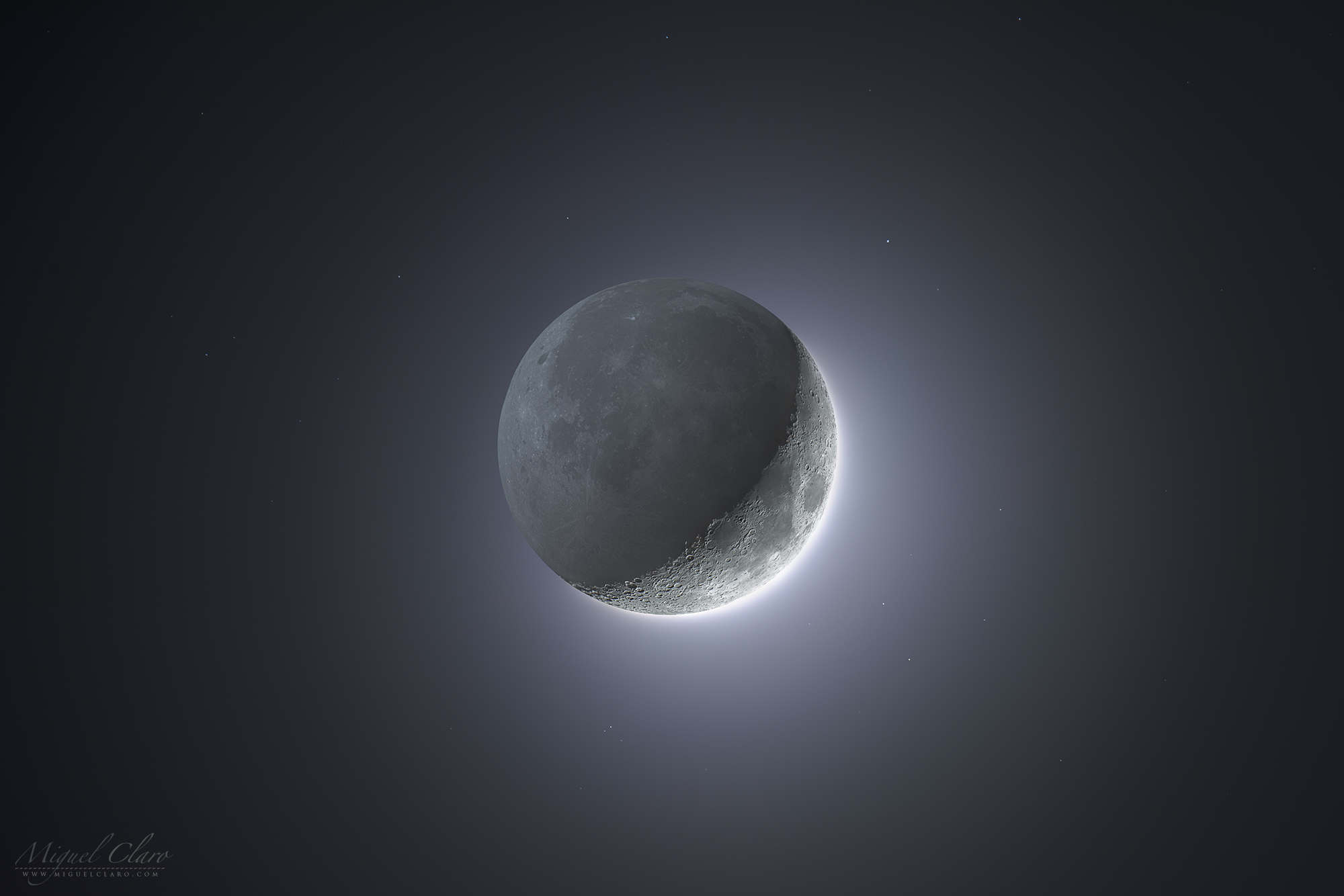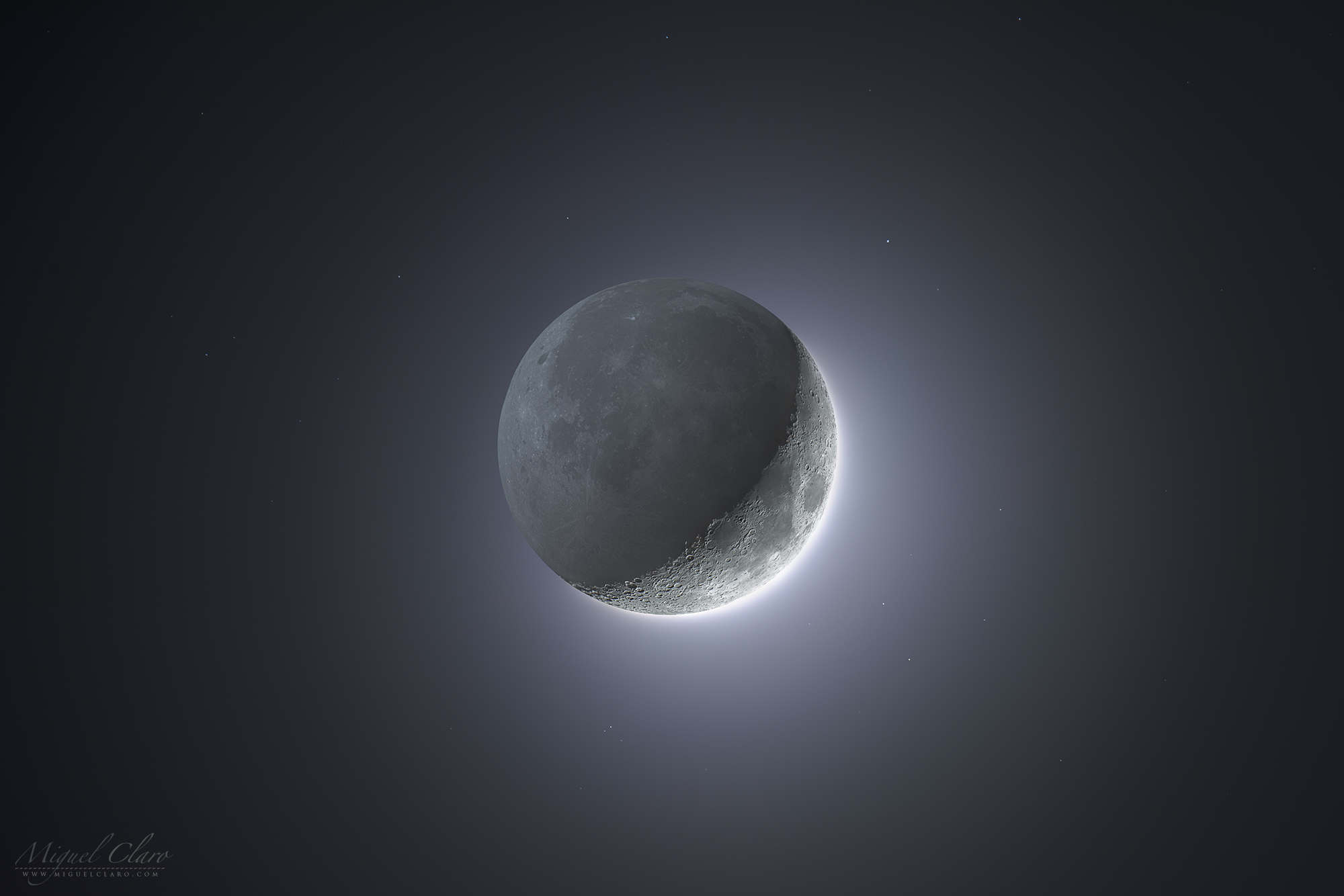
How come the crescent Moon doesn't look like this? For one reason, because your eyes can't simultaneously discern bright and dark regions like this. Called earthshine or the da Vinci glow, the unlit part of a crescent Moon is visible but usually hard to see because it is much dimmer than the sunlit arc. In our digital age, however, the differences in brightness can be artificially reduced. The featured image is actually a digital composite of 15 short exposures of the bright crescent, and 14 longer exposures of the dim remainder. The origin of the da Vinci glow, as explained by Leonardo da Vinci about 510 years ago, is sunlight reflected first by the Earth to the Moon, and then back from the Moon to the Earth.
¿Por qué la Luna creciente no se ve así? Por una razón, porque tus ojos no pueden discernir simultáneamente regiones brillantes y oscuras como esta. Llamada luz terrestre o brillo de Da Vinci, la parte no iluminada de una Luna creciente es visible pero normalmente difícil de ver porque es mucho más tenue que el arco iluminado por el Sol. Sin embargo, en nuestra era digital, las diferencias en brillo pueden reducirse artificialmente. La imagen destacada es en realidad un compuesto digital de 15 exposiciones cortas de la creciente brillante, y 14 exposiciones más largas del resto tenue. El origen del brillo de Da Vinci, explicado por Leonardo Da Vinci hace aproximadamente 510 años, es la luz solar reflejada primero por la Tierra hacia la Luna, y luego de vuelta desde la Luna a la Tierra.