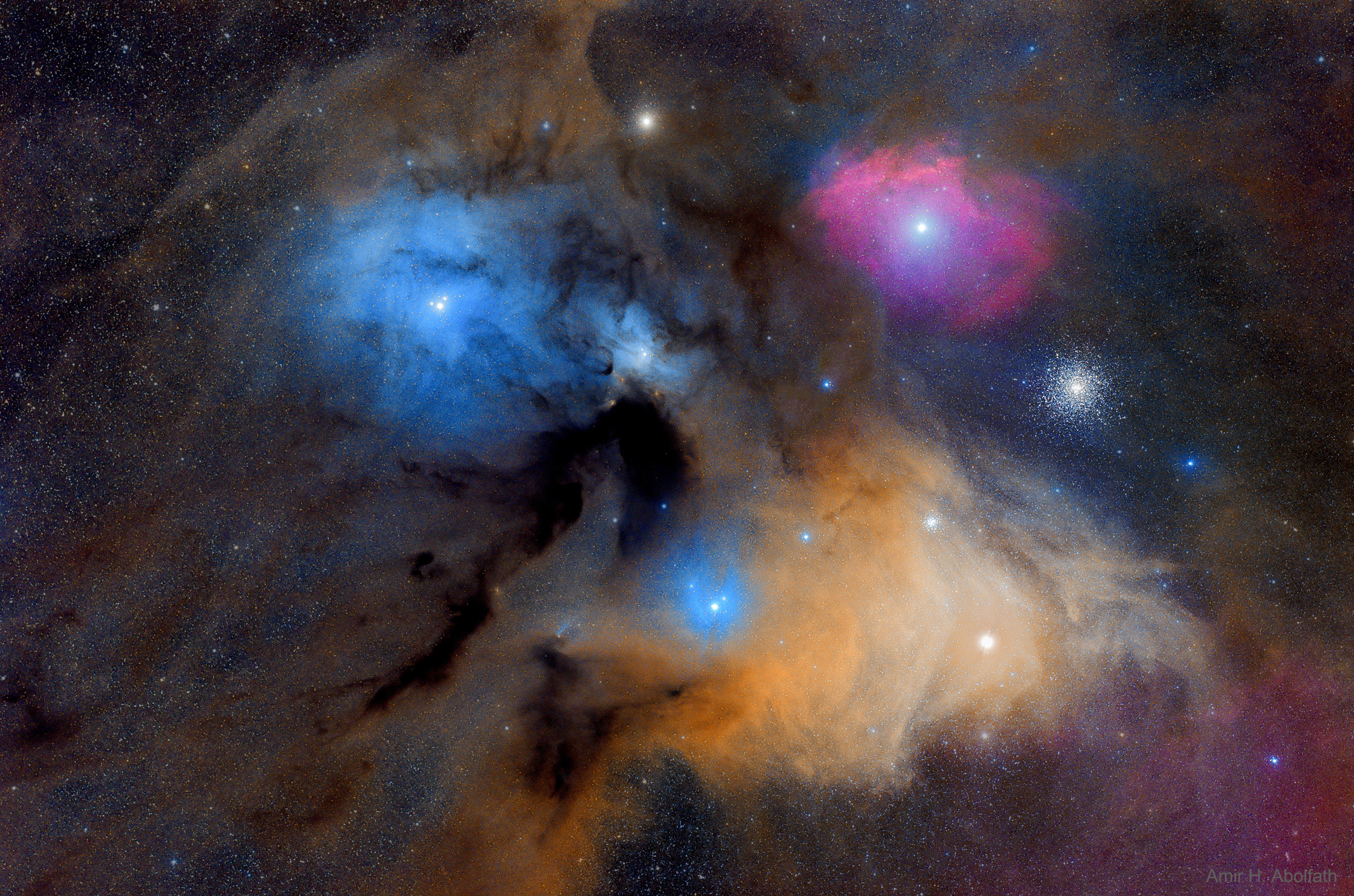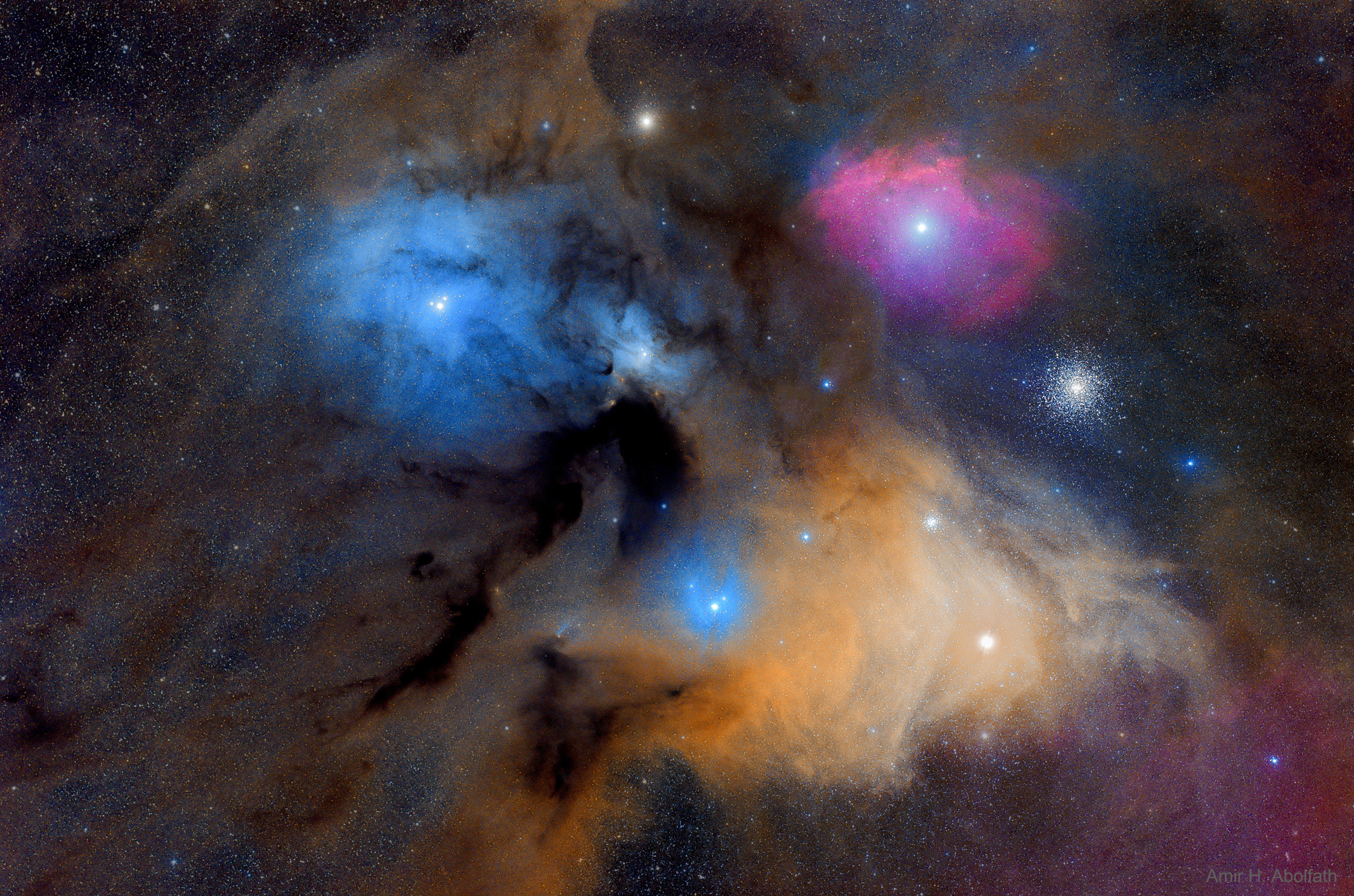
The many spectacular colors of the Rho Ophiuchi (oh'-fee-yu-kee) clouds highlight the many processes that occur there. The blue regions shine primarily by reflected light. Blue light from the Rho Ophiuchi star system and nearby stars reflects more efficiently off this portion of the nebula than red light. The Earth's daytime sky appears blue for the same reason. The red and yellow regions shine primarily because of emission from the nebula's atomic and molecular gas. Light from nearby blue stars - more energetic than the bright star Antares - knocks electrons away from the gas, which then shines when the electrons recombine with the gas. The dark brown regions are caused by dust grains - born in young stellar atmospheres - which effectively block light emitted behind them. The Rho Ophiuchi star clouds, well in front of the globular cluster M4 visible here on the upper right, are even more colorful than humans can see - the clouds emits light in every wavelength band from the radio to the gamma-ray. Astrophysicists: Browse 2,200+ codes in the Astrophysics Source Code Library
Los muchos colores espectaculares de las nubes de Rho Ophiuchi (oh'-fee-yu-kee) resaltan los muchos procesos que ocurren allí. Las regiones azules brillan principalmente por luz reflejada. La luz azul del sistema estelar Rho Ophiuchi y de estrellas cercanas se refleja con mayor eficiencia en esta parte de la nebulosa que la luz roja. El cielo terrestre durante el día aparece azul por la misma razón. Las regiones rojas y amarillas brillan principalmente debido a la emisión del gas atómico y molecular de la nebulosa. La luz de estrellas azules cercanas, más energética que la del brillante Antares, arranca electrones del gas, el cual luego emite luz cuando los electrones se recombinan con el gas. Las regiones marrones oscuras son causadas por granos de polvo — nacidos en atmósferas estelares jóvenes — que bloquean eficazmente la luz emitida detrás de ellos. Las nubes estelares de Rho Ophiuchi, ubicadas claramente delante del cúmulo globular M4 visible aquí en la parte superior derecha, son aún más coloridas de lo que los humanos pueden ver: las nubes emiten luz en cada banda de longitud de onda, desde la radio hasta los rayos gamma.