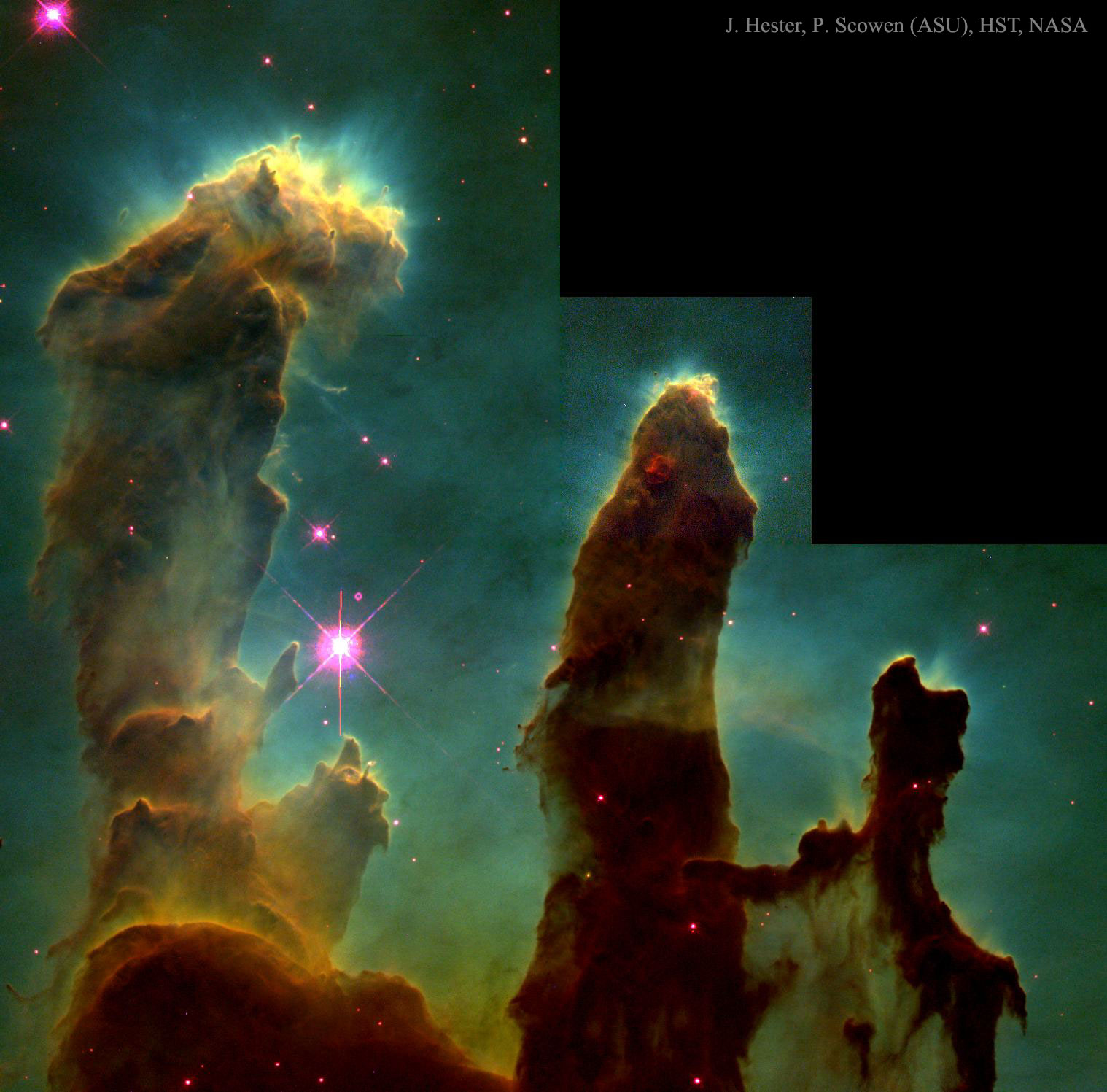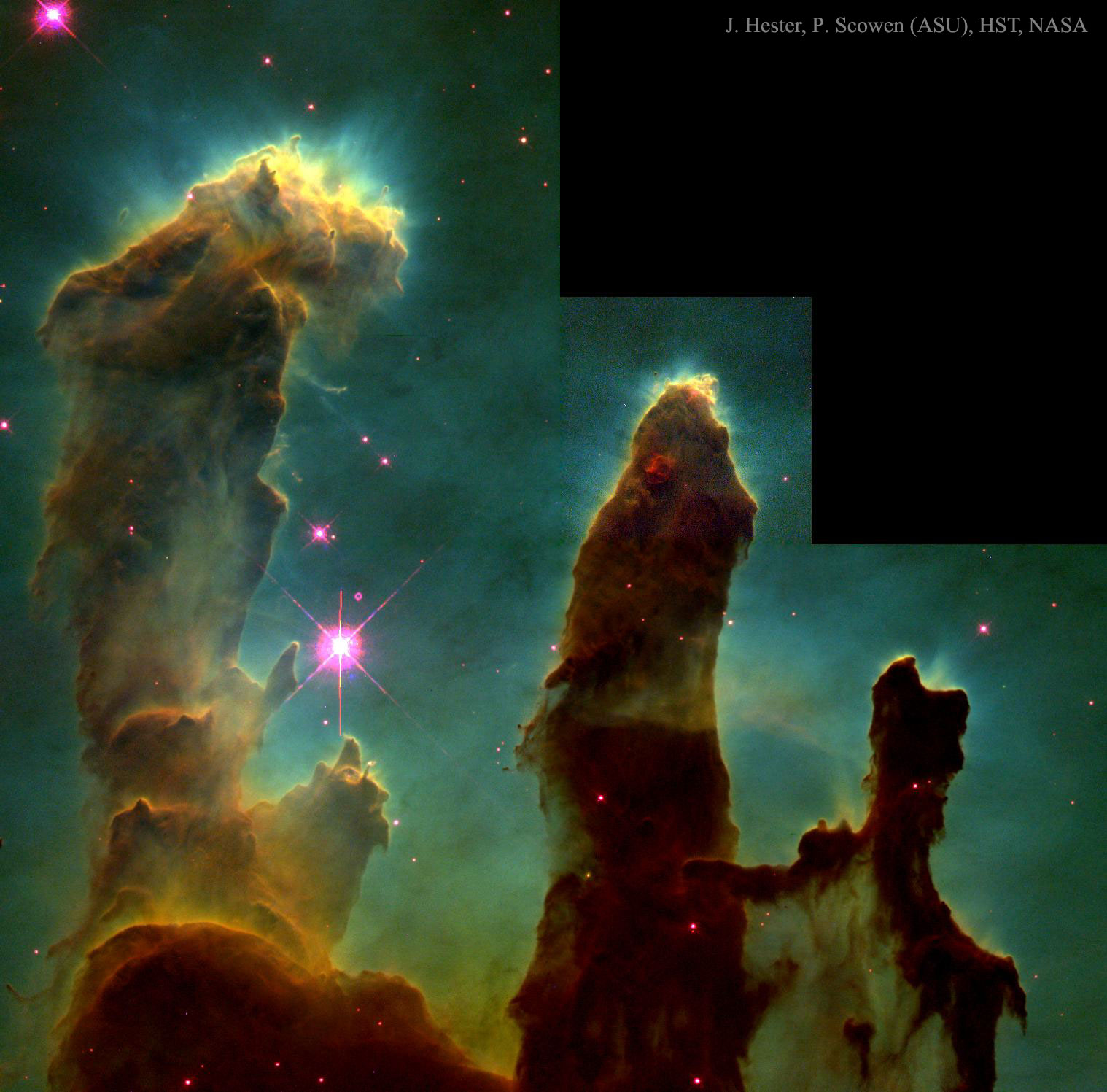
These dark pillars may look destructive, but they are creating stars. This pillar-capturing image of the inside of the Eagle Nebula, taken with the Hubble Space Telescope in 1995, shows evaporating gaseous globules (EGGs) emerging from pillars of molecular hydrogen gas and dust. The giant pillars are light years in length and are so dense that interior gas contracts gravitationally to form stars. At each pillars' end, the intense radiation of bright young stars causes low density material to boil away, leaving stellar nurseries of dense EGGs exposed. The Eagle Nebula, associated with the open star cluster M16, lies about 7000 light years away. The pillars of creation have been imaged more recently in infrared light by Hubble, NASA's Spitzer Space Telescope, and ESA's Herschel Space Observatory -- showing new detail. Be Honest: Have you seen this image before?
Estos oscuros pilares pueden parecer destructivos, pero en realidad están creando estrellas. Esta imagen capturada por el Telescopio Espacial Hubble en 1995 muestra globulos gaseosos evaporados (EGGs) emergiendo de pilares de gas de hidrógeno molecular y polvo dentro de la Nebulosa del Águila. Los gigantescos pilares tienen la longitud de años luz y son tan densos que el gas interior se contrae gravitacionalmente para formar estrellas. En cada extremo de los pilares, la intensa radiación de estrellas jóvenes brillantes hace que el material de baja densidad se evapore, dejando al descubierto las incubadoras estelares de EGGs densos. La Nebulosa del Águila, asociada al cúmulo estelar abierto M16, se encuentra a unos 7000 años luz de distancia. Los pilares de la creación han sido recientemente fotografiados en luz infrarroja por Hubble, el Telescopio Espacial Spitzer de la NASA y el Observatorio Espacial Herschel de la ESA, mostrando nuevos detalles.