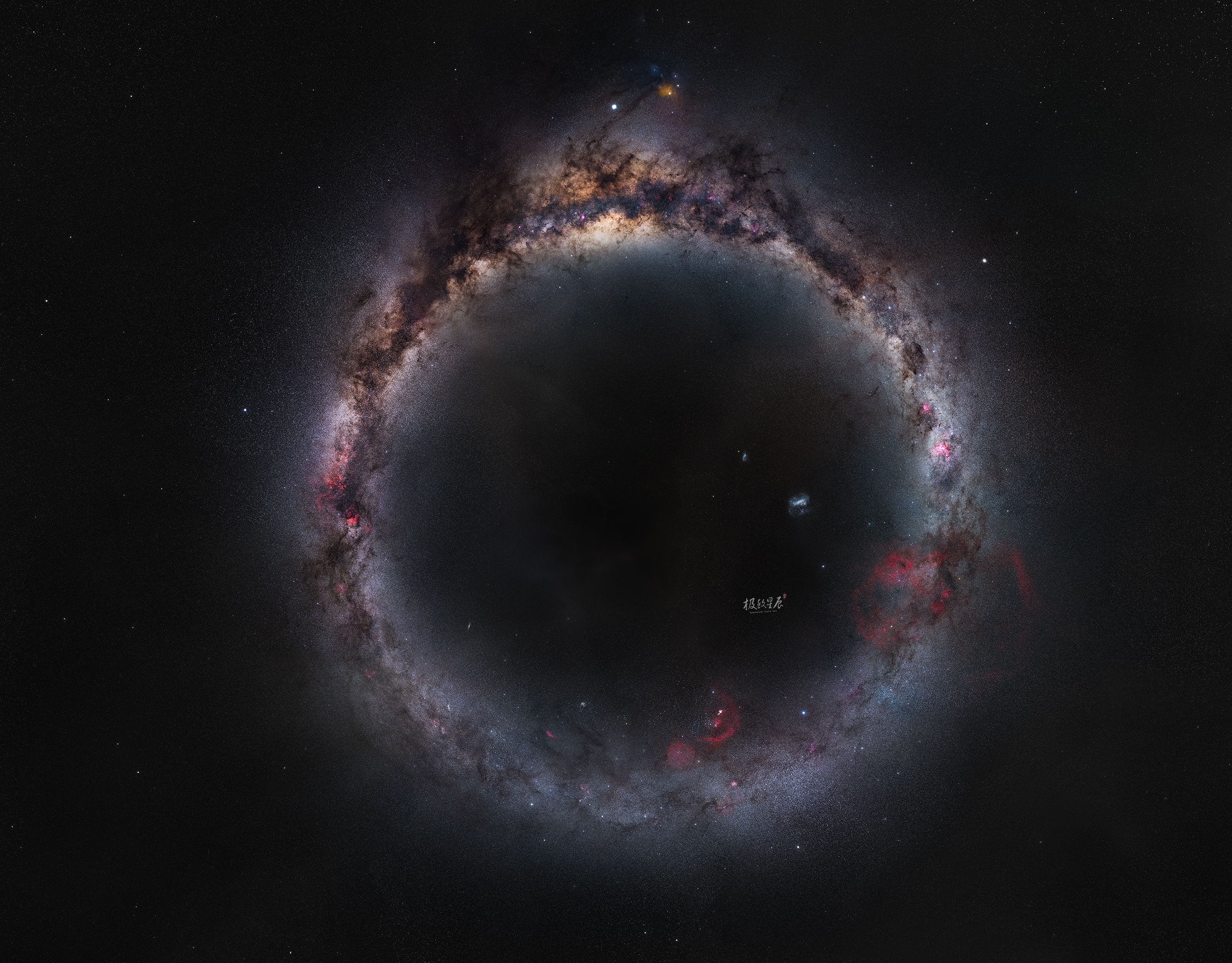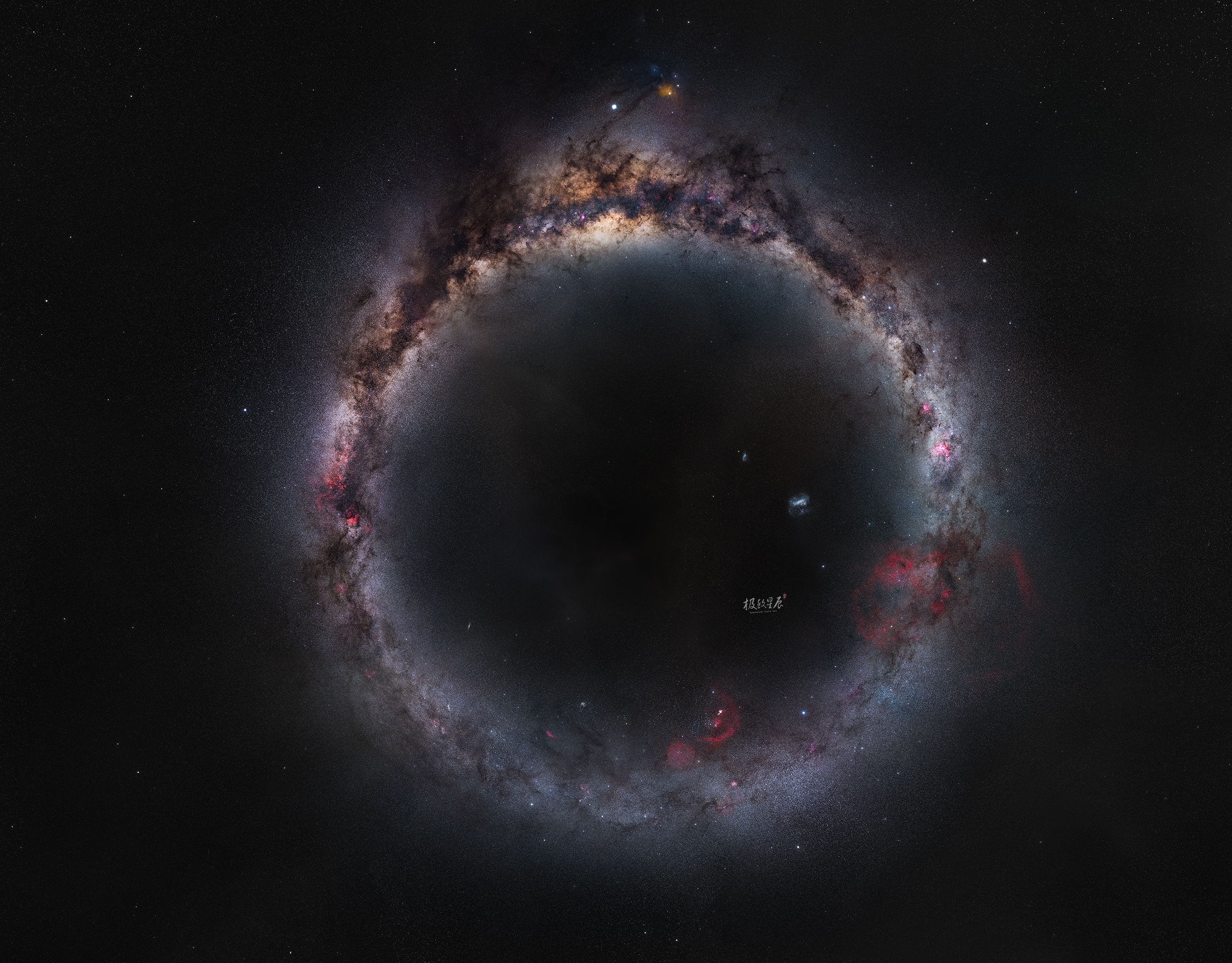
An expanse of cosmic dust, stars and nebulae along the plane of our Milky Way galaxy form a beautiful ring in this projected all-sky view. The creative panorama covers the entire galaxy visible from planet Earth, an ambitious 360 degree mosaic that took two years to complete. Northern hemisphere sites in western China and southern hemisphere sites in New Zealand were used to collect the image data. Like a glowing jewel set in the milky ring, the bulge of the galactic center, is at the very top. Bright planet Jupiter is the beacon just above the central bulge and left of red giant star Antares. Along the plane and almost 180 degrees from the galactic center, at the bottom of the ring is the area around Orion, denizen of the northern hemisphere's evening winter skies. In this projection the ring of the Milky Way encompasses two notable galaxies in southern skies, the large and small Magellanic clouds.
Una extensa región de polvo cósmico, estrellas y nebulosas a lo largo del plano de nuestra galaxia, la Vía Láctea, forma un hermoso anillo en esta vista proyectada de todo el cielo. El panorama creativo cubre toda la galaxia visible desde la Tierra, una ambiciosa mosaico de 360 grados que tomó dos años completar. Se utilizaron sitios en el hemisferio norte en el oeste de China y sitios en el hemisferio sur en Nueva Zelanda para recopilar los datos de la imagen. Como una joya brillante incrustada en el anillo lechoso, la zona central galáctica se encuentra justo en la parte superior. El planeta Júpiter brillante es el faro justo encima del bulbo central y a la izquierda de la estrella gigante roja Antares. A lo largo del plano y casi 180 grados alejado del centro galáctico, en la parte inferior del anillo se encuentra la región de Orión, habitante de los cielos invernales nocturnos del hemisferio norte. En esta proyección, el anillo de la Vía Láctea abarca dos galaxias notables en los cielos australes, las nubes grandes y pequeñas de Magallanes.