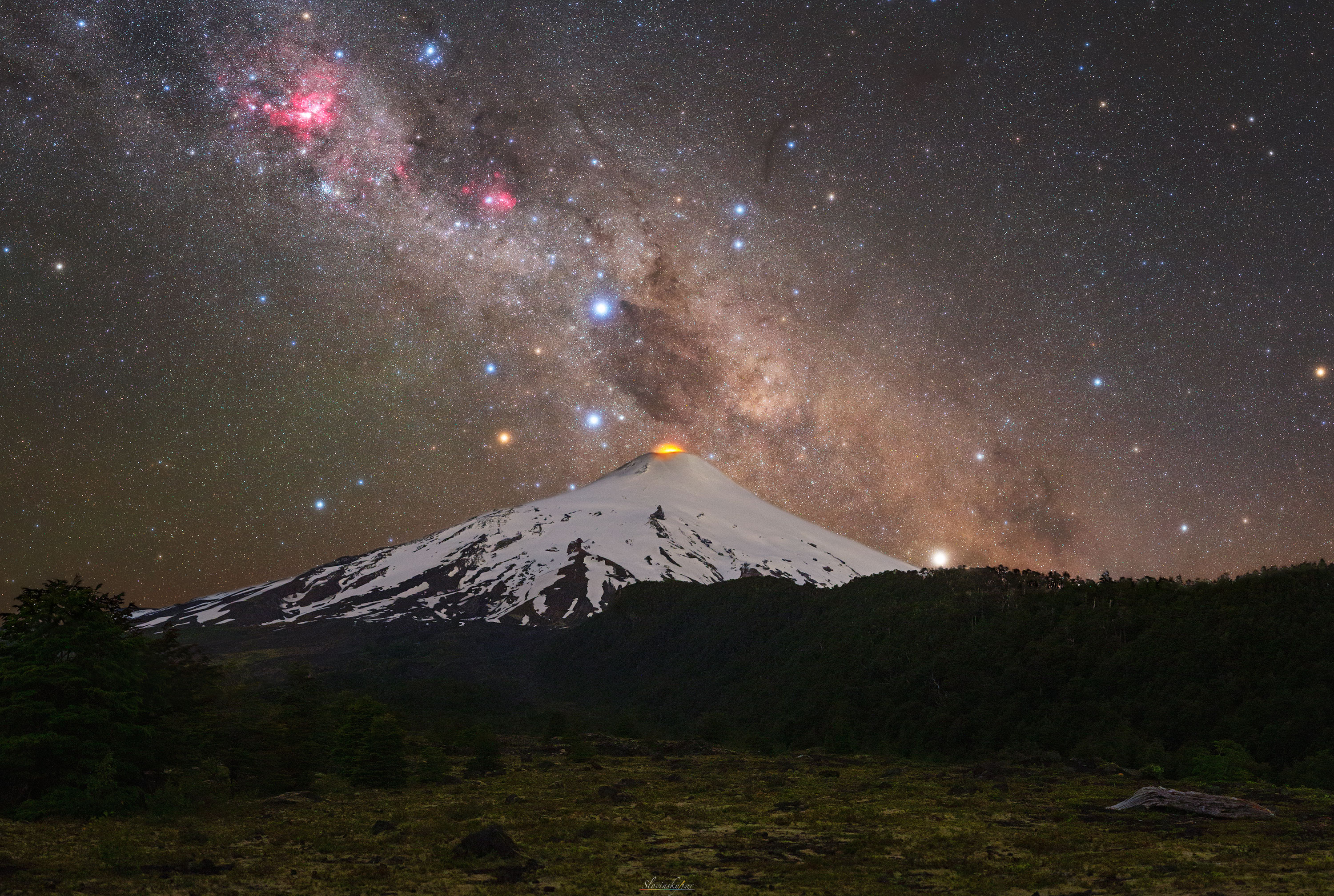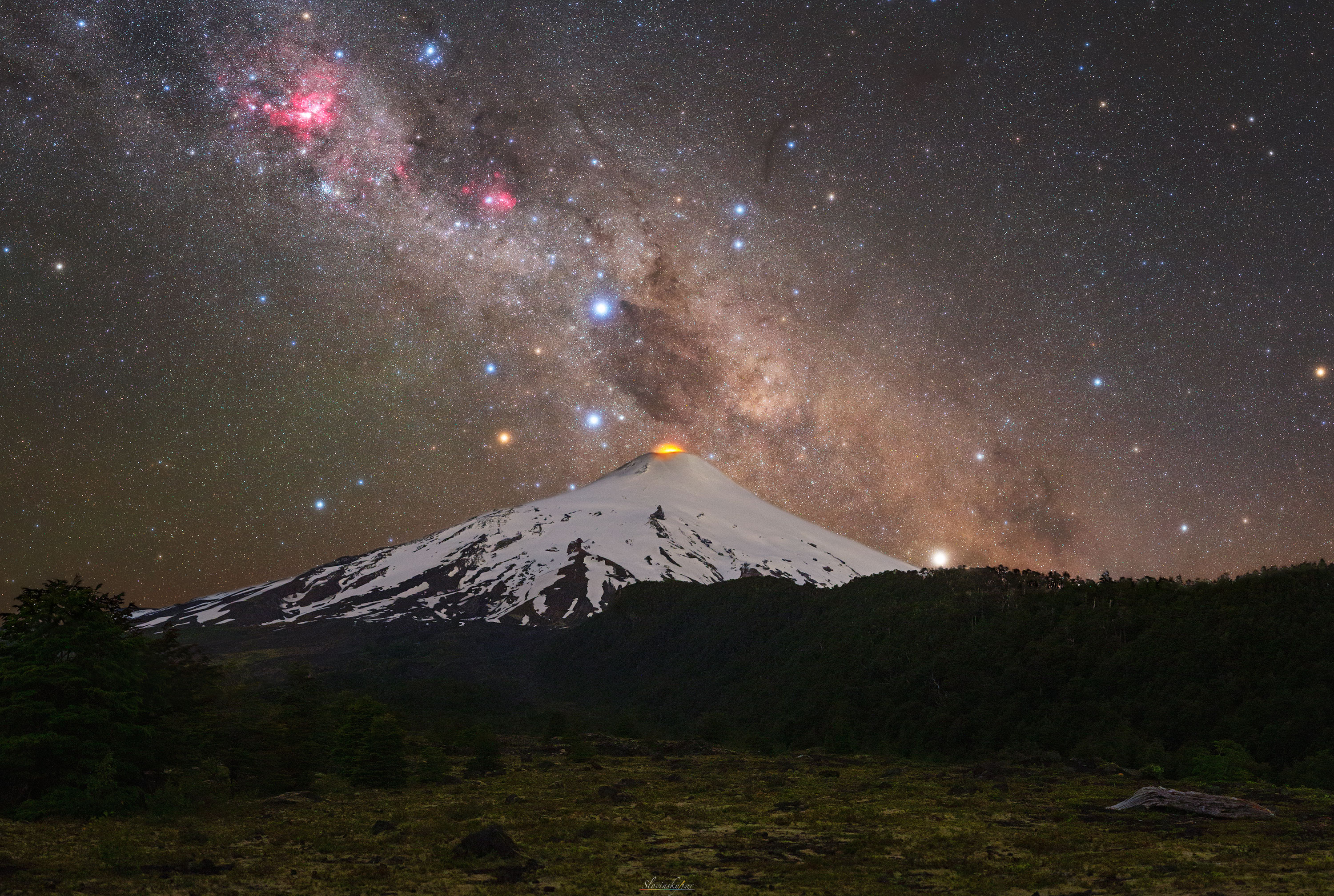
Have you ever seen the Southern Cross? This famous four-star icon is best seen from Earth's Southern Hemisphere. The featured image was taken last month in Chile and captures the Southern Cross just to the left of erupting Villarrica, one of the most active volcanos in our Solar System. Connecting the reddest Southern Cross star Gacrux through the brightest star Acrux points near the most southern location in the sky: the South Celestial Pole (SCP), around which all southern stars appear to spin as the Earth turns. In modern times, no bright star resides near the SCP, unlike in the north where bright Polaris now appears near the NCP. Extending the Gacrux - Acrux line still further (from about four to about seven times their angular separation) leads near the Small Magellanic Cloud, a bright satellite galaxy of our Milky Way Galaxy. The Southern Cross asterism dominates the Crux constellation, a deeper array of stars that includes four Cepheid variable stars visible to the unaided eye. Just above the volcano in the image, and looking like a dark plume, is the Coalsack Nebula, while the large red star-forming Carina Nebula is visible on the upper left. Portal Universe: Random APOD Generator
¿Alguna vez has visto la Cruz del Sur? Este famoso icono de cuatro estrellas se ve mejor desde el hemisferio sur de la Tierra. La imagen destacada fue tomada el mes pasado en Chile y captura la Cruz del Sur justo a la izquierda del volcán Villarrica en erupción, uno de los volcanes más activos de nuestro Sistema Solar. Unir la estrella más rojiza de la Cruz del Sur, Gacrux, con la estrella más brillante, Acrux, señala hacia la ubicación más austral en el cielo: el Polo Celeste Sur (PCS), alrededor del cual todas las estrellas del sur parecen girar a medida que la Tierra gira. En la actualidad, ninguna estrella brillante reside cerca del PCS, a diferencia del norte, donde la brillante Polar ahora aparece cerca del PNC. Extender la línea Gacrux-Acrux aún más (aproximadamente de cuatro a siete veces su separación angular) lleva cerca de la Nube de Magallanes Menor, una galaxia satélite brillante de nuestra galaxia Vía Láctea. El asterismo de la Cruz del Sur domina la constelación de Cruz, un conjunto más profundo de estrellas que incluye cuatro estrellas variables Cefeidas visibles a simple vista. Justo encima del volcán en la imagen, y pareciendo una pluma oscura, se encuentra la Nebulosa de la Bovedilla, mientras que la gran nebulosa de formación estelar Carina es visible en la parte superior izquierda.