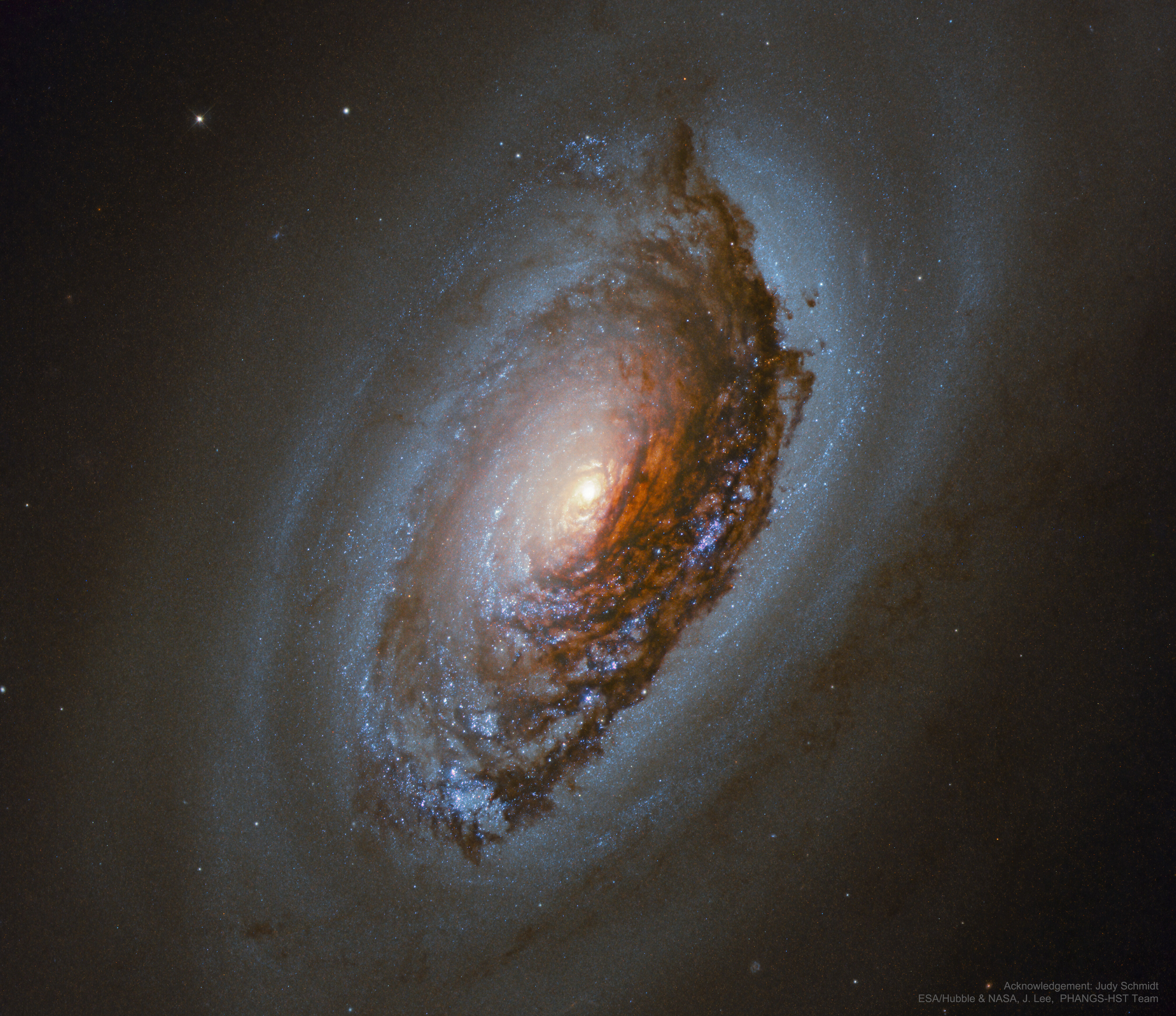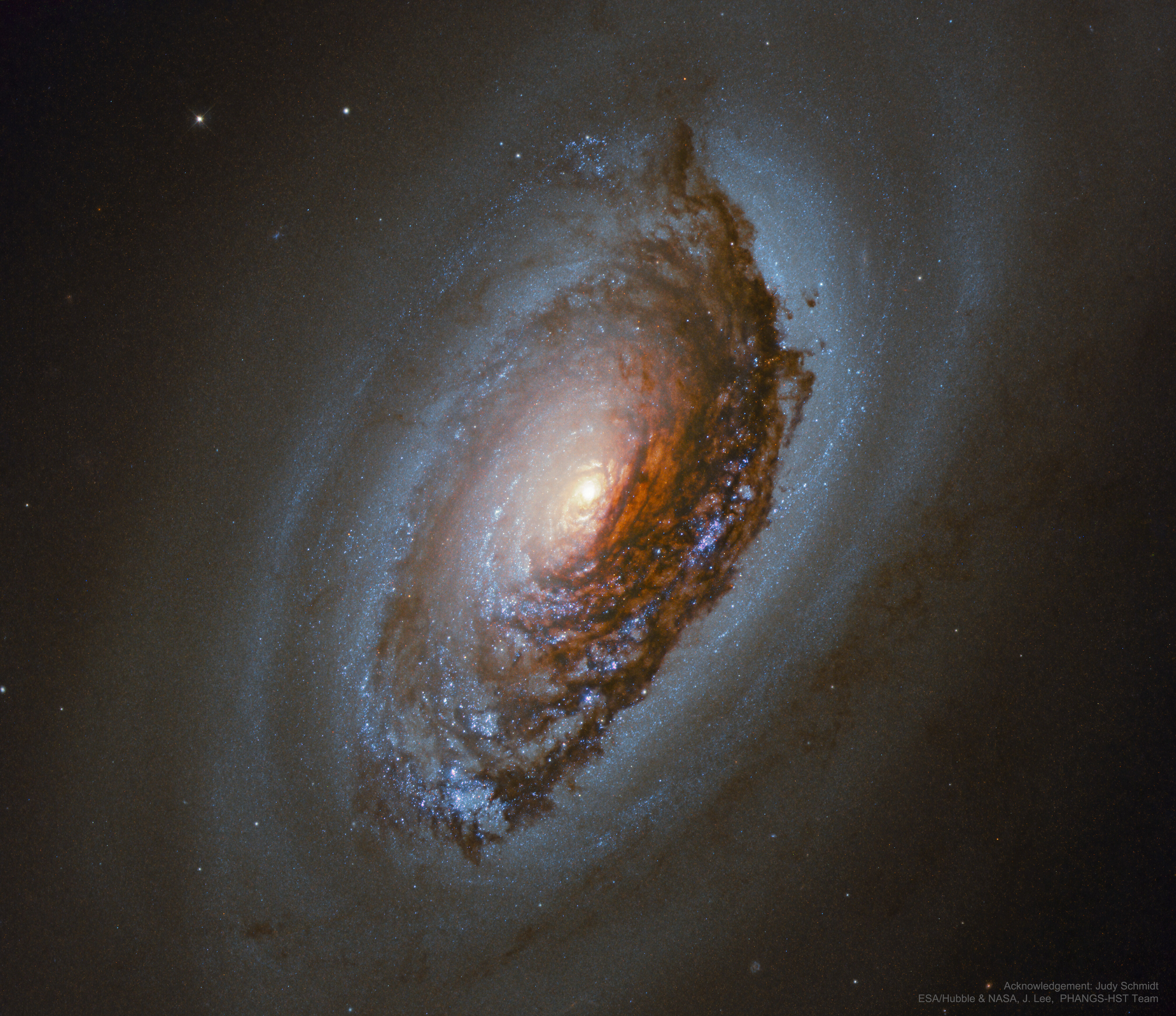
Who knows what evil lurks in the eyes of galaxies? The Hubble knows -- or in the case of spiral galaxy M64 -- is helping to find out. Messier 64, also known as the Evil Eye or Sleeping Beauty Galaxy, may seem to have evil in its eye because all of its stars rotate in the same direction as the interstellar gas in the galaxy's central region, but in the opposite direction in the outer regions. Captured here in great detail by the Earth-orbiting Hubble Space Telescope, enormous dust clouds obscure the near-side of M64's central region, which are laced with the telltale reddish glow of hydrogen associated with star formation. M64 lies about 17 million light years away, meaning that the light we see from it today left when the last common ancestor between humans and chimpanzees roamed the Earth. The dusty eye and bizarre rotation are likely the result of a billion-year-old merger of two different galaxies.
¿Quién sabe qué maldad acecha en los ojos de las galaxias? El Hubble sí lo sabe — o, en el caso de la galaxia espiral M64, está ayudando a descubrirlo. Messier 64, también conocida como la Galaxia Ojo del Mal o Bella Durmiente, podría parecer que tiene maldad en su ojo porque todas sus estrellas giran en la misma dirección que el gas interestelar en la región central de la galaxia, pero en dirección opuesta en las regiones externas. Capturada aquí con gran detalle por el Telescopio Espacial Hubble en órbita terrestre, enormes nubes de polvo ocultan la región central de M64, las cuales están teñidas con el característico brillo rojizo del hidrógeno asociado a la formación de estrellas. M64 se encuentra a unos 17 millones de años luz de distancia, lo que significa que la luz que vemos hoy salió de allí cuando el último antepasado común entre humanos y chimpancés paseaba por la Tierra. El ojo polvoriento y la rotación inusual probablemente sean el resultado de una fusión de dos galaxias diferentes hace mil millones de años.