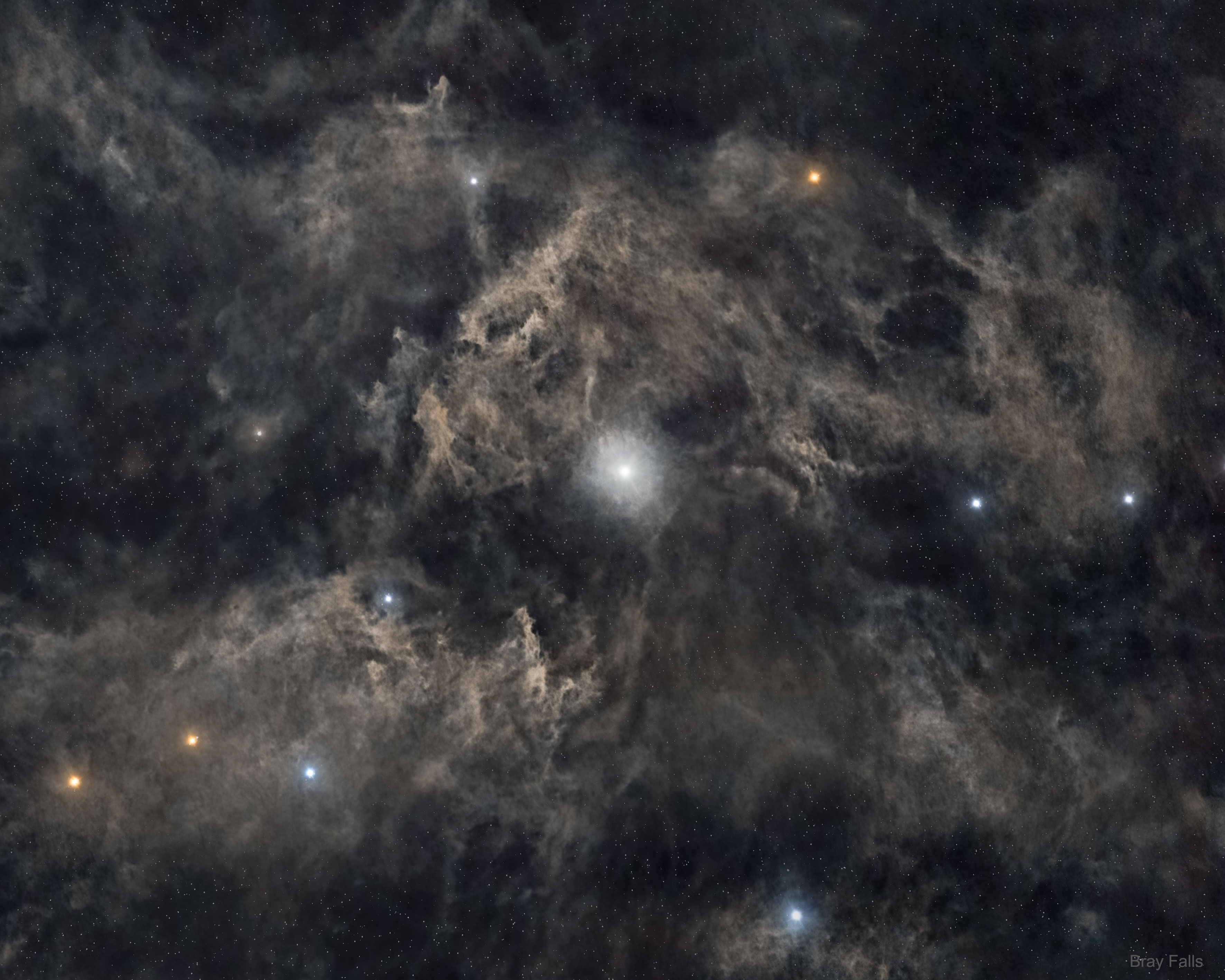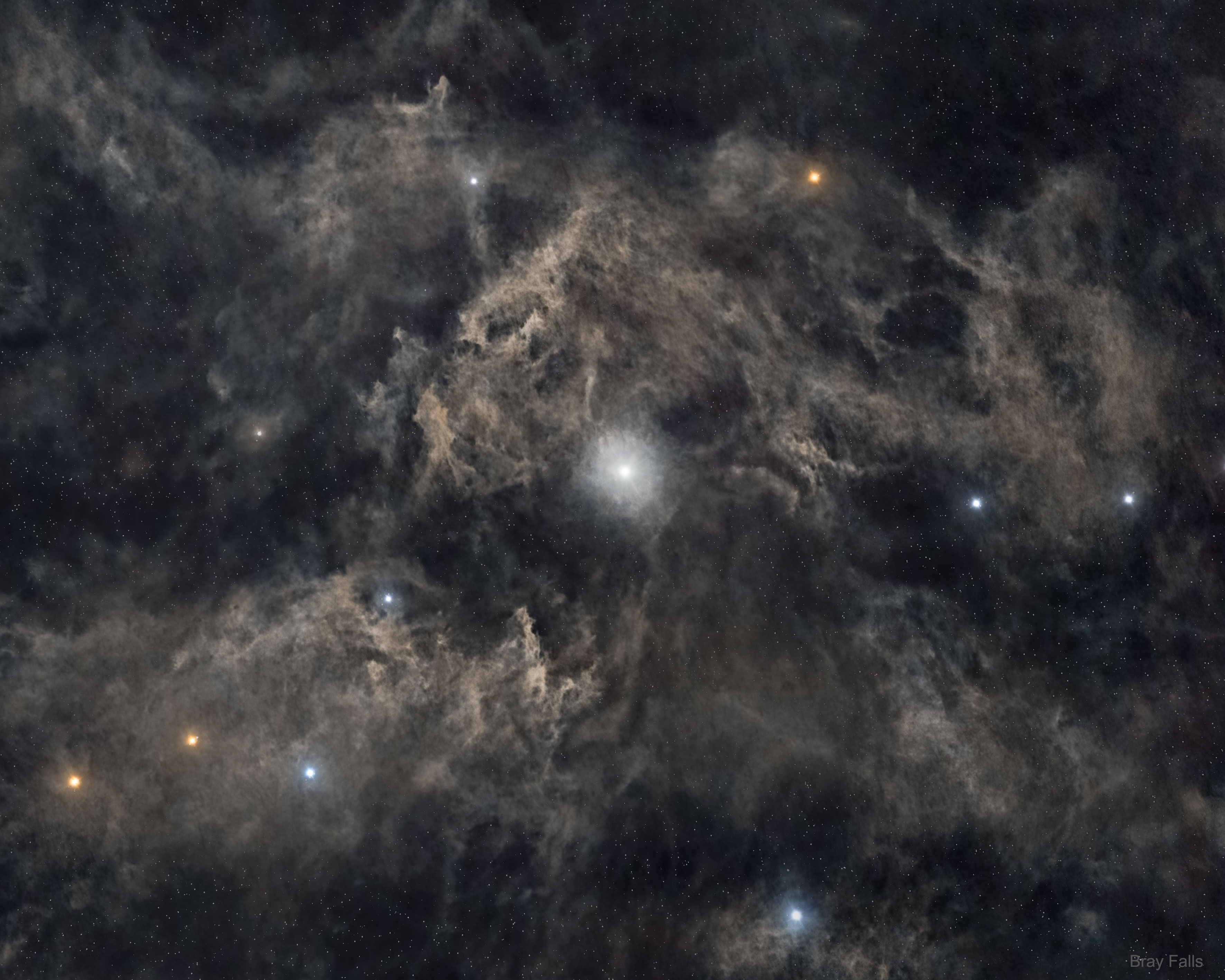
Why is Polaris called the North Star? First, Polaris is the nearest bright star toward the north spin axis of the Earth. Therefore, as the Earth turns, stars appear to revolve around Polaris, but Polaris itself always stays in the same northerly direction -- making it the North Star. Since no bright star is near the south spin axis of the Earth, there is currently no South Star. Thousands of years ago, Earth's spin axis pointed in a slightly different direction so that Vega was the North Star. Although Polaris is not the brightest star on the sky, it is easily located because it is nearly aligned with two stars in the cup of the Big Dipper. Polaris is near the center of the eight-degree wide featured image, an image that has been digitally manipulated to suppress surrounding dim stars but accentuate the faint gas and dust of the Integrated Flux Nebula (IFN). The surface of Cepheid Polaris slowly pulsates, causing the star to change its brightness by a few percent over the course of a few days. Portal Universe: Random APOD Generator
¿Por qué se llama Polaris la Estrella del Norte? En primer lugar, Polaris es la estrella brillante más cercana hacia el eje de rotación norte de la Tierra. Por lo tanto, a medida que la Tierra gira, las estrellas parecen girar alrededor de Polaris, pero Polaris en sí siempre permanece en la misma dirección norte —haciéndola la Estrella del Norte. Dado que no hay una estrella brillante cerca del eje de rotación sur de la Tierra, actualmente no hay una Estrella del Sur. Hace miles de años, el eje de rotación de la Tierra apuntaba en una dirección ligeramente diferente, por lo que Vega era la Estrella del Norte. Aunque Polaris no es la estrella más brillante del cielo, es fácil de localizar porque está casi alineada con dos estrellas en la parte superior del Cazo del Oso Mayor. Polaris se encuentra cerca del centro de la imagen de ocho grados de ancho mostrada aquí, una imagen que ha sido manipulada digitalmente para suprimir las estrellas cercanas más débiles, pero resaltar el gas y el polvo tenues de la Nebulosa de Flujo Integrado (IFN). La superficie de Polaris, una estrella Cefeida, se expande y contrae lentamente, causando que la estrella cambie su brillo en un par de por ciento durante el transcurso de unos días.