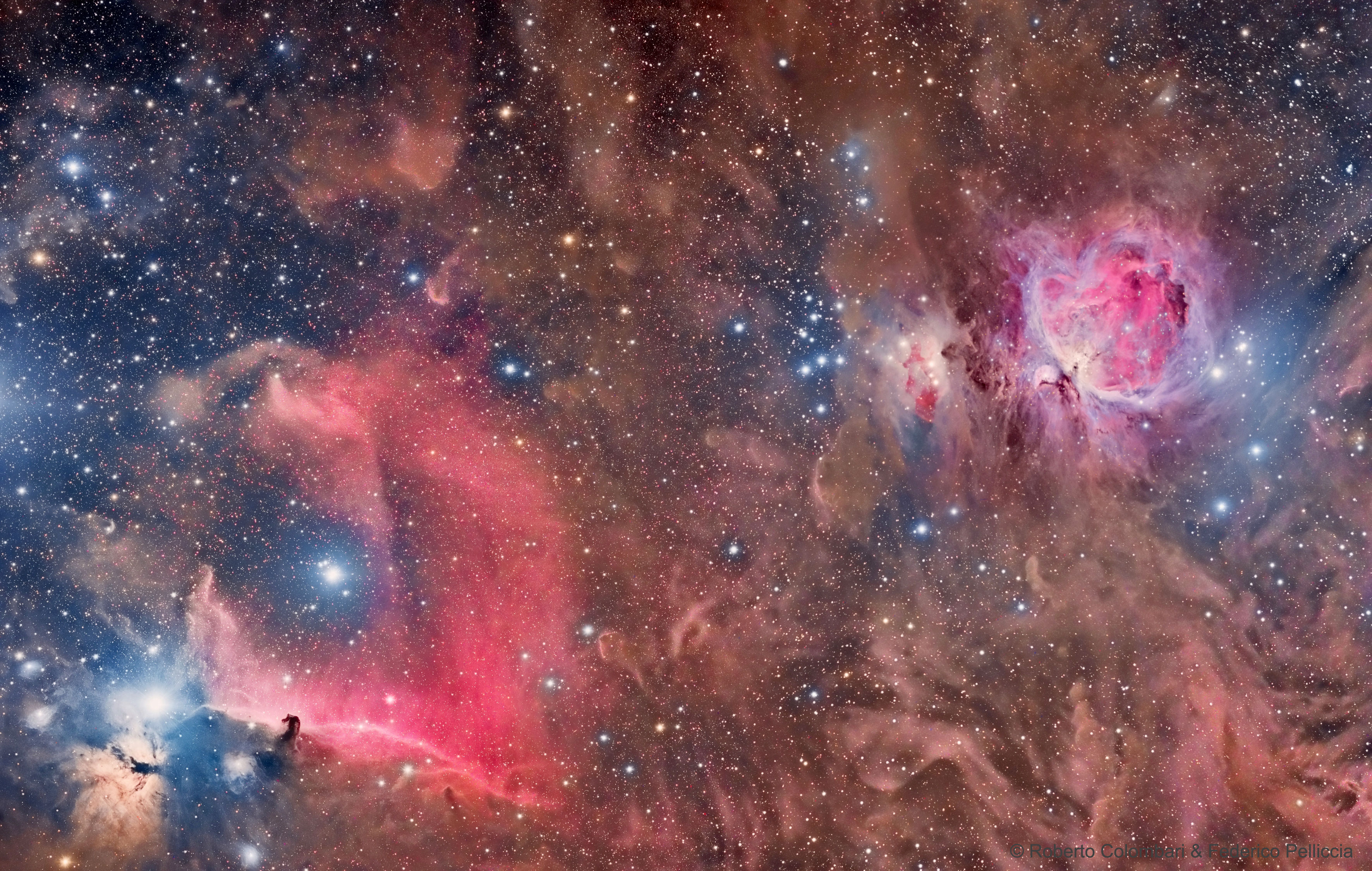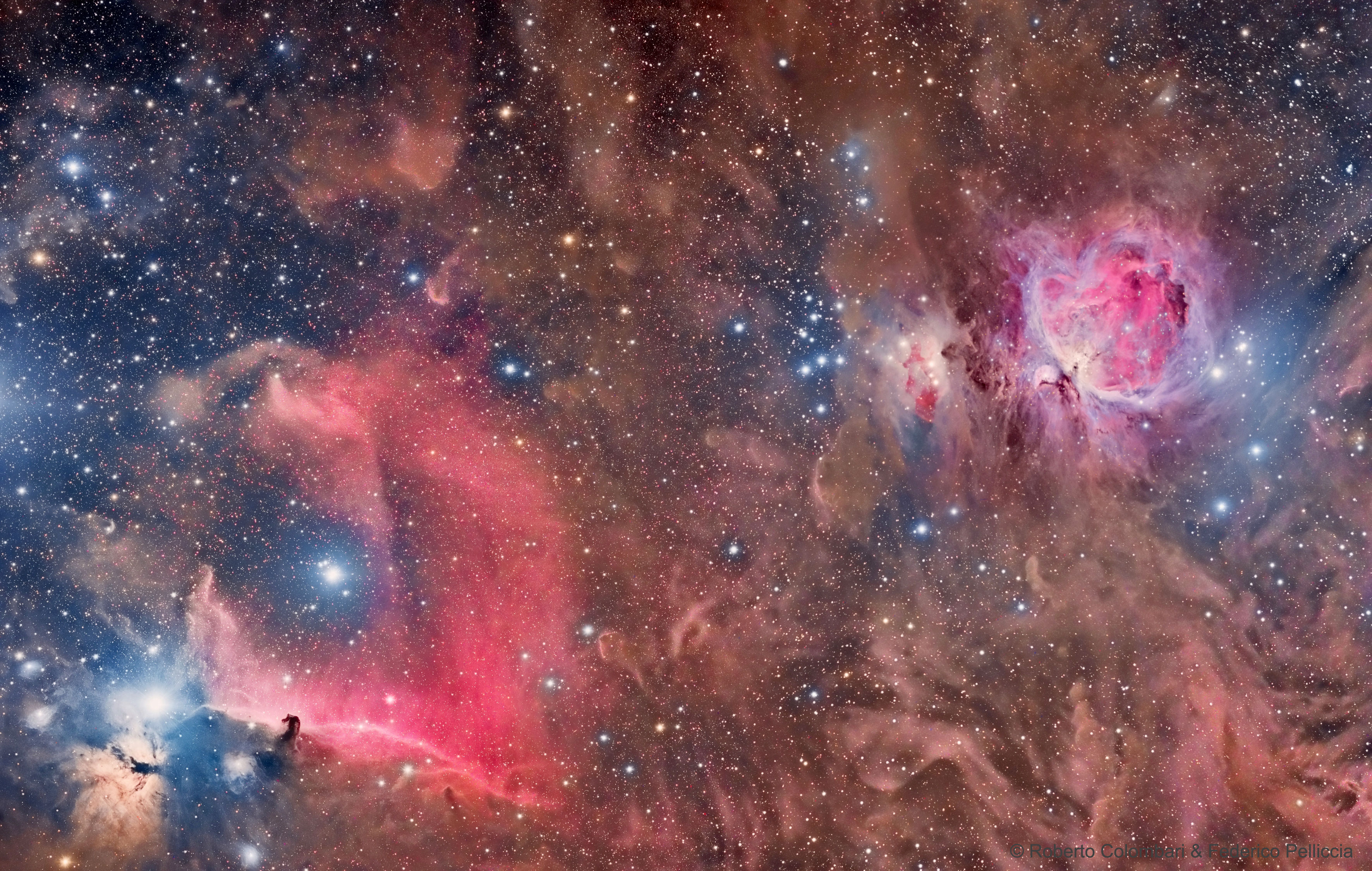
The dark Horsehead Nebula and the glowing Orion Nebula are contrasting cosmic vistas. Adrift 1,500 light-years away in one of the night sky's most recognizable constellations, they appear in opposite corners of the above stunning mosaic. The familiar Horsehead nebula appears as a dark cloud, a small silhouette notched against the long red glow at the lower left. Alnitak is the easternmost star in Orion's belt and is seen as the brightest star to the left of the Horsehead. Below Alnitak is the Flame Nebula, with clouds of bright emission and dramatic dark dust lanes. The magnificent emission region, the Orion Nebula (aka M42), lies at the upper right. Immediately to its left is a prominent reflection nebula sometimes called the Running Man. Pervasive tendrils of glowing hydrogen gas are easily traced throughout the region. Astrophysicists: Browse 2,500+ codes in the Astrophysics Source Code Library
La oscura Nebulosa del Caballo de Troya y la resplandeciente Nebulosa de Orión son vistas cósmicas contrastantes. A la deriva a 1500 años luz de distancia en una de las constelaciones más reconocibles del cielo nocturno, aparecen en esquinas opuestas del mosaico asombroso mostrado arriba. La conocida Nebulosa del Caballo de Troya aparece como una nube oscura, una pequeña silueta tallada contra el largo resplandor rojizo en la esquina inferior izquierda. Alnitak es la estrella más oriental de la cintura de Orión y se ve como la estrella más brillante a la izquierda del Caballo de Troya. Debajo de Alnitak se encuentra la Nebulosa de la Llama, con nubes de emisión brillante y dramáticas vías oscuras de polvo. La magnífica región de emisión, la Nebulosa de Orión (también conocida como M42), se encuentra en la esquina superior derecha. Inmediatamente a su izquierda se encuentra una prominente nebulosa de reflexión, a veces llamada el Hombre Corredor. Tendrils extensos de gas hidrógeno luminoso son fácilmente trazados a través de la región.