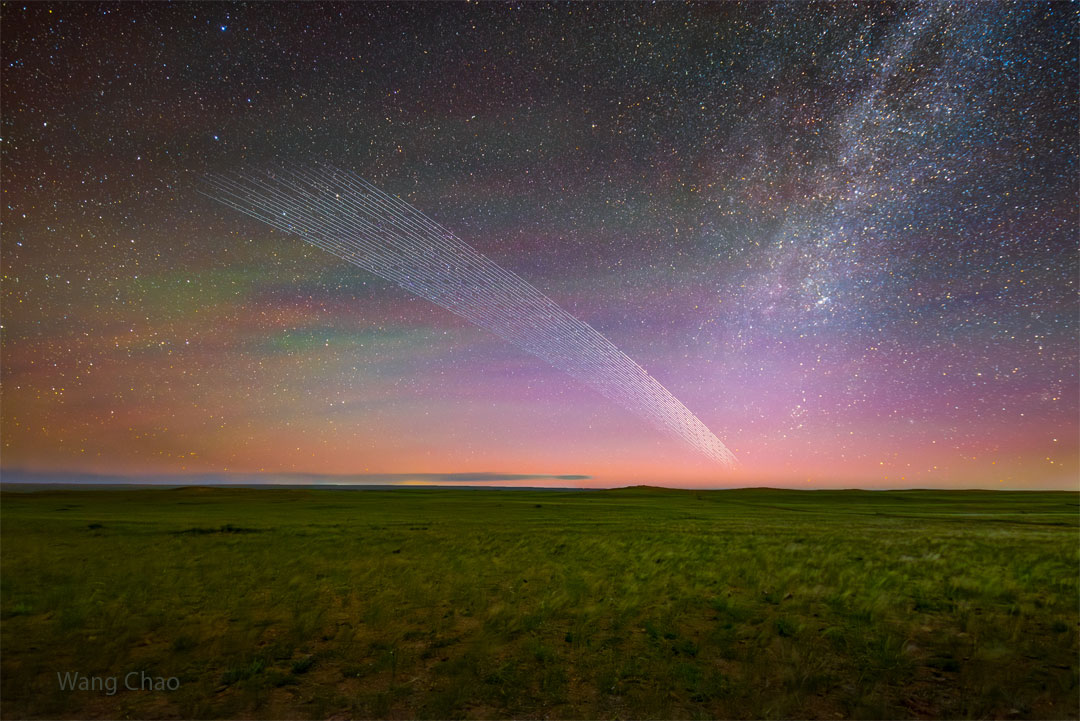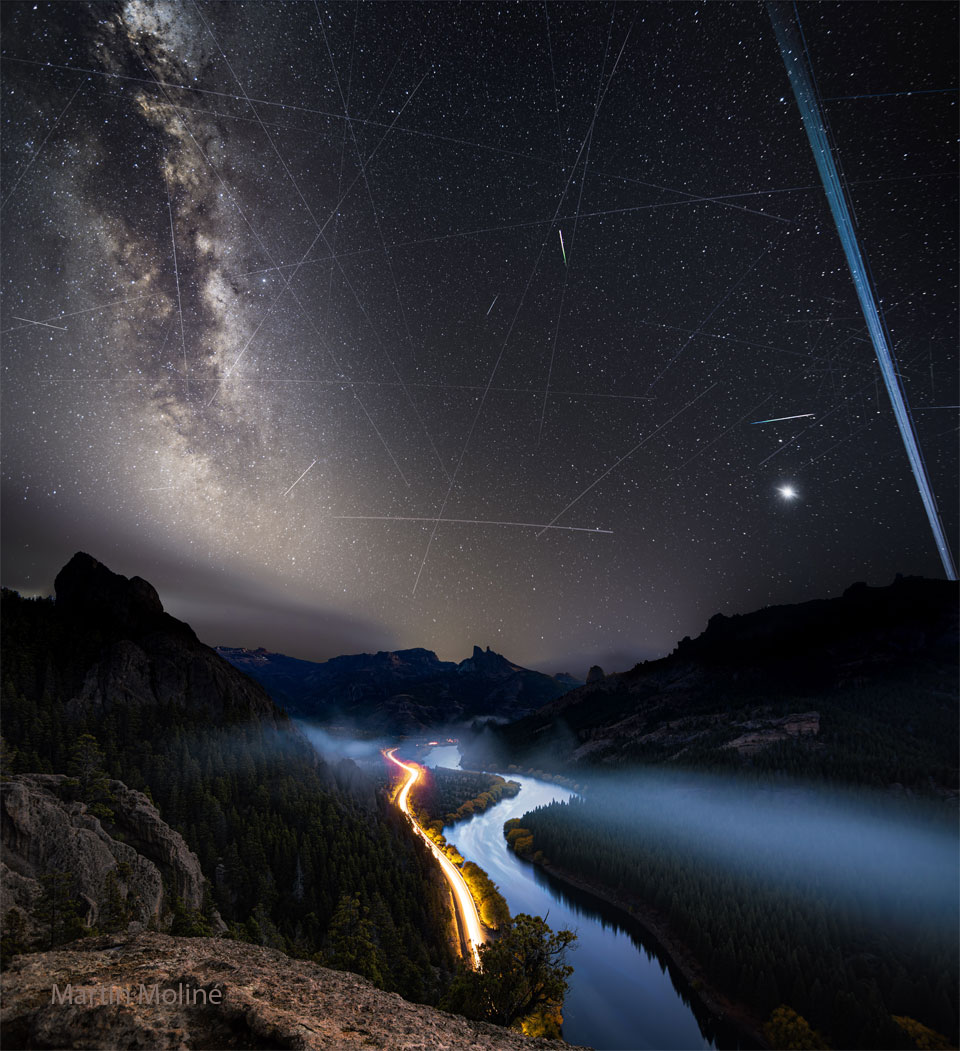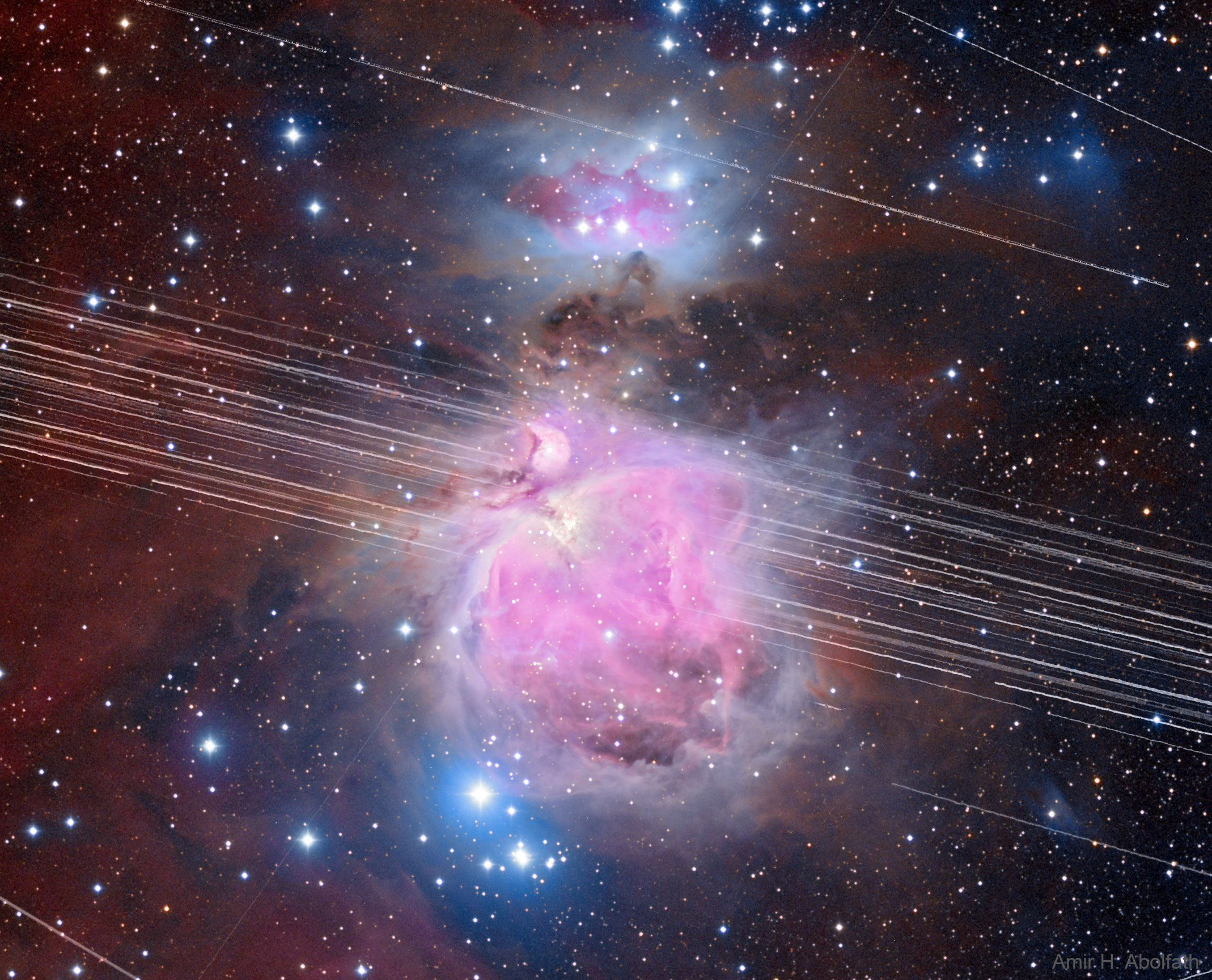
What are those streaks across Orion? They are reflections of sunlight from numerous Earth-orbiting satellites. Appearing by eye as a series of successive points floating across a twilight sky, the increasing number of communications satellites, including SpaceX Starlink satellites, are causing concern among many astronomers. On the positive side, Starlink and similar constellations make the post-sunset sky more dynamic, satellite-based global communications faster, and help provide digital services to currently underserved rural areas. On the negative side, though, these low Earth-orbit satellites make some deep astronomical imaging programs more difficult, in particular observing programs that need images taken just after sunset and just before dawn. Planned future satellite arrays that function in higher orbits may impact investigations of the deep universe planned for large ground-based telescopes at any time during the night. The streaks across Orion are not from Starlink but rather satellites in high geosynchronous orbit. The featured picture, taken in 2019 December, is a digital combination of over 65 3-minutes exposures, with some images taken to highlight the background Orion Nebula, while others to feature the passing satellites. SatCon2 Wokshop 12-16 July 2021: Mitigating Satellite Constellations
Crédito: NASA, CGRO SSC ¿Qué son esos rayos a través de Orión? Son reflejos de la luz solar provenientes de numerosos satélites en órbita alrededor de la Tierra. A simple vista, aparecen como una serie de puntos sucesivos flotando a través de un cielo crepuscular, y el número creciente de satélites de comunicaciones, incluyendo los satélites Starlink de SpaceX, ha causado preocupación entre muchos astrónomos. Por el lado positivo, Starlink y constelaciones similares hacen que el cielo después de la puesta de sol sea más dinámico, las comunicaciones globales basadas en satélites más rápidas, y ayudan a proporcionar servicios digitales a áreas rurales actualmente no atendidas. Por el lado negativo, sin embargo, estos satélites en órbita baja dificultan algunos programas de imagen astronómica profunda, especialmente aquellos que requieren imágenes tomadas justo después de la puesta de sol y justo antes del amanecer. Las futuras matrices de satélites planeadas que funcionen en órbitas más altas podrían afectar investigaciones sobre el universo profundo planeadas para telescopios terrestres de gran tamaño en cualquier momento durante la noche. Los rayos a través de Orión no provienen de Starlink, sino de satélites en órbita geoestacionaria alta. La imagen destacada, tomada en diciembre de 2019, es una combinación digital de más de 65 exposiciones de 3 minutos, con algunas imágenes tomadas para resaltar la Nebulosa de Orión en el fondo, mientras que otras destacan los satélites que pasan.