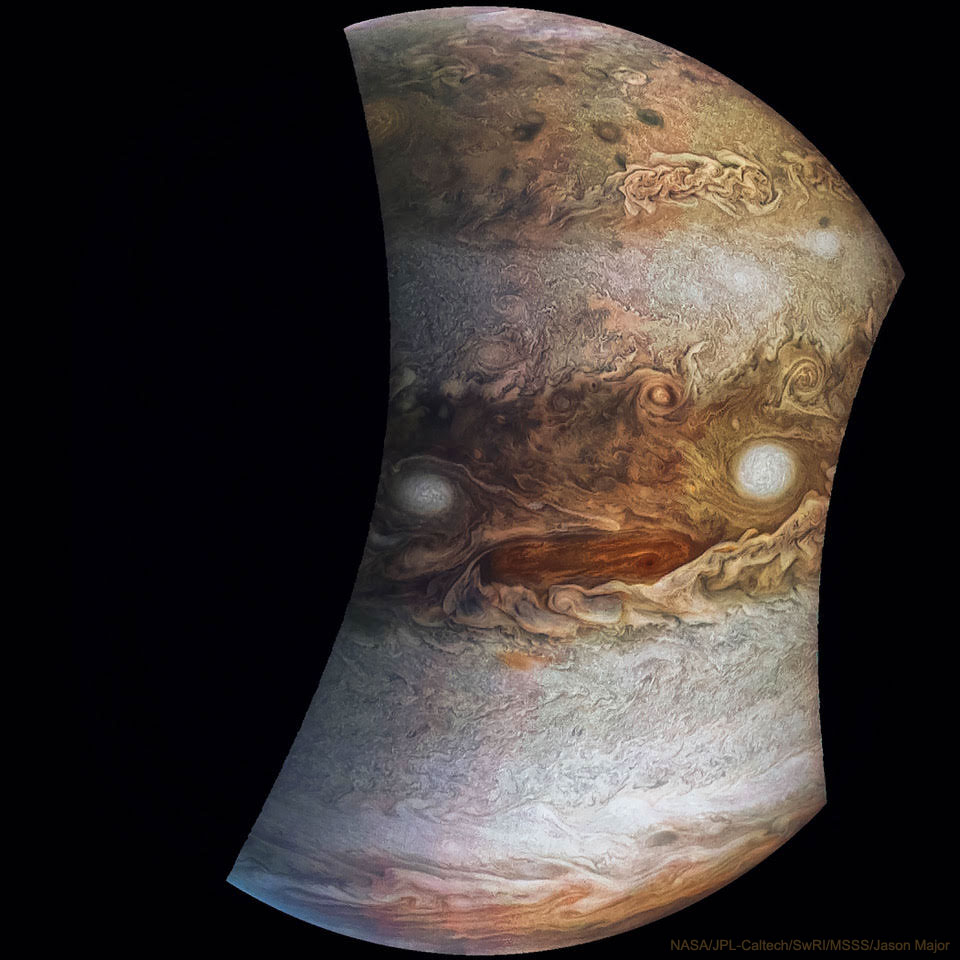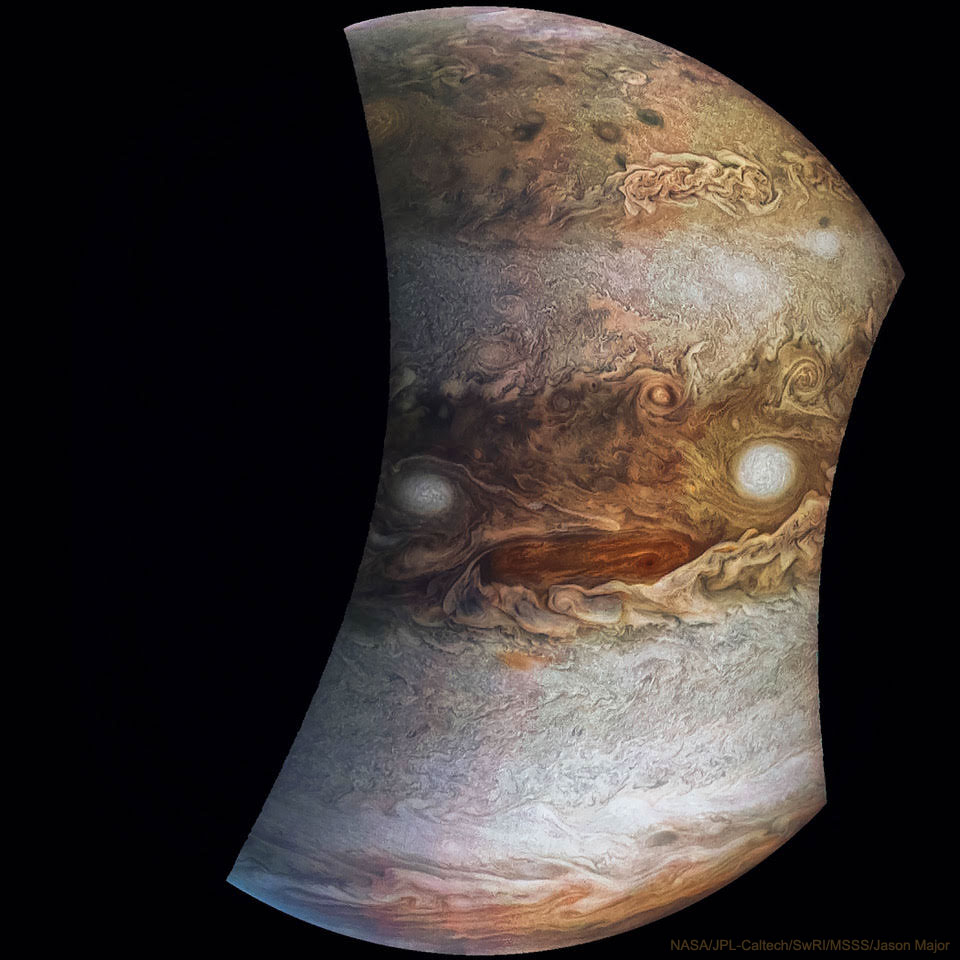
What do you see in the clouds of Jupiter? On the largest scale, circling the planet, Jupiter has alternating light zones and reddish-brown belts. Rising zone gas, mostly hydrogen and helium, usually swirls around regions of high pressure. Conversely, falling belt gas usually whirls around regions of low pressure, like cyclones and hurricanes on Earth. Belt storms can form into large and long-lasting white ovals and elongated red spots. NASA's robotic Juno spacecraft captured most of these cloud features in 2017 during perijove 6, its sixth pass over the giant planet in its looping 2-month orbit. But it is surely not these clouds themselves that draws your attention to the displayed image, but rather their arrangement. The face that stands out, nicknamed Jovey McJupiterFace, lasted perhaps a few weeks before the neighboring storm clouds rotated away. Juno has now completed 33 orbits around Jupiter and just yesterday made a close pass near Ganymede, our Solar System's largest moon.
¿Qué ves en las nubes de Júpiter? A gran escala, rodeando al planeta, Júpiter tiene zonas alternas claras y cinturones rojizos-marrones. El gas de las zonas ascendentes, principalmente hidrógeno y helio, suele girar alrededor de regiones de alta presión. Por el contrario, el gas de los cinturones descendentes suele girar alrededor de regiones de baja presión, como ciclones y huracanes en la Tierra. Las tormentas de los cinturones pueden formar grandes y duraderos óvalos blancos y manchas rojizas alargadas. La nave espacial robótica Juno de la NASA capturó la mayoría de estas características en las nubes en 2017 durante el perijove 6, su sexta pasada sobre el gigante gaseoso en su órbita de dos meses. Pero seguramente no son estas nubes en sí mismas las que atraen tu atención en la imagen mostrada, sino más bien su disposición. El rostro que destaca, apodado Jovey McJupiterFace, duró quizás unas pocas semanas antes de que las nubes tormentosas vecinas se desplazaran al rotar. Juno ha completado ya 33 órbitas alrededor de Júpiter y ayer realizó una aproximación cercana a Ganímedes, la luna más grande de nuestro Sistema Solar.