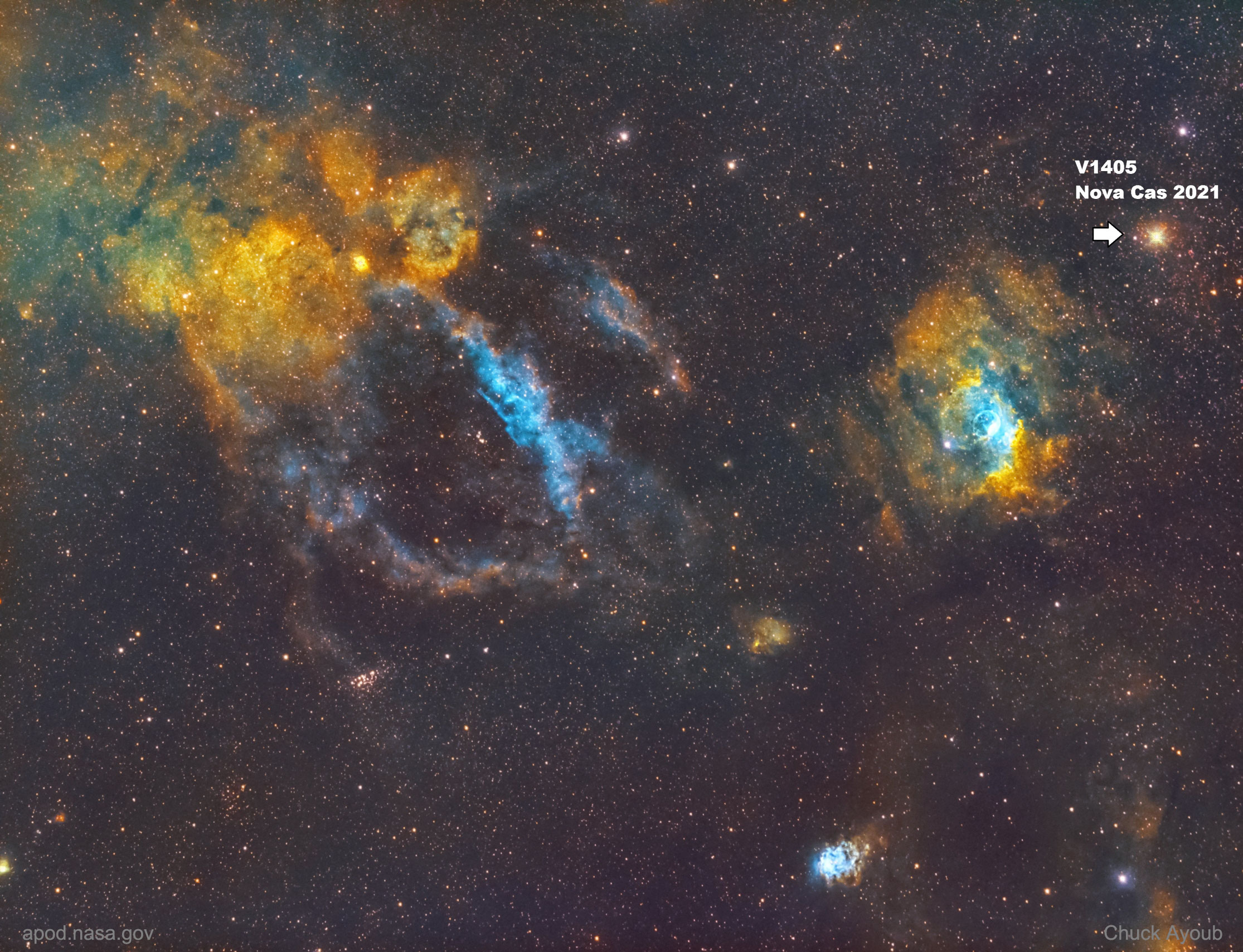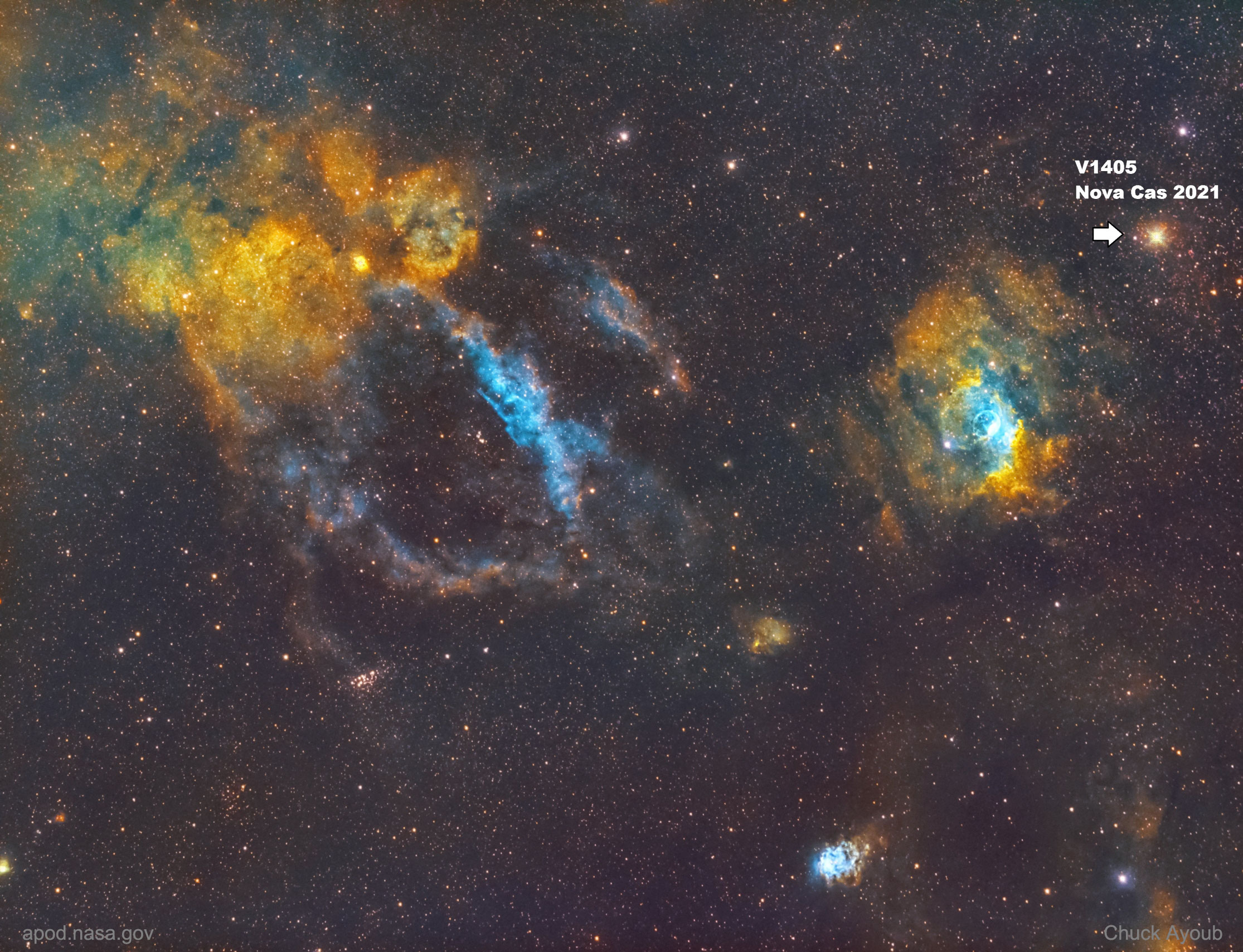
What’s that new spot of light in Cassiopeia? A nova. Although novas occur frequently throughout the universe, this nova, known as Nova Cas 2021 or V1405 Cas, became so unusually bright in the skies of Earth last month that it was visible to the unaided eye. Nova Cas 2021 first brightened in mid-March but then, unexpectedly, became even brighter in mid-May and remained quite bright for about a week. The nova then faded back to early-May levels, but now is slightly brightening again and remains visible through binoculars. Identified by the arrow, the nova occurred toward the constellation of Cassiopeia, not far from the Bubble Nebula. A nova is typically caused by a thermonuclear explosion on the surface of a white dwarf star that is accreting matter from a binary-star companion -- although details of this outburst are currently unknown. Novas don't destroy the underlying star, and are sometimes seen to recur. The featured image was created from 14 hours of imaging from Detroit, Michigan, USA. Both professional and amateur astronomers will likely continue to monitor Nova Cas 2021 and hypothesize about details of its cause.
¿Qué es ese nuevo punto de luz en Casiopea? Una nova. Aunque las novas ocurren con frecuencia en todo el universo, esta nova, conocida como Nova Cas 2021 o V1405 Cas, se volvió inusualmente brillante en los cielos de la Tierra el mes pasado, hasta el punto de ser visible a simple vista. Nova Cas 2021 comenzó a brillar a mediados de marzo, pero luego, inesperadamente, se volvió aún más brillante a mediados de mayo y permaneció bastante brillante durante aproximadamente una semana. La nova luego disminuyó de brillo hasta los niveles de principios de mayo, pero ahora está ligeramente aumentando de brillo nuevamente y sigue siendo visible con binoculares. Identificada por la flecha, la nova ocurrió en dirección a la constelación de Casiopea, no muy lejos de la Nebulosa Burbuja. Una nova se produce típicamente por una explosión termonuclear en la superficie de una enana blanca que está acumulando materia de una estrella compañera en un sistema binario, aunque los detalles de esta erupción aún no se conocen. Las novas no destruyen la estrella subyacente y a veces se ven repetirse. La imagen destacada fue creada a partir de 14 horas de imágenes tomadas en Detroit, Michigan, EE.UU. Tanto astrónomos profesionales como aficionados probablemente continuarán monitoreando Nova Cas 2021 y formulando hipótesis sobre los detalles de su causa.